




I Predicted Coca-Cola Was a Better Buy Than Procter & Gamble in 2025, and I Was Right. Here Is My New Prediction for 2026.
Key Points
The consumer staples sector got crushed in 2025.
Coke outperformed the sector while P&G sold off.
Both stocks could be solid buys in the new year.
- 10 stocks we like better than Coca-Cola ›
Just as I predicted, Coca-Cola (NYSE: KO) was a better buy than Procter & Gamble (NYSE: PG) in 2025, with Coke gaining 12.3% compared to a 14.5% decline in P&G.
Coke's performance was particularly impressive considering consumer staples was the worst-performing stock market sector in 2025, with the sector sliding 1.2% compared to a 16.4% gain in the S&P 500 (SNPINDEX: ^GSPC).
Where to invest $1,000 right now? Our analyst team just revealed what they believe are the 10 best stocks to buy right now. Continue »
Here's why Coke crushed P&G in 2025, and which dividend stock is the better buy for 2026.

Image source: Getty Images.
Coke and P&G have a similar recipe for success
When it comes to passive income powerhouses, Coke and P&G are 1A and 1B. Coke has 63 consecutive years of boosting its payout compared to 69 years for P&G -- making both stocks some of the longest-tenured Dividend Kings -- an elite group of companies that have grown their dividends for more than 50 consecutive years.
Coke and P&G both have impeccable supply chains and global brand recognition. Coke's network of bottling partners allows it to maintain high margins. Corporate Coke produces syrups and concentrates, which its bottling partners use to manufacture, package, merchandise, and distribute its products. In this vein, Coke maintains high operational flexibility across global markets, which can help it withstand region-specific slowdowns.
Similarly, P&G has industry-leading margins due to its size, global partnerships, and elite portfolio of brands -- many of which are category leading.
High margins allow Coke and P&G to convert more revenue into operating income than their peers, thereby maximizing earnings and supporting dividend growth.
Coke has a more concentrated brand portfolio than P&G
Despite being similar on paper, the two companies differ significantly in their capital allocation. Coke has favored mergers and acquisitions over P&G in recent years -- acquiring key brands like BodyArmor, Fairlife, Topo Chico, and Costa Coffee to become a well-rounded non-alcoholic beverage company and reduce its reliance on soda. P&G has preferred to innovate within its existing brand portfolio through innovation and marketing efforts to drive loyalty.
Despite Coke's investments, it still relies heavily on its flagship Coca-Cola brand, with trademark Coca-Cola accounting for 42% of 2024 U.S. unit case volume compared to 48% of non-U.S. unit case volume. P&G has core brands too -- like Gillette, Tide, Pampers, Crest, Dawn, Olay, Febreze, Bounty, and Charmin. But it doesn't have that dominating brand like Coke.
Diversification can be a strength, but in recent years, Coke's concentration on a few key brands was an advantage, as it was better prepared to absorb and pass along rising costs to consumers than P&G.
For full-year 2025, Coke is guiding for non-generally accepted accounting principles (non-GAAP) organic revenue growth of 5% to 6%. P&G grew organic sales by just 2% in fiscal 2025 (ended June 30, 2025) and is guiding for 0% to 4% organic revenue growth for fiscal 2026.
Coke and P&G are great values
Heading into 2025, Coke was a much better value than P&G, especially given its high margins. Throughout the year, Coke did an excellent job maintaining or slightly increasing volume while demonstrating impeccable pricing power.
The narrative has flipped for 2026, as P&G is the better value. But both P&G and Coke are trading below their historical valuations, as reflected in both price-to-earnings and forward P/E ratios.
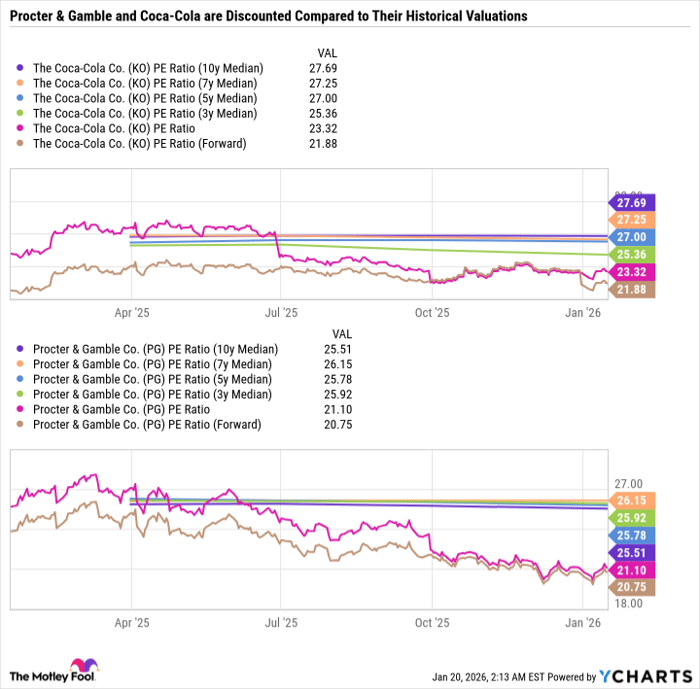
KO PE Ratio (10y Median) data by YCharts
However, given the slowdown in earnings from both companies, the discount is warranted.
After P&G's sell-off last year compared to Coke's modest gain, both stocks are solid buys in 2026. Especially for income investors looking to boost their passive income streams.
Should you buy stock in Coca-Cola right now?
Before you buy stock in Coca-Cola, consider this:
The Motley Fool Stock Advisor analyst team just identified what they believe are the 10 best stocks for investors to buy now… and Coca-Cola wasn’t one of them. The 10 stocks that made the cut could produce monster returns in the coming years.
Consider when Netflix made this list on December 17, 2004... if you invested $1,000 at the time of our recommendation, you’d have $474,578!* Or when Nvidia made this list on April 15, 2005... if you invested $1,000 at the time of our recommendation, you’d have $1,141,628!*
Now, it’s worth noting Stock Advisor’s total average return is 955% — a market-crushing outperformance compared to 196% for the S&P 500. Don't miss the latest top 10 list, available with Stock Advisor, and join an investing community built by individual investors for individual investors.
See the 10 stocks »
*Stock Advisor returns as of January 20, 2026.
Daniel Foelber has positions in Procter & Gamble and has the following options: short February 2026 $150 calls on Procter & Gamble. The Motley Fool has no position in any of the stocks mentioned. The Motley Fool has a disclosure policy.
Recommended Articles


