

1 No-Brainer Artificial Intelligence (AI) Stock to Buy Right Now

Source The Motley Fool

Key Points

  • TSMC's Q3 earnings report proves just why this company is one of the best ways to capitalize on the AI chip boom.

  • The foundry giant is now expecting to end 2025 with stronger growth than it was anticipating earlier.

  • The potential spending on AI infrastructure next year can ensure more upside for TSMC stock.

  • 10 stocks we like better than Taiwan Semiconductor Manufacturing ›

Spending on artificial intelligence (AI) hardware and software is showing no signs of slowing down. Market research firm Gartner forecasts global AI spending will hit a whopping $1.5 trillion in 2025, up by 50% from last year. Even better, the firm expects that figure to jump to $2 trillion in 2026. What's worth noting is that a nice chunk of that spending is set to go toward semiconductors. Spending on data center graphics processing units (GPUs), custom AI processors, central processing units (CPUs), and other AI processors could together generate close to $600 billion in revenue in 2026, up from an estimated $477 billion this year.

One of the best ways to make the most of this lucrative opportunity is by investing in shares of Taiwan Semiconductor Manufacturing (NYSE: TSM), the world's largest semiconductor foundry. Popularly known as TSMC, the Taiwan-based company fabricates all kinds of AI chips that are mentioned above for multiple clients. Not surprisingly, it has been growing at an incredible pace, which seems sustainable going forward as well.

Where to invest $1,000 right now? Our analyst team just revealed what they believe are the 10 best stocks to buy right now, when you join Stock Advisor. See the stocks »

Let's look at the reasons why buying TSMC stock is a no-brainer right now.

TSMC logo in front of a company building.

Image source: TSMC.

TSMC's latest results make it clear that it is winning from the AI chip boom

TSMC released its third-quarter results on Oct. 16. The company's revenue and earnings, unsurprisingly, were ahead of Wall Street's expectations. TSMC's earnings jumped 39% year over year to $2.92 per share on a 41% increase in its revenue to $33.1 billion. What's more, the company now expects 2025 revenue to increase by mid-30% as compared to the earlier forecast of 30% growth.

It is easy to see why that's the case. The demand for AI chips is growing across multiple verticals, ranging from data centers to smartphones to computers. For instance, sales of AI PCs are forecast to jump by 60% in 2026, along with a 32% increase in shipments of generative AI smartphones. TSMC's position as the world's largest semiconductor foundry, with an estimated share of 70% means that it manufactures chips for almost all the companies involved in different AI verticals.

From AMD to Qualcomm to Nvidia to Broadcom to Apple to MediaTek, the list of TSMC's customers is very long. All these companies benefit from the AI boom. While AMD, Nvidia, and Broadcom capitalize on the growing adoption of AI in data centers and PCs, Qualcomm, Apple, and MediaTek benefit from an improvement in generative AI smartphone sales.

In fact, the demand for TSMC's fabrication facilities is so strong that the company has increased the midpoint of its capital expenditure guidance for 2025 to $41 billion from the earlier estimate of $40 billion. What's worth noting is that TSMC will allocate 70% of its capex toward building advanced chipmaking facilities, with another 10% to 20% going toward advanced packaging.

This isn't surprising, considering the sharp increase in sales of AI chips and related devices that's anticipated in 2026. The impressive end-market potential should ideally allow TSMC to sustain stronger growth levels next year, and beyond that as well, when compared to the growth that analysts are expecting from it.
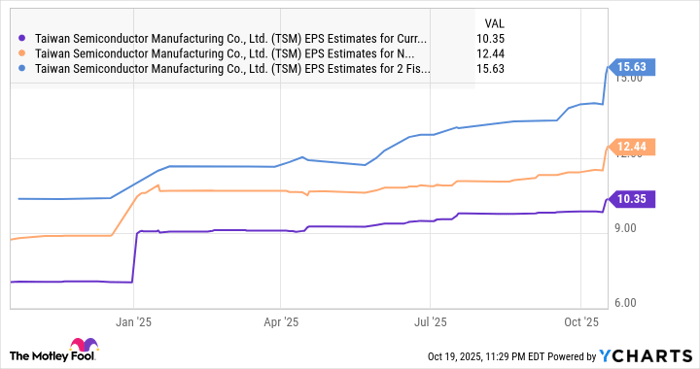
TSM EPS Estimates for Current Fiscal Year Chart

Data by YCharts.

The stock is primed for more gains

Share prices of TSMC have jumped 49% this year. Even then, the stock trades at an attractive 25 times forward earnings. That's a steal for a company expected to clock 46% growth in earnings this year. Analysts, however, expect TSMC's bottom-line growth to slow down to 20% in 2026.

But the continued strength in AI chip spending, along with TSMC's potential to increase the price of its advanced chip nodes by 5% to 10% next year, will pave the way for stronger growth in TSMC's bottom line. Assuming that the company manages to increase its earnings by even 30% in 2026 to $13.45 per share (based on the 2025 earnings estimate of $10.29 per share), its stock could hit $450 (based on the tech-laden Nasdaq-100 index's average earnings multiple of 33.5).

That points toward a potential jump of 50% from current levels, making TSMC a no-brainer AI stock to buy right now as it isn't done soaring yet.

Should you invest $1,000 in Taiwan Semiconductor Manufacturing right now?

Before you buy stock in Taiwan Semiconductor Manufacturing, consider this:

The Motley Fool Stock Advisor analyst team just identified what they believe are the 10 best stocks for investors to buy now… and Taiwan Semiconductor Manufacturing wasn’t one of them. The 10 stocks that made the cut could produce monster returns in the coming years.

Consider when Netflix made this list on December 17, 2004... if you invested $1,000 at the time of our recommendation, you’d have $669,449!* Or when Nvidia made this list on April 15, 2005... if you invested $1,000 at the time of our recommendation, you’d have $1,110,486!*

Now, it’s worth noting Stock Advisor’s total average return is 1,076% — a market-crushing outperformance compared to 191% for the S&P 500. Don’t miss out on the latest top 10 list, available when you join Stock Advisor.

See the 10 stocks »

*Stock Advisor returns as of October 20, 2025

Harsh Chauhan has no position in any of the stocks mentioned. The Motley Fool has positions in and recommends Advanced Micro Devices, Apple, Nvidia, Qualcomm, and Taiwan Semiconductor Manufacturing. The Motley Fool recommends Broadcom and Gartner. The Motley Fool has a disclosure policy.

Disclaimer: For information purposes only. Past performance is not indicative of future results.
placeholder
Bitcoin CME gaps at $35,000, $27,000 and $21,000, which one gets filled first?Prioritize filling the $27,000 gap and even try higher.
Author  FXStreet
Aug 22, 2023
Prioritize filling the $27,000 gap and even try higher.
placeholder
Natural Gas sinks to pivotal level as China’s demand slumpsNatural Gas price (XNG/USD) edges lower and sinks to $2.56 on Monday, extending its losing streak for the fifth day in a row. The move comes on the back of China cutting its Liquified Natural Gas (LNG) imports after prices rose above $3.0 in June. It
Author  FXStreet
Jul 01, 2024
Natural Gas price (XNG/USD) edges lower and sinks to $2.56 on Monday, extending its losing streak for the fifth day in a row. The move comes on the back of China cutting its Liquified Natural Gas (LNG) imports after prices rose above $3.0 in June. It
placeholder
Pinduoduo Earnings Incoming: Morgan Stanley Sees Long-Term Profit Potential​Insights – On November 21, Chinese e-commerce giant Pinduoduo (PDD) will release its Q3 2024 earnings.
Author  Mitrade
Nov 20, 2024
​Insights – On November 21, Chinese e-commerce giant Pinduoduo (PDD) will release its Q3 2024 earnings.
placeholder
Bitcoin briefly loses 2025 gains as crypto plunges over the weekend.Bitcoin experienced a sharp decline this weekend, briefly erasing its 2025 gains and dipping below its year-opening value of $93,507. The cryptocurrency fell to a low of $93,029 on Sunday, representing a 25% drop from its all-time high in October. Although it has rebounded slightly to around $94,209, the pressures on the market remain significant. The downturn occurred despite the reopening of the U.S. government on Thursday, which many had hoped would provide essential support for crypto markets. This year initially appeared promising for cryptocurrencies, particularly after the inauguration of President Donald Trump, who has established the most pro-crypto administration thus far. However, ongoing political tensions—including Trump's tariff strategies and the recent government shutdown, lasting a historic 43 days—have contributed to several rapid price pullbacks for Bitcoin throughout the year. Market dynamics are also being influenced by Bitcoin whales—investors holding large amounts of Bitcoin—who have been offloading portions of their assets, consequently stalling price rallies even as positive regulatory developments emerge. Despite these sell-offs, analysts from Glassnode argue that this behavior aligns with typical patterns seen among long-term investors during the concluding stages of bull markets, suggesting it is not indicative of a mass exodus. Notably, Bitcoin is not alone in its struggles, as Ethereum and Solana have also recorded declines of 7.95% and 28.3%, respectively, since the start of the year, while numerous altcoins have faced even steeper losses. Looking ahead, questions linger regarding the viability of the four-year cycle thesis, particularly given the increasing institutional support and regulatory frameworks now in place in the crypto landscape. Matt Hougan, chief investment officer at Bitwise, remains optimistic, suggesting a potential Bitcoin resurgence in 2026 driven by the “debasement trade” thesis and a broader trend toward increased adoption of stablecoins, tokenization, and decentralized finance. Hougan emphasized the soundness of the underlying fundamentals, pointing to a positive outlook for the sector in the longer term.
Author  Mitrade
Nov 17, 2025
Bitcoin experienced a sharp decline this weekend, briefly erasing its 2025 gains and dipping below its year-opening value of $93,507. The cryptocurrency fell to a low of $93,029 on Sunday, representing a 25% drop from its all-time high in October. Although it has rebounded slightly to around $94,209, the pressures on the market remain significant. The downturn occurred despite the reopening of the U.S. government on Thursday, which many had hoped would provide essential support for crypto markets. This year initially appeared promising for cryptocurrencies, particularly after the inauguration of President Donald Trump, who has established the most pro-crypto administration thus far. However, ongoing political tensions—including Trump's tariff strategies and the recent government shutdown, lasting a historic 43 days—have contributed to several rapid price pullbacks for Bitcoin throughout the year. Market dynamics are also being influenced by Bitcoin whales—investors holding large amounts of Bitcoin—who have been offloading portions of their assets, consequently stalling price rallies even as positive regulatory developments emerge. Despite these sell-offs, analysts from Glassnode argue that this behavior aligns with typical patterns seen among long-term investors during the concluding stages of bull markets, suggesting it is not indicative of a mass exodus. Notably, Bitcoin is not alone in its struggles, as Ethereum and Solana have also recorded declines of 7.95% and 28.3%, respectively, since the start of the year, while numerous altcoins have faced even steeper losses. Looking ahead, questions linger regarding the viability of the four-year cycle thesis, particularly given the increasing institutional support and regulatory frameworks now in place in the crypto landscape. Matt Hougan, chief investment officer at Bitwise, remains optimistic, suggesting a potential Bitcoin resurgence in 2026 driven by the “debasement trade” thesis and a broader trend toward increased adoption of stablecoins, tokenization, and decentralized finance. Hougan emphasized the soundness of the underlying fundamentals, pointing to a positive outlook for the sector in the longer term.
placeholder
WTI Price Forecast: Seems vulnerable near $90.50 as technical breakdown comes into playWest Texas Intermediate (WTI) – the benchmark US Crude Oil price – plummets to a nearly two-week trough during the Asian session on Wednesday in reaction to news that the US and Iran have agreed to a two-week ceasefire.
Author  FXStreet
Yesterday 01: 48
West Texas Intermediate (WTI) – the benchmark US Crude Oil price – plummets to a nearly two-week trough during the Asian session on Wednesday in reaction to news that the US and Iran have agreed to a two-week ceasefire.
goTop
quote