


CEO Jensen Huang Just Delivered Incredible News for Nvidia Stock Investors
Key Points
After being virtually locked out of China's AI chip market, Nvidia is mounting a comeback.
A previously announced deal with the Trump Administration gives Nvidia access to a potentially lucrative market.
Nvidia isn't stopping there, but is designing a chip for Chinese customers based on its highly successful Blackwell architecture, tapping the growing demand for AI chips in the country.
- 10 stocks we like better than Nvidia ›
This year has been quite a roller-coaster ride for semiconductor specialist Nvidia (NASDAQ: NVDA). After rallying to a new all-time high to start the year, the stock plunged 37% from that level before regaining its footing and climbing to even greater heights. Concerns about the impact of tariffs, the battle to keep inflation in check, and the uncertainty about chip sales to China all fueled the historic volatility in 2025.
However, it appears those doubts have been put to rest, at least for the time being. Nvidia stock sat just 4% below a new record when the market closed on Wednesday, and it could be gearing up for another leg higher.
Where to invest $1,000 right now? Our analyst team just revealed what they believe are the 10 best stocks to buy right now. Learn More »
Reports emerged this week that may just be the catalyst that Nvidia investors have been waiting for.
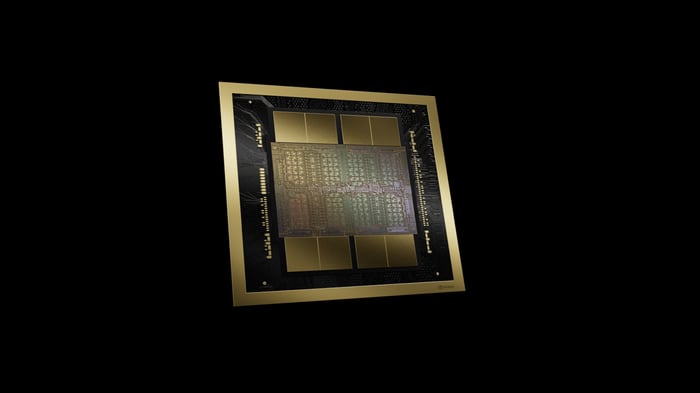
Nvidia's Blackwell Architecture. Image source: Nvidia.
An answer to the China conundrum
As stated, there has been considerable uncertainty regarding the sale of artificial intelligence (AI) chips to customers in China. Earlier this year, the U.S. government suspended the sale of Nvidia's H20 chips. These graphics processing units (GPUs) are specialized processors designed to meet the strict export restrictions imposed by the U.S. government, while still providing the computational horsepower needed for AI processing. In light of the moratorium, Nvidia took a $4.5 billion charge in the first quarter associated with the H20 chips.
Sales of these China-centric AI chips totaled $17 billion in fiscal 2025 (ended Jan. 26, 2025), representing roughly 13% of total sales. Wall Street is estimating total sales of $202 billion this year, which would have meant a potential $26 billion hit to revenue.
However, Huang's extensive lobbying paid off. Nvidia agreed to a 15% revenue-sharing agreement with the U.S. government, which allowed the company to resume sales of the H20 chip to China. While the deal could weigh on Nvidia's margins, it marks the continuation of a potentially lucrative opportunity, but there's more good news.
Meet the B30A
A report emerged this week that Nvidia is developing a new AI chip for customers in China based on the company's wildly successful Blackwell architecture, according to Reuters, which cited "two people briefed on the matter." The new processor, reportedly dubbed the B30A, is said to deliver half the computational horsepower of Nvidia's flagship Blackwell B300 processor, according to the report.
It's no coincidence that Nvidia arrived at the 50% figure. During a press conference last week, President Trump admitted to being open to the idea of a reduced-capacity Blackwell chip. "It's possible I'd make a deal" on a "somewhat enhanced -- in a negative way -- Blackwell" chip, Trump said. "In other words, take 30% to 50% [of the computing power] off of it."
Nvidia continues hold its cards close to the vest. "We evaluate a variety of products for our roadmap, so that we can be prepared to compete to the extent that governments allow," the company said in a statement. "Everything we offer is with the full approval of the applicable authorities and designed solely for beneficial commercial use."
That said, if Nvidia can come to terms with the Trump administration, this could open up a veritable windfall for the company in China.
The implications for Nvidia investors
In an interview in May, Huang estimated that the market for AI chips in China could reach $50 billion annually over the next few years, making it a potentially lucrative opportunity for the company.
Wall Street estimates Nvidia will generate revenue of $200 billion in fiscal 2026 (ending Jan. 26, 2026), $257 billion in fiscal 2027, and $302 billion in fiscal 2028. Given that China was responsible for roughly 13% of total sales last year, that suggests it could generate revenue from the country of as much as $99 billion over the coming three years. Furthermore, most Wall Street analysts are likely to haven't updated their models to reflect the higher revenue potential.
Furthermore, given the advanced capabilities of the Blackwell chips, even a scaled-back version would command a higher price from Chinese customers, resulting in additional revenue potential.
Fair-weather investors headed for the exits when it appeared Nvidia would be locked out of China's AI market. Now that Huang has been given the keys to the kingdom, the company's future prospects have just improved. And at less than 30 times next year's sales, Nvidia stock is attractively priced.
Should you invest $1,000 in Nvidia right now?
Before you buy stock in Nvidia, consider this:
The Motley Fool Stock Advisor analyst team just identified what they believe are the 10 best stocks for investors to buy now… and Nvidia wasn’t one of them. The 10 stocks that made the cut could produce monster returns in the coming years.
Consider when Netflix made this list on December 17, 2004... if you invested $1,000 at the time of our recommendation, you’d have $654,624!* Or when Nvidia made this list on April 15, 2005... if you invested $1,000 at the time of our recommendation, you’d have $1,075,117!*
Now, it’s worth noting Stock Advisor’s total average return is 1,049% — a market-crushing outperformance compared to 183% for the S&P 500. Don’t miss out on the latest top 10 list, available when you join Stock Advisor.
See the 10 stocks »
*Stock Advisor returns as of August 18, 2025
Danny Vena has positions in Nvidia. The Motley Fool has positions in and recommends Nvidia. The Motley Fool has a disclosure policy.
Recommended Articles


