


US Dollar eases after Trump-Harris debate, ahead of August CPI
- The US Dollar edges lower on Wednesday after markets labelled Harris as the winner of Tuesday’s presidential election debate.
- US CPI data for August is the last point for the Fed to take into account before next week’s decision.
- The US Dollar Index falls back below 101.50 and could extend decline if US inflation comes lower than expected.
The US Dollar (USD) eases a touch on Wednesday, with several news correspondents commenting that Vice President Kamala Harris has won the presidential election debate between her and former US President Donald Trump. The victory is a very small one though, not a landslide at all. Expectations are that Kamala Harris will now gain some points in the polls, though it will still remain a close call towards the November 5 elections.
On the economic data front, the US Consumer Price Index (CPI) release for August will focus all the attention for this week. Markets see this as the last data point for the US Federal Reserve (Fed) and its Federal Open Market Committee (FOMC) to make their interest rate decision next week. A softer CPI release would open the door for a 50 basis point rate cut, while a steady or stronger CPI number might limit the outcome to only a 25 basis point rate cut.
Daily digest market movers: 25 or 50 bps rate cut?
- A CNN poll revealed that 63% of the viewers saw Harris as the winner of the presidential election debate, Bloomberg reported.
- At 11:00 GMT, the Mortgage Bankers Association will release its weekly Mortgage Applications number for the week ending September 6. Prior week, there was a rise of 1.6%, with no forecast available.
- At 12:30 GMT, the US Consumer Price Index (CPI) for August will be released:
- Monthly Headline CPI inflation is expected to remain stable at 0.2%.
- Yearly Headline CPI inflation is expected to ease to 2.6% from 2.9%.
- Monthly Core CPI inflation should remain at 0.2%.
- Yearly Core CPI inflation is expected to remain at 3.2%.
- At 17:00 GMT, the US Treasury will allocate 10-year notes.
- Equities are struggling, with Asian equities already closing with losses often more than 1% on Wednesday. European equities are in the red, though less than 0.5%. Meanwhile US Futures are down by 0.5% on average.
- The CME Fedwatch Tool shows a 67.0% chance of a 25 basis points (bps) interest rate cut by the Fed on September 18 against a 33.0% chance for a 50 bps cut. For the meeting on November 7, another 25 bps cut (if September is a 25 bps cut) is expected by 27.2%, while there is a 53.2% chance that rates will be 75 bps (25 bps + 50 bps) and a 19.6% probability of rates being 100 (25 bps + 75 bps) basis points lower.
- The US 10-year benchmark rate trades at 3.61%, a fresh 15 month low at levels not seen since mid-June 2023.
US Dollar Index Technical Analysis: Range trading 2.0
The US Dollar Index (DXY) is stuck in a range between 101.90 on the upside to 100.62 on the downside since September began. Markets are still awaiting clarity from US data on whether the Fed’s interest rate cut next week will be a 25 or a 50 basis point. Expect the US CPI release on Wednesday to give some more clarity or even an answer on that question.
The first resistance at 101.90 is getting ready for a second test after its rejection last week. Further up, a steep 1.2% uprising would be needed to get the index to 103.18. The next tranche up is a very misty one, with the 55-day Simple Moving Average (SMA) at 103.40, followed by the 200-day SMA at 103.89, just ahead of the big 104.00 round level.
On the downside, 100.62 (the low from December 28) holds strong and has already made the DXY rebound four times in recent weeks. Should it break, the low from July 14, 2023, at 99.58, will be the ultimate level to look out for. Once that level gives way, early levels from 2023 are coming in near 97.73.
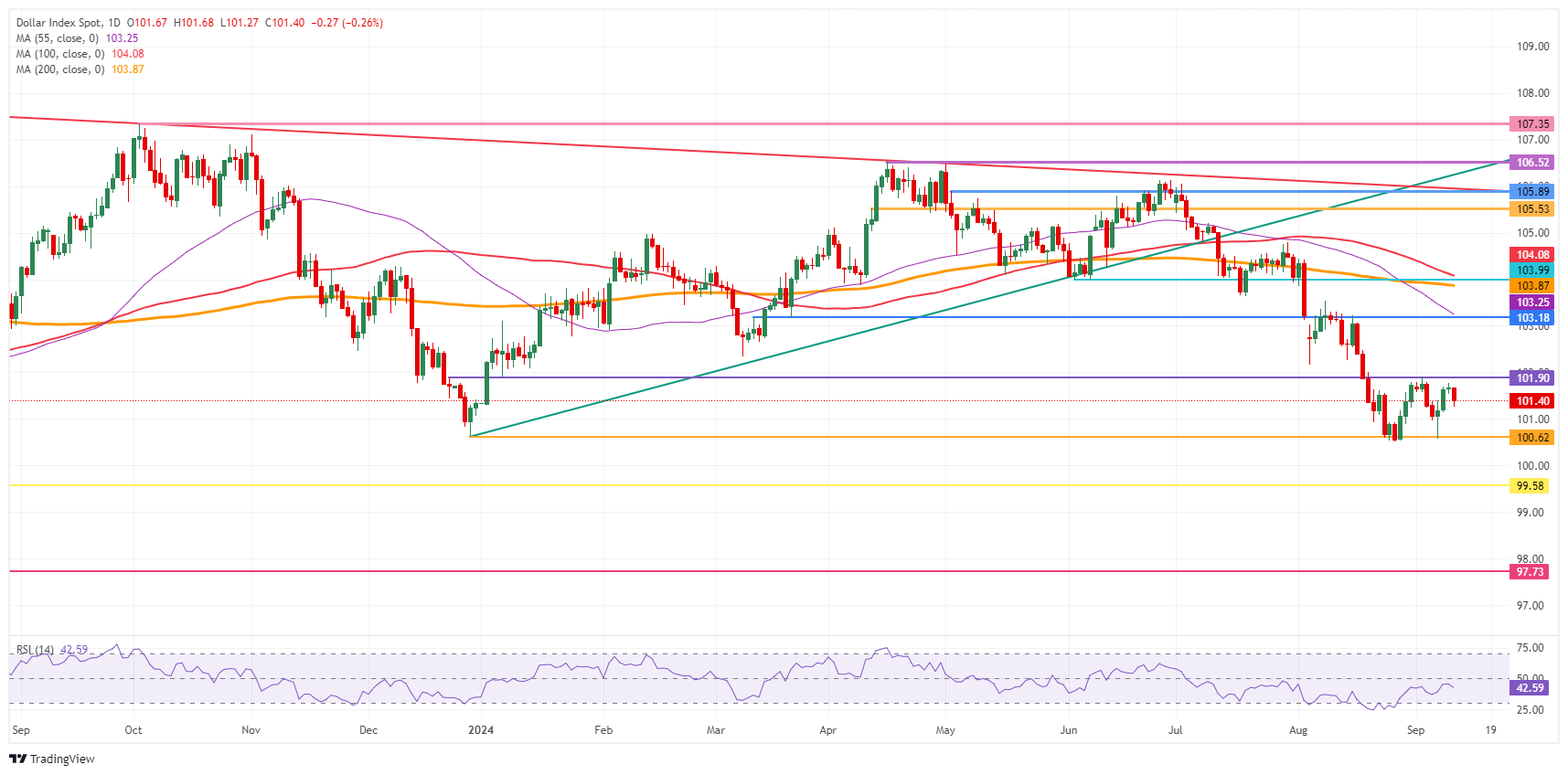
US Dollar Index: Daily Chart
US Dollar FAQs
The US Dollar (USD) is the official currency of the United States of America, and the ‘de facto’ currency of a significant number of other countries where it is found in circulation alongside local notes. It is the most heavily traded currency in the world, accounting for over 88% of all global foreign exchange turnover, or an average of $6.6 trillion in transactions per day, according to data from 2022. Following the second world war, the USD took over from the British Pound as the world’s reserve currency. For most of its history, the US Dollar was backed by Gold, until the Bretton Woods Agreement in 1971 when the Gold Standard went away.
The most important single factor impacting on the value of the US Dollar is monetary policy, which is shaped by the Federal Reserve (Fed). The Fed has two mandates: to achieve price stability (control inflation) and foster full employment. Its primary tool to achieve these two goals is by adjusting interest rates. When prices are rising too quickly and inflation is above the Fed’s 2% target, the Fed will raise rates, which helps the USD value. When inflation falls below 2% or the Unemployment Rate is too high, the Fed may lower interest rates, which weighs on the Greenback.
In extreme situations, the Federal Reserve can also print more Dollars and enact quantitative easing (QE). QE is the process by which the Fed substantially increases the flow of credit in a stuck financial system. It is a non-standard policy measure used when credit has dried up because banks will not lend to each other (out of the fear of counterparty default). It is a last resort when simply lowering interest rates is unlikely to achieve the necessary result. It was the Fed’s weapon of choice to combat the credit crunch that occurred during the Great Financial Crisis in 2008. It involves the Fed printing more Dollars and using them to buy US government bonds predominantly from financial institutions. QE usually leads to a weaker US Dollar.
Quantitative tightening (QT) is the reverse process whereby the Federal Reserve stops buying bonds from financial institutions and does not reinvest the principal from the bonds it holds maturing in new purchases. It is usually positive for the US Dollar.
Recommended Articles


