


Dow Jones Industrial Average rises as ceasefire talks lift sentiment
- The Dow climbed a slim 120 points on Monday as traders reacted to Friday's stronger-than-expected jobs report and weighed Iran ceasefire prospects.
- Institute for Supply Management Services data showed a sharp drop in employment and a surge in prices paid, raising stagflation concerns.
- Crude Oil prices whipsawed as reports emerged of a potential 45-day ceasefire framework between the US and Iran.
- Wall Street is coming off its best weekly performance since late November, snapping a five-week losing streak across all three major indexes.
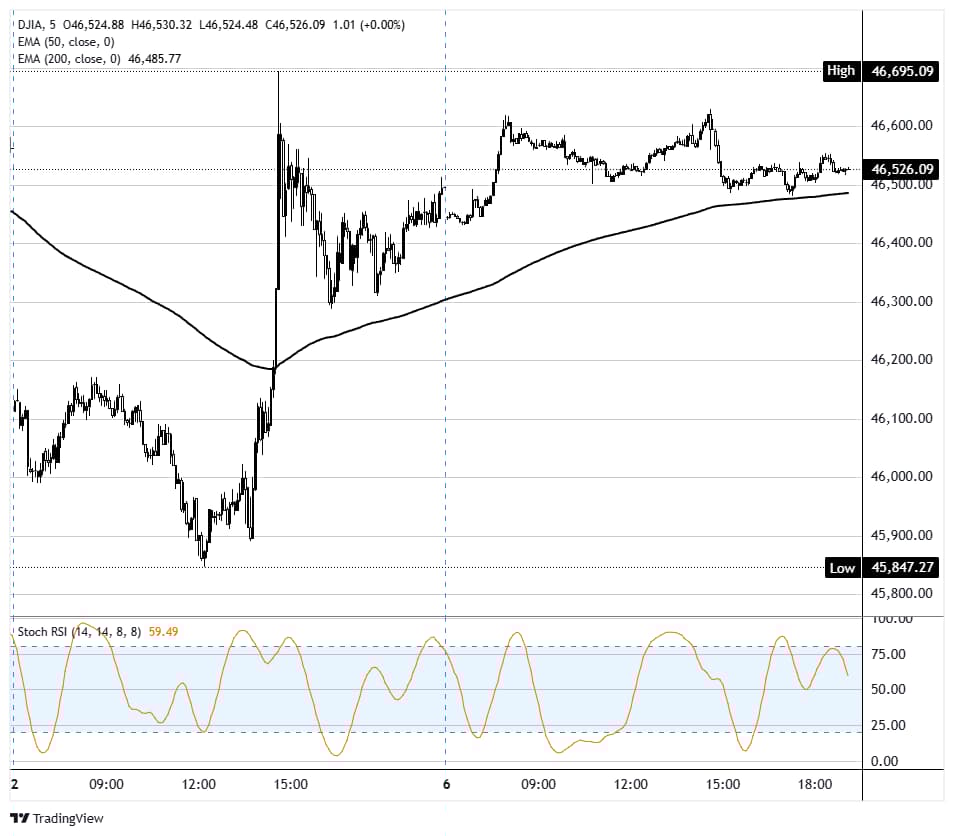
The Dow Jones Industrial Average gained a scant 120 points, or 0.3%, on Monday in the first session following the Good Friday market closure. The index pushed toward 46,700 in early trading before fading through the midday session and ultimately settling around 46,500. The S&P 500 ticked up 0.4% and the Nasdaq Composite added 0.5%, extending last week's rally that saw gains of 3%, 3.4%, and 4.4% respectively. Monday's session marked the first opportunity for traders to digest Friday's blowout March Nonfarm Payrolls (NFP) report, which showed the economy added 178K jobs against expectations for just 60K.
Services sector growth cools as prices surge
The Institute for Supply Management (ISM) Services Purchasing Managers Index (PMI) came in at 54.0 for March, below the consensus forecast of 55 and down from 56.1 in February. The headline number marked a 21st consecutive month of expansion, but the subcomponents told a more concerning story. The Employment Index plunged to 45.2 from 51.8, its lowest reading since December 2023 and a sharp reversal into contraction territory. The Prices Paid Index jumped to 70.7 from 63.0, reflecting the pass-through of elevated Oil prices and fuel costs tied to the Middle East conflict. ISM chair Steve Miller noted that Iran-related cost impacts dominated respondent commentary, with companies across industries reporting higher gas and diesel pricing. On a more positive note, the New Orders Index climbed to 60.6 from 58.6, its highest level since February 2023, suggesting demand in the services economy remains resilient even as cost pressures build.
Ceasefire speculation drives volatile Oil trading
Oil prices swung sharply throughout Monday's session as conflicting reports on US-Iran diplomacy kept traders guessing. A draft proposal put together by Egyptian, Pakistani, and Turkish mediators called for a 45-day ceasefire and the reopening of the Strait of Hormuz, but Iran rejected it outright. Foreign ministry spokesperson Esmail Baghaei called the proposal "illogical," stating that Tehran demands a permanent end to the war with guarantees against future attacks rather than a temporary halt to fighting. Despite the rejection, US equities shrugged off the headline and held onto gains, suggesting markets may be growing desensitized to the back-and-forth of failed diplomatic efforts. West Texas Intermediate (WTI) crude for May delivery was last up 0.7% above $112 per barrel, while Brent crude gained 0.6% above $109. President Donald Trump warned Sunday that the US would strike Iran's power plants and bridges if the Strait isn't reopened by Tuesday, though he walked back the rhetoric somewhat on Monday. Michael Rosen, chief investment officer at Angeles Investments, cautioned that markets may be underestimating the magnitude of the energy disruption, warning that prices could stay elevated for longer than expected.
Jobs data lands strong but wage growth softens
Friday's March NFP report showed 178K jobs added, nearly three times the consensus estimate of 60K, with healthcare accounting for 76K of the gain as striking Kaiser Permanente workers returned to payrolls. The unemployment rate edged down to 4.3%. However, average hourly earnings rose just 0.2% MoM, with the YoY rate slipping to 3.5%, the lowest since May 2021. February's payroll figure was also revised sharply lower to a loss of 133K from the initially reported 92K decline. The combination of a headline beat driven largely by strike resolution and cooling wage growth left the broader labor market picture largely unchanged. Futures markets reflected virtually no probability of a Federal Reserve (Fed) rate move at the April 28-29 Federal Open Market Committee (FOMC) meeting, with a 77.5% chance the Fed holds rates steady at 3.50%-3.75% through year-end according to the CME FedWatch tool.
Inflation data in focus later this week
Attention now turns to a pair of high-impact inflation releases later in the week. On Thursday, the Bureau of Economic Analysis (BEA) will publish the third estimate of fourth-quarter Gross Domestic Product (GDP) alongside the Personal Consumption Expenditures Price Index (PCE), the Fed's preferred inflation gauge. February's headline Consumer Price Index (CPI) came in at 2.4% YoY, and the March CPI release on Friday will be closely watched for any early signs of Oil-driven price acceleration filtering into broader consumer costs. With ISM manufacturing prices already at their highest since June 2022 and services prices now surging, the inflation outlook heading into the second quarter is becoming increasingly uncomfortable for a Fed that remains firmly on hold.
Dow Jones 5-minute chart
Dow Jones FAQs
The Dow Jones Industrial Average, one of the oldest stock market indices in the world, is compiled of the 30 most traded stocks in the US. The index is price-weighted rather than weighted by capitalization. It is calculated by summing the prices of the constituent stocks and dividing them by a factor, currently 0.152. The index was founded by Charles Dow, who also founded the Wall Street Journal. In later years it has been criticized for not being broadly representative enough because it only tracks 30 conglomerates, unlike broader indices such as the S&P 500.
Many different factors drive the Dow Jones Industrial Average (DJIA). The aggregate performance of the component companies revealed in quarterly company earnings reports is the main one. US and global macroeconomic data also contributes as it impacts on investor sentiment. The level of interest rates, set by the Federal Reserve (Fed), also influences the DJIA as it affects the cost of credit, on which many corporations are heavily reliant. Therefore, inflation can be a major driver as well as other metrics which impact the Fed decisions.
Dow Theory is a method for identifying the primary trend of the stock market developed by Charles Dow. A key step is to compare the direction of the Dow Jones Industrial Average (DJIA) and the Dow Jones Transportation Average (DJTA) and only follow trends where both are moving in the same direction. Volume is a confirmatory criteria. The theory uses elements of peak and trough analysis. Dow’s theory posits three trend phases: accumulation, when smart money starts buying or selling; public participation, when the wider public joins in; and distribution, when the smart money exits.
There are a number of ways to trade the DJIA. One is to use ETFs which allow investors to trade the DJIA as a single security, rather than having to buy shares in all 30 constituent companies. A leading example is the SPDR Dow Jones Industrial Average ETF (DIA). DJIA futures contracts enable traders to speculate on the future value of the index and Options provide the right, but not the obligation, to buy or sell the index at a predetermined price in the future. Mutual funds enable investors to buy a share of a diversified portfolio of DJIA stocks thus providing exposure to the overall index.
Recommended Articles


