

Tokenized Funds, Not Stablecoins, May Be the True Engine Driving Crypto Growth in 2025

Source Tradingkey

TradingKey - So far in 2025, stablecoins and asset tokenization have emerged as the two biggest trends in the crypto space. Compared to the steady 25% increase in stablecoin market capitalization this year, tokenized money market funds and U.S. Treasury-backed products have surged by an impressive 80%, highlighting the massive growth potential of this segment.

According to RWA.xyz, as of early July, the total assets under management (AUM) in tokenized treasury products — including digital tokenized funds and U.S. Treasury bonds — have grown by 80% year-to-date, reaching $7.4 billion. Among them, BlackRock’s tokenized fund BUIDL and Franklin Templeton’s BENJI lead the market in terms of scale, with growth rates reaching up to double that of others.
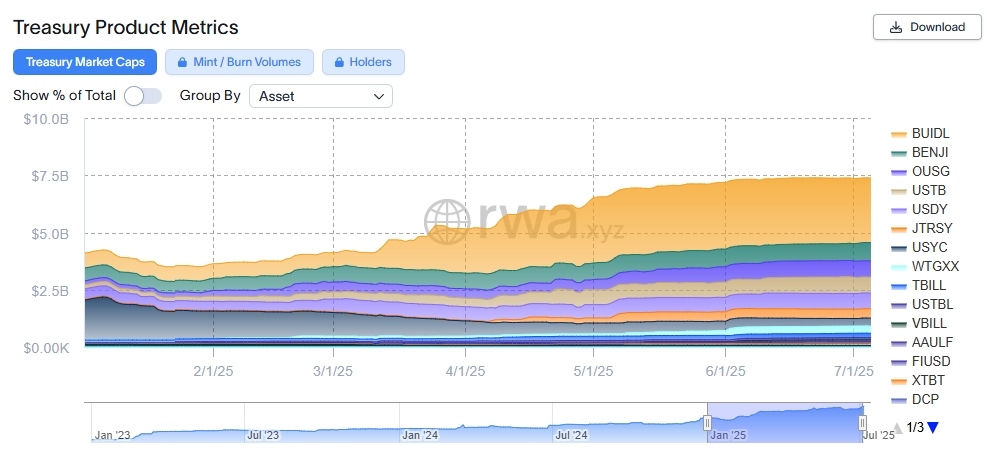
rwa-xyz.tokenized-treasuries

Total Value of Tokenized Treasury Products, Source: RWA.xyz

Data from DeFiLlama shows that over the same period, the stablecoin market cap increased by 24.58%, reaching $255.6 billion. This year, the passage of the U.S. GENIUS Act and Hong Kong’s stablecoin regulations has triggered a global wave of regulation and standardization for stablecoins. Circle, referred to as the first "stablecoin stock," saw its share price surge tenfold in its debut month.
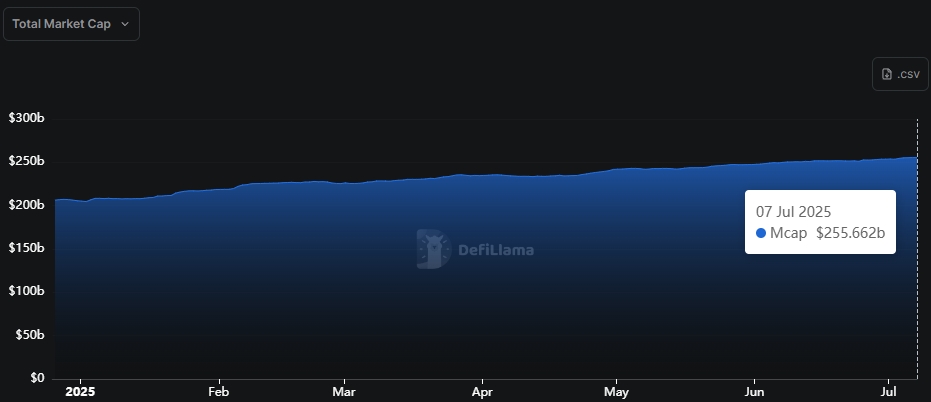
stablecoins-market-cap-defillama

Stablecoin Market Cap in 2025, Source: DeFiLlama

As reported by the Financial Times, the tokenized treasury market has attracted significant inflows from crypto firms and traders who find tokenized funds more suitable than stablecoins for holding idle capital. These funds are also increasingly used as collateral in crypto derivatives trading.

Olivier Portenseigne from FundsDLT, a subsidiary of a major clearinghouse, said that while stablecoins still dominate, tokenized money market funds are becoming the real tradable instruments, and traders are beginning to shift toward this space.

Portenseigne added that tokenization offers a cheaper and more accessible way to invest in mutual funds, significantly improving liquidity.

Both crypto traders and traditional financial institutions have been buzzing about the growth prospects of Real World Assets (RWA) tokenization in recent months. The rationale is that tokenization can enable more efficient and lower-cost transactions, and the role of tokenized treasuries and money market funds as collateral is accelerating adoption.

McKinsey estimates that the future market size for tokenized mutual funds, bonds, and exchange-traded notes could grow to $2 trillion — roughly 30% of the current $7 trillion traditional money market fund industry.

Moody’s analysts noted that, unlike most stablecoins, tokenized products allow investors to hold any spare cash “in a format that is easy to use and earn a yield.

On the other hand, stablecoin issuers themselves are contributing to the expansion of tokenized assets by investing their reserves into high-quality, yield-generating assets like tokenized Treasuries. 

For example, Janus Henderson’s $409 million tokenized treasury fund is primarily held by Sky Money, the issuer of the third-largest stablecoin, USDS, formerly known as MakerDAO.

However, some voices caution that the tokenized asset space is still in its infancy. Tokenized bonds, for instance, are not yet more liquid or efficient than traditional cash bonds and may still lag behind in key aspects.

Disclaimer: For information purposes only. Past performance is not indicative of future results.
placeholder
Bitcoin falls below $75,000 as the CLARITY Act fails in the Senate — what the vote means for cryptoThe US Senate blocked the Digital Asset Market CLARITY Act in a 49-50 procedural vote, sending Bitcoin briefly below $75,000 — its biggest one-day drop since June. Ethereum fell more than 8%, Coinbase slid 10% and $75 billion of crypto market value evaporated. Here is what the vote was, why it failed, and the levels that matter now.
Author  Suzie
Sep 16, Wed
The US Senate blocked the Digital Asset Market CLARITY Act in a 49-50 procedural vote, sending Bitcoin briefly below $75,000 — its biggest one-day drop since June. Ethereum fell more than 8%, Coinbase slid 10% and $75 billion of crypto market value evaporated. Here is what the vote was, why it failed, and the levels that matter now.
placeholder
Dollar index tops 100 for the first time since July as the Fed's hawkish dot plot sinks inThe U.S. dollar index broke back above 100 for the first time since 31 July after the Fed delivered its first rate hike since 2023, with the dot plot showing 16 of 18 officials expect at least one more increase this year. Here are the levels that matter for DXY, the currencies feeling it most, and what to watch next.
Author  Irene Q.
Sep 17, Thu
The U.S. dollar index broke back above 100 for the first time since 31 July after the Fed delivered its first rate hike since 2023, with the dot plot showing 16 of 18 officials expect at least one more increase this year. Here are the levels that matter for DXY, the currencies feeling it most, and what to watch next.
placeholder
US to delay new "overcapacity" tariffs on China — what the pause means for trade, inflation and the dollarWashington is expected to hold off announcing new tariffs over Chinese "overcapacity" until after the 24 September summit, according to Bloomberg. The postponed plan would have added 7.5% to Chinese goods, taking second-term US tariffs to around 20%. Here is what is on the table, and what a deal versus no deal would mean for the yuan, Hong Kong equities and the dollar.
Author  Mitrade
Sep 18, Fri
Washington is expected to hold off announcing new tariffs over Chinese "overcapacity" until after the 24 September summit, according to Bloomberg. The postponed plan would have added 7.5% to Chinese goods, taking second-term US tariffs to around 20%. Here is what is on the table, and what a deal versus no deal would mean for the yuan, Hong Kong equities and the dollar.
placeholder
Gold ends three-week slide at the $4,400 line — eight straight days of ETF inflows vs a 5% 10-year and a 100 dollarSpot gold closed Friday at $4,378.39, up 0.84% on the day and about 0.8% for the week — its first weekly gain in four weeks — with the intraday high of $4,399.67 leaving it 33 cents shy of the $4,400 line. Gold ETFs have now logged eight straight sessions of inflows, but with the 10-year back above 5% and the dollar index near 100, here is what decides whether this is a reversal or a bounce.
Author  Suzie
Yesterday 05: 53
Spot gold closed Friday at $4,378.39, up 0.84% on the day and about 0.8% for the week — its first weekly gain in four weeks — with the intraday high of $4,399.67 leaving it 33 cents shy of the $4,400 line. Gold ETFs have now logged eight straight sessions of inflows, but with the 10-year back above 5% and the dollar index near 100, here is what decides whether this is a reversal or a bounce.
placeholder
Bitcoin squeezes back above $80,000 — 110,000 traders liquidated as the hawkish Fed and CLARITY setback fail to hold it down; is $83,000 next?Bitcoin closed above $80,000 on Friday for the first time since September 7, and pushed to $81,299 over the weekend, triggering about $603 million of liquidations — $523 million of them shorts — across more than 110,000 traders. With the Fed's hike already priced and the SEC and CFTC advancing crypto rules after the CLARITY Act failed, here is what stands between BTC and the $83,000 gate.
Author  Suzie
Yesterday 06: 19
Bitcoin closed above $80,000 on Friday for the first time since September 7, and pushed to $81,299 over the weekend, triggering about $603 million of liquidations — $523 million of them shorts — across more than 110,000 traders. With the Fed's hike already priced and the SEC and CFTC advancing crypto rules after the CLARITY Act failed, here is what stands between BTC and the $83,000 gate.
goTop
quote