


June CPI Cooling May Be a Smokescreen? Brent May Rise to $125, Middle East Conflict Risks Igniting Next Month’s Inflation Report
TradingKey - US CPI inflation slowed more than market expectations in June, but Federal Reserve Chairman Warsh made hawkish remarks, emphasizing that the current primary task is to restore price stability and ensure that the high inflation of the past five years becomes a thing of the past.
On July 14 Eastern Time, inflation data released by the US Bureau of Labor Statistics showed that the unadjusted CPI rose by 3.5% in June, significantly lower than the market expectation of 3.8%; CPI fell 0.4% month-on-month, also exceeding the market expectation of a 0.1% decline. In terms of core inflation, the monthly core CPI rate was 0%, marking the smallest increase since January 2021, whereas the market had previously expected 0.2%.
Overall, driven by falling energy prices, the decline in June CPI growth exceeded expectations, but substantial inflationary pressure remains, and the current 3.5% year-on-year increase is still a long way from the Federal Reserve's 2% inflation target.
The Department of Labor stated that falling energy prices were the biggest contributor to the moderation in the Consumer Price Index for the month, offsetting the impact of price increases in other areas such as shelter and food.
Following the release of the CPI data, the implied probability of a July rate hike in the interest rate market fell back to about 15%, basically returning to the level before Waller's speech, which means investors have almost completely priced out a July rate hike.
However, it should be noted that inflation data is lagging. The current escalation of the situation in the Middle East has disrupted energy supplies again and led to a sharp rise in oil prices. This will push up next month's inflation report data and cause the Fed to reassess the threat posed by inflation.
As of press time, both major crude oil futures have risen to mid-June levels, with Brent crude futures up 1.93% to $84.91.
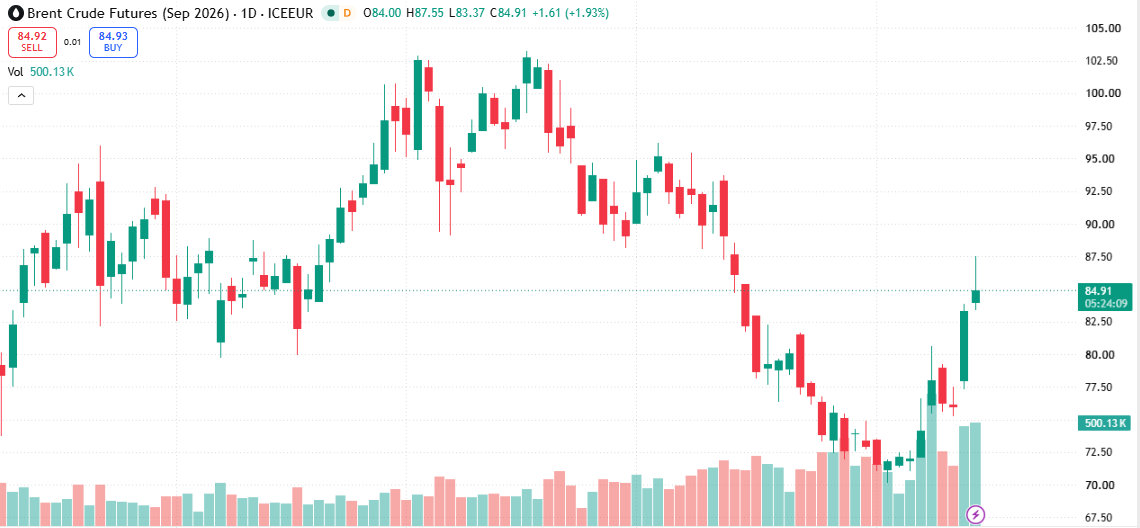
[Source: TradingView]
Market analysis suggests that if the conflict between the US and Iran escalates further, Brent crude could surge to the $125 level.
Economist Robin J. Brooks stated that the core basis of his estimate is the potentially severe disruption of oil shipments through the Strait of Hormuz. He assumed that, out of the pre-war daily crude exports of about 20 million barrels from the Persian Gulf, taking into account alternative pipelines in Saudi Arabia and the UAE that can bypass the strait, as well as some movement of Iranian tankers during the conflict, the region's effective exports under a 'hot war' scenario would plunge to about 10 million barrels per day (bpd). If the US were to reimpose a naval blockade on Iran on top of this, cutting off Iran's daily exports of about 2 million barrels, total outbound shipments from the Persian Gulf would further contract to 8 million bpd.
To measure the impact of this supply shock on prices, Brooks cited academic research on the price elasticity of crude oil demand—with a median estimate of about 0.15, meaning that for every 10% increase in oil prices, demand drops by only 1.5%, exhibiting highly inelastic characteristics. Based on this, to absorb a supply gap dropping from 20 million barrels to 8 million barrels, oil prices would need to rise by about 80%.
Brooks further analyzed that even if the current situation deteriorates again, the peak in oil prices may still be lower than the highs recorded earlier this year. The reason is that the market has accumulated a wealth of coping experience after experiencing the turmoil of previous months. Various countries have established alternatives and redundant capacity: countries with abundant crude reserves, such as China and Japan, have significantly cut imports, while countries with relatively limited inventories, such as South Korea and India, have worked to maintain imports at nearly flat levels. These experiences accumulated in recent months, along with restructured supply chains, mean that even if the conflict returns to a 'hot war' state, its disruption to the oil market will be milder than in the initial stage, thereby helping to curb price rallies more effectively.
Recommended Articles


