

Solana Leads The Bull Case For Crypto, Says Multicoin’s Samani

Source Newsbtc

Kyle Samani, co-founder and managing partner of Multicoin Capital, outlined his renewed Solana bull thesis in an interview with Frank Chaparro.. Multicoin, one of Solana’s earliest backers since its seed round in 2018, is doubling down on its conviction that Solana is the most strategically positioned blockchain to power the future of decentralized finance and payments.

Samani made it clear that Multicoin’s outlook on the crypto sector has sharpened significantly over the years. “We’ve fundamentally recognized that these systems are financial systems, first and foremost,” he stated. “We need to be focused on investing in things that are fundamentally tied to innovations in finance.”

Samani reflected on the broader downturn in venture funding across the crypto space, pointing to a necessary reckoning around utility and real-world applicability. According to DeFiLlama data cited in the interview, venture capital inflows have now dipped below 2017–2018 levels despite increasing regulatory clarity.

Samani attributes this to an overdue market correction away from overfunded, non-viable projects. “People, LPs, have funded crypto venture funds with the implicit implication that crypto will substantially impact all parts of the economy. And I have a narrower view — I think it will have a very high impact in financial services. Otherwise, I generally don’t care.”

This recalibration has led Multicoin to double down on areas where product-market fit is finally emerging, including stablecoins, real-world assets (RWAs), decentralized physical infrastructure networks (DePIN), and cross-border payment systems. “We have these areas now where there’s definitive market fit,” Samani said, highlighting projects like Felix Pago’s remittance network in Mexico and growing interest in crypto-native labor marketplaces integrating stablecoin payouts.

Solana’s Edge: Speed And On-Chain Order Books

Central to Multicoin’s latest thesis is the growing realization that Solana remains unmatched in providing the speed, throughput, and cost structure necessary to support global financial applications at scale.

“If you look at core L1 infrastructure, Solana is the fastest horse today,” Samani asserted. He emphasized that after five years since mainnet launch, Solana is now on the cusp of making fully on-chain order books not only possible but functionally competitive with centralized exchanges.

“Latency was not low enough. Chain would fall over […] But as the chain has gotten more stable, as latency’s come down, as throughput is increased, that’s made it more usable for on-chain order books,” Samani explained. He expects the market to reach an inflection point in the next three to six months, where on-chain order books are “functionally usable for both makers and takers, comparable enough to Binance and Coinbase.”

Key to unlocking this potential, according to Samani, is “conditional liquidity” — an innovation he believes is now within reach thanks to the maturity of the Solana ecosystem.

Ethereum Vs. Solana

Samani drew a sharp contrast between Solana’s singular optimization for financial use cases and Ethereum’s generalized approach. “Ethereum’s core problem is they’re not optimized for anything,” he argued. “The definition of focus is saying no to things. And they absolutely refuse to do so.”

While Ethereum pursues roll-up-centric scaling, Samani remains skeptical of both the intra- and inter-roll-up challenges. “All of the rollups we have today are entirely centralized in their operations,” he noted. “Ethereum started off maximum decentralization […] and the path to scaling is to centralize and then re-decentralize. It strikes me as bizarre.”

In contrast, Samani believes Solana’s monolithic architecture — emphasizing low latency and high throughput — is best suited for building the backbone of Internet-native capital markets. “You have to be focused on latency, throughput, and gas cost,” he said. “Bitcoin and Ethereum from inception were always like, ‘Oh my God, scarcity.’ Solana’s perspective has always been, ‘Let’s let Moore’s Law do its thing and run a billion transactions in parallel.'”

Regulatory Winds Shifting

Samani also described a noticeable shift in the regulatory environment, referencing the White House Crypto Summit where he sat alongside major industry figures. “It was really awesome for me to see that they committed two hours, they sat there with us, they listened, they took notes, and they were asking really good questions,” he said.

In Samani’s view, this new dialogue with Washington is already catalyzing changes in capital flows. Multicoin has seen several of its largest LPs — historically venture-only — express interest in their liquid hedge fund product. “Three of our largest LPs have all called us since the election and said, ‘Hey, we would like to explore your liquid fund.’ We feel pretty good that the tides are shifting.”

Samani reiterated that, from a risk-reward standpoint, liquid markets — specifically top-performing tokens like Solana and its ecosystem projects — now offer the most compelling opportunities. “My general belief today is that the easiest money to be made in crypto is buying liquid names that are the winners in their respective areas.”

Five years after backing Solana in its earliest days, Multicoin Capital remains unwavering in its conviction. “We underestimated the difficulty of on-chain order books,” Samani admitted. “But we never gave up on it, and I think we’re pretty close now.”

At press time, SOL traded at $140.
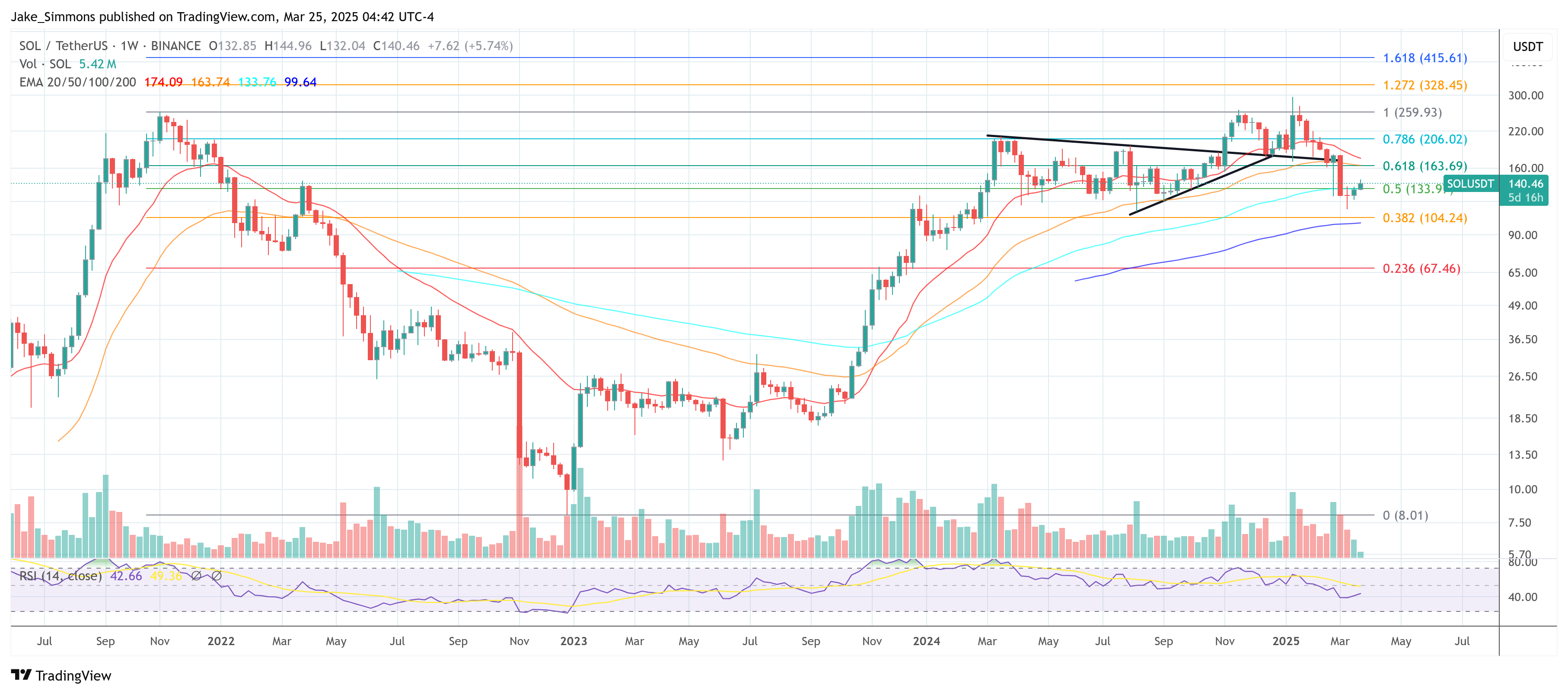
Solana price
Disclaimer: For information purposes only. Past performance is not indicative of future results.
placeholder
Bitcoin CME gaps at $35,000, $27,000 and $21,000, which one gets filled first?Prioritize filling the $27,000 gap and even try higher.
Author  FXStreet
Aug 22, 2023
Prioritize filling the $27,000 gap and even try higher.
placeholder
Natural Gas sinks to pivotal level as China’s demand slumpsNatural Gas price (XNG/USD) edges lower and sinks to $2.56 on Monday, extending its losing streak for the fifth day in a row. The move comes on the back of China cutting its Liquified Natural Gas (LNG) imports after prices rose above $3.0 in June. It
Author  FXStreet
Jul 01, 2024
Natural Gas price (XNG/USD) edges lower and sinks to $2.56 on Monday, extending its losing streak for the fifth day in a row. The move comes on the back of China cutting its Liquified Natural Gas (LNG) imports after prices rose above $3.0 in June. It
placeholder
Bitcoin briefly loses 2025 gains as crypto plunges over the weekend.Bitcoin experienced a sharp decline this weekend, briefly erasing its 2025 gains and dipping below its year-opening value of $93,507. The cryptocurrency fell to a low of $93,029 on Sunday, representing a 25% drop from its all-time high in October. Although it has rebounded slightly to around $94,209, the pressures on the market remain significant. The downturn occurred despite the reopening of the U.S. government on Thursday, which many had hoped would provide essential support for crypto markets. This year initially appeared promising for cryptocurrencies, particularly after the inauguration of President Donald Trump, who has established the most pro-crypto administration thus far. However, ongoing political tensions—including Trump's tariff strategies and the recent government shutdown, lasting a historic 43 days—have contributed to several rapid price pullbacks for Bitcoin throughout the year. Market dynamics are also being influenced by Bitcoin whales—investors holding large amounts of Bitcoin—who have been offloading portions of their assets, consequently stalling price rallies even as positive regulatory developments emerge. Despite these sell-offs, analysts from Glassnode argue that this behavior aligns with typical patterns seen among long-term investors during the concluding stages of bull markets, suggesting it is not indicative of a mass exodus. Notably, Bitcoin is not alone in its struggles, as Ethereum and Solana have also recorded declines of 7.95% and 28.3%, respectively, since the start of the year, while numerous altcoins have faced even steeper losses. Looking ahead, questions linger regarding the viability of the four-year cycle thesis, particularly given the increasing institutional support and regulatory frameworks now in place in the crypto landscape. Matt Hougan, chief investment officer at Bitwise, remains optimistic, suggesting a potential Bitcoin resurgence in 2026 driven by the “debasement trade” thesis and a broader trend toward increased adoption of stablecoins, tokenization, and decentralized finance. Hougan emphasized the soundness of the underlying fundamentals, pointing to a positive outlook for the sector in the longer term.
Author  Mitrade
Nov 17, 2025
Bitcoin experienced a sharp decline this weekend, briefly erasing its 2025 gains and dipping below its year-opening value of $93,507. The cryptocurrency fell to a low of $93,029 on Sunday, representing a 25% drop from its all-time high in October. Although it has rebounded slightly to around $94,209, the pressures on the market remain significant. The downturn occurred despite the reopening of the U.S. government on Thursday, which many had hoped would provide essential support for crypto markets. This year initially appeared promising for cryptocurrencies, particularly after the inauguration of President Donald Trump, who has established the most pro-crypto administration thus far. However, ongoing political tensions—including Trump's tariff strategies and the recent government shutdown, lasting a historic 43 days—have contributed to several rapid price pullbacks for Bitcoin throughout the year. Market dynamics are also being influenced by Bitcoin whales—investors holding large amounts of Bitcoin—who have been offloading portions of their assets, consequently stalling price rallies even as positive regulatory developments emerge. Despite these sell-offs, analysts from Glassnode argue that this behavior aligns with typical patterns seen among long-term investors during the concluding stages of bull markets, suggesting it is not indicative of a mass exodus. Notably, Bitcoin is not alone in its struggles, as Ethereum and Solana have also recorded declines of 7.95% and 28.3%, respectively, since the start of the year, while numerous altcoins have faced even steeper losses. Looking ahead, questions linger regarding the viability of the four-year cycle thesis, particularly given the increasing institutional support and regulatory frameworks now in place in the crypto landscape. Matt Hougan, chief investment officer at Bitwise, remains optimistic, suggesting a potential Bitcoin resurgence in 2026 driven by the “debasement trade” thesis and a broader trend toward increased adoption of stablecoins, tokenization, and decentralized finance. Hougan emphasized the soundness of the underlying fundamentals, pointing to a positive outlook for the sector in the longer term.
placeholder
WTI Price Forecast: Seems vulnerable near $90.50 as technical breakdown comes into playWest Texas Intermediate (WTI) – the benchmark US Crude Oil price – plummets to a nearly two-week trough during the Asian session on Wednesday in reaction to news that the US and Iran have agreed to a two-week ceasefire.
Author  FXStreet
Yesterday 01: 48
West Texas Intermediate (WTI) – the benchmark US Crude Oil price – plummets to a nearly two-week trough during the Asian session on Wednesday in reaction to news that the US and Iran have agreed to a two-week ceasefire.
placeholder
Gold remains depressed as skepticism over US-Iran truce supports USDGold (XAU/USD) once again shows some resilience below the $4,700 mark during the Asian session on Thursday, and for now, seems to have stalled the previous day's retracement slide from a three-week high.
Author  FXStreet
6 hours ago
Gold (XAU/USD) once again shows some resilience below the $4,700 mark during the Asian session on Thursday, and for now, seems to have stalled the previous day's retracement slide from a three-week high.
goTop
quote