


US prosecutors call Huawei a ‘criminal enterprise’ as landmark trial begins
On Wednesday, a prosecutor in the U.S. stated in front of a jury in Brooklyn that Huawei was a “criminal enterprise“, which marked the start of a trial regarding trade secret theft, sanctions infringement, and bank fraud that had been delayed for a long time. Huawei has denied all charges brought against it.
Accusations date back several years, but their impact in 2026 is different. Huawei is currently involved in Beijing’s attempt to develop an AI-chip ecosystem independent of U.S. technology, while Nvidia experiences growing competition from China-based businesses.
“Theft, lies, cover-up” versus “competition, not conspiracy”
“Theft, lies, cover-up,” Justice Department trial attorney Taylor Stout told jurors, alleging Huawei spent two decades victimizing U.S. companies and abusing the financial system.
Prosecutors say Huawei conspired to steal trade secrets from five American companies, including Cisco router source code and T-Mobile phone-testing technology.
Huawei’s representative rejected that image. Attorney Brian Heberlig characterized the litigation as a matter of “competition, not conspiracy,” and accused the prosecution of using only “cherry-picking isolated events.” He added that the Cisco and T-Mobile incidents did not involve the whole company but only particular employees, and the management took action upon finding out about these incidents.
Skycom, Iran and the Meng Wanzhou standoff
The case has grown into a wider RICO prosecution from being a case of bank fraud and sanctions. The Department of Justice’s amended case against Huawei states that the company has used Hong Kong’s Skycom to procure prohibited goods from the U.S. for Iran and to transfer funds through the global banking system.
As per Reuters report, Skycom had provided Hewlett-Packard products worth at least €1.3 million ($1.5 million) to Iran’s biggest mobile operator. A Cryptopolitan report revealed that HSBC okayed over $100 million in transactions linked to Skycom. The prosecutors have also accused Huawei of transactions in North Korea and providing surveillance equipment that ended up being used against protesters in Iran in 2009.
From telecom giant to China’s AI-chip champion
The crucial importance of Huawei now relies heavily on its Ascend accelerators.
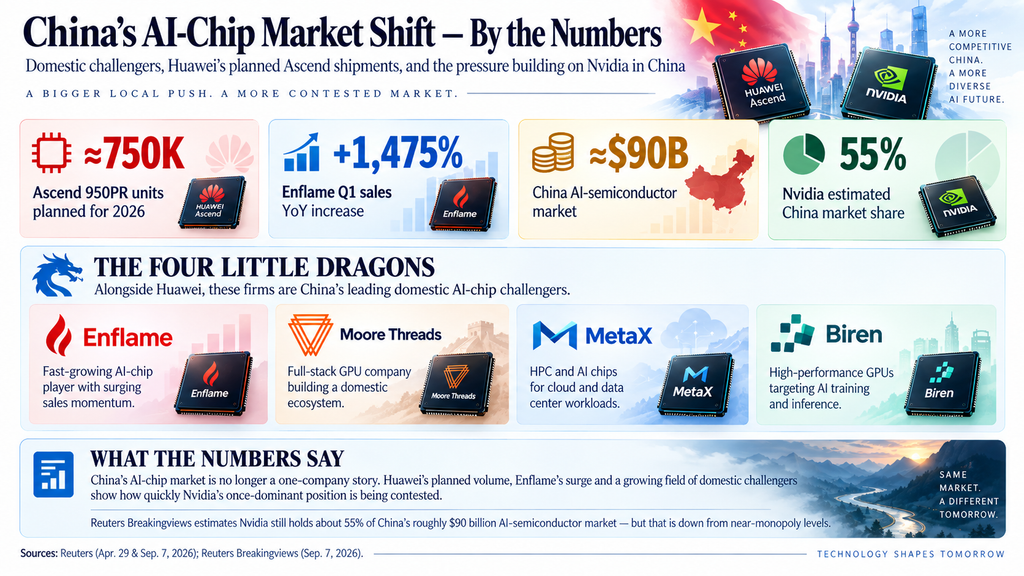
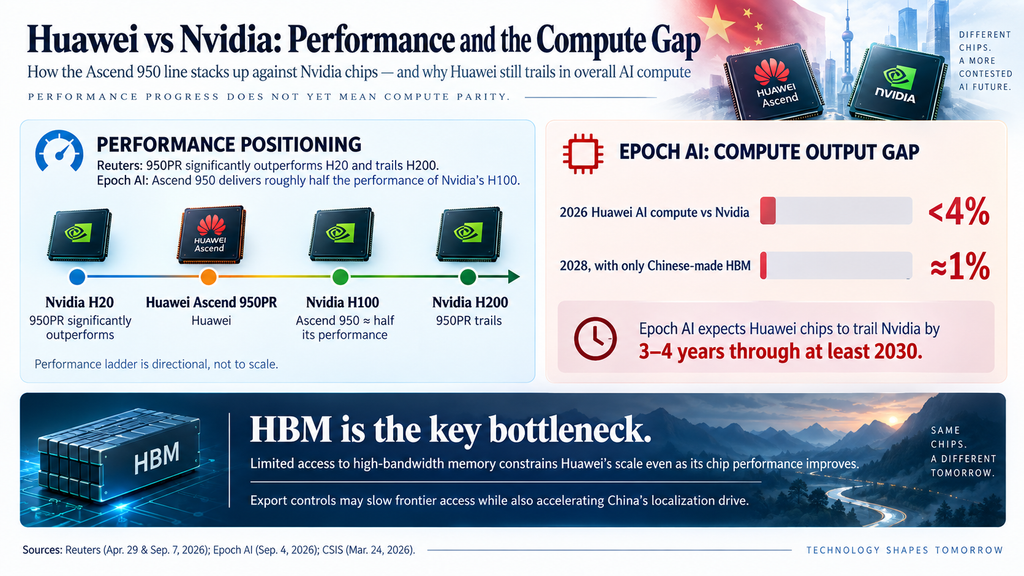
According to a report by Reuters published in April, there is a surge in demand for the Ascend 950 after DeepSeek launched its V4, and companies like ByteDance, Tencent and Alibaba are interested in buying it. The 950PR greatly surpasses Nvidia’s H20, although it lags behind the H200. At the same time, Epoch AI estimates that the Ascend 950’s performance is only slightly above half of that of Nvidia’s H100. Huawei is planning to deliver approximately 750,000 units of the 950PR in 2026.
Huawei is not the only company in China working in this area. Enflame, Moore Threads, MetaX, and Biren are the four other companies named by Reuters Breakingviews that are considered as ‘the four little dragons’ of China. Enflame has shown unprecedented growth of 1,475% in sales during the first quarter while raising $900 million in Shanghai.
This is happening while the share of Nvidia in the AI semiconductor market of China has declined considerably from close to a monopoly state to 55%.
Why the compute gap still favors Nvidia
That market-share shift does not mean Huawei has caught Nvidia technologically.
Epoch AI estimates Huawei will produce less than 4% as much AI compute as Nvidia in 2026. High-bandwidth memory remains the biggest bottleneck. If Huawei relies only on Chinese-made HBM, its output could remain around 1% of Nvidia’s through 2028, while its chips may continue trailing Nvidia’s by three to four years through at least 2030.
That leaves Washington with a difficult trade-off. CSIS argues that export controls have limited China’s access to advanced technology but also accelerated domestic substitution. China’s integrated-circuit output fell 9.8% in 2022 before the localization push gathered momentum, while controls still constrain manufacturing beyond roughly the 7-nanometer node.
A 2025 BIS guidance also identified several Huawei Ascend chips as presumptively subject to GP10 restrictions. For global markets, the stakes extend well beyond Huawei and Nvidia. PwC projects $31.6 trillion in AI-infrastructure capital spending through 2050.
If the U.S. and China continue building increasingly separate hardware ecosystems, the result could reshape where semiconductor capacity, data centers, energy investment and AI infrastructure are built for decades.
If you're reading this, you’re already ahead. Stay there with our newsletter.
Recommended Articles


