


UNI up 39%, ARB doubles in a week as Robinhood Chain Breaks Volume Records
Altcoins across the board have had an impressive last month with the TOTAL2ES, which measures the entire marketcap of all crypto assets excluding Bitcoin and Stablecoins, up close to 32%. Over the past week, we saw large cap alts like Zcash and legacy coins like Dash posted double digit rallies. The other two notable assets within the top 100 cryptocurrencies by market cap were Uniswap’s UNI, which is up 39.1% and Arbitrum’s ARB, which more than doubled, up 107.4% at the time of writing. For ARB, this is the highest price level it’s been at since early January while UNI hasn’t traded at these levels since November last year.
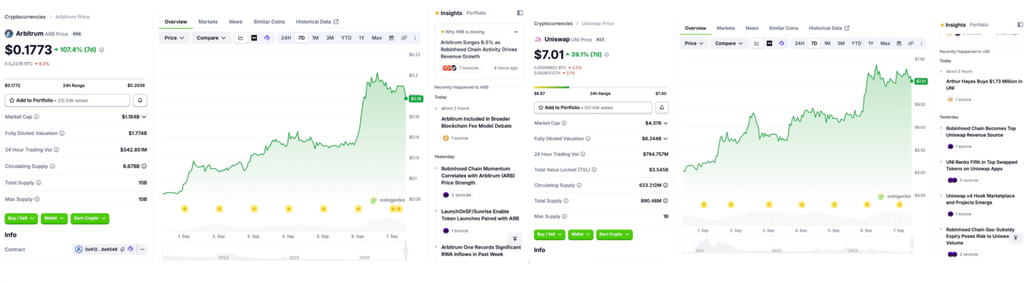
Source: CoinGecko
Both the moves can be traced back to one place. Robinhood Chain, the network that went live around two months ago, has become the biggest fee generating chain across crypto, and Uniswap and Arbitrum are the two protocols sitting closest to that money. Cumulative DEX volume on the chain has now gone past the $40 billion mark. Daily chain revenue is now above $4 million, which puts it ahead of Hyperliquid, Ethereum, BNB chain and Base.
Uniswap Is Collecting Almost All of the Flow
Uniswap is the main exchange on Robinhood Chain and almost all of the trading happens there. The exchange also earns more per dollar traded on that chain than it does elsewhere. It keeps 0.465% of every dollar traded on the Robinhood network compared to a rate of 0.214% across the rest of its network. Tokenized stocks are a main reason for this because they trade in Uniswap’s priciest fee tiers. Those pairs were close to nothing in chain volume in August but now they are at around 4.1%.
The Fee Switch Turned Volume Into Supply Reduction
The UNI token itself wouldn’t have reacted much a year ago to this. Liquidity providers took up the fees and token sat outside this loop until the UNIfication upgrade changed this entirely. With the fee switch live, fees are now used to buy and burn UNI, permanently removing it from circulation.
More Robinhood users generate more Uniswap volume, more volume generates more fees, and more fees burn more UNI.
Arbitrum’s Cut Is Written Into a Contract
ARB’s connection works differently. Robinhood Chain is built with Arbitrum technology, and under the Arbitrum Expansion Program the chain sends back 10% of its net protocol revenue. That splits 8% to the Arbitrum DAO treasury and 2% to the developer guild.
By early September, 30 days of that arrangement came to roughly $1.32 million. Set against the $78.73 million Uniswap pulled from the same chain in trading fees, it is a rounding error. The money also lands in a treasury controlled by DAO governance rather than flowing to ARB holders in any direct way.
One Chain, One Company, Two Thirds of the Fees
The concentration is the part worth watching. Uniswap has spent years spreading itself across dozens of chains, and that sprawl was the point. Now the majority of its fee revenue depends on a single network controlled by a publicly listed brokerage that answers to the SEC and to its own shareholders.
If Robinhood adjusts how swaps route, changes its fee structure, or runs into a regulatory problem, the burn rate that is currently supporting UNI’s price shrinks with it. Uniswap has never carried that kind of single-counterparty exposure before.
For now the growth story is doing the talking. The chain is setting volume records, the burn is climbing, and both tokens have been repriced accordingly.
If you're reading this, you’re already ahead. Stay there with our newsletter.
Recommended Articles


