


South Korea Stock Index Forecast: Goldman Sachs Maintains 12,000 Target, Can AI Memory Cycle Push KOSPI to New Highs?
TradingKey - Goldman Sachs (GS) remains bullish on the South Korean stock market.
Although South Korea's KOSPI index has pulled back about 27% from its June record high and market concerns over the sustainability of AI capital expenditures, the high volatility of South Korean stocks, and the semiconductor cycle continue to escalate, Timothy Moe, Chief Asia Pacific Regional Equity Strategist at Goldman Sachs, has still not lowered his previously stated 12,000-point target.
Based on current market levels, this target implies nearly 80% upside potential for the KOSPI going forward. Months ago, when Moe first made the 12,000-point forecast, this figure was one of the most aggressive calls in the market; today, even after South Korean equities experienced a sharp correction, he still chooses to maintain this target.
Moe believes the market's biggest misconception at present is underestimating the boost from AI infrastructure investment to the earnings cycle of South Korean memory chipmakers, as well as how long this wave of demand growth could persist.
AI Boom Is Not Over Yet, Memory Chips May See a Longer Upcycle
The South Korean stock market has come under pressure recently, largely due to investors beginning to question whether global tech giants' surging AI capital expenditures can be sustained over the long term. If Big Tech slows data center buildouts, earnings forecasts for South Korean chipmakers such as Samsung Electronics and SK Hynix will naturally be affected.
However, Moe takes the opposite view.
He believes that AI infrastructure buildout remains in an expansion phase, and data center demand for high-performance computing and memory is likely to continue growing rapidly. As global hyperscalers continue building AI data centers, the supply of memory and storage chips has already tightened, with rising prices further improving the profitability of South Korean memory manufacturers.
Moe expects that this supply-demand mismatch could become even more pronounced by 2027.
Meanwhile, Goldman Sachs projects that total capital expenditures by major U.S. tech companies could top $1.2 trillion next year, significantly higher than its previous forecast of around $800 billion. Even if certain AI operations have yet to achieve ideal profitability, tech giants must still ramp up infrastructure spending to maintain their computing power and market competitiveness.
In Moe's view, this capex pattern is in itself a significant positive for memory chipmakers. Higher AI workloads drive stronger demand for high-bandwidth memory and other high-performance storage products, which ultimately feeds through to South Korean firms such as Samsung Electronics and SK Hynix.
Goldman Sachs Sees Ample Room for South Korean Corporate Earnings Growth
Another core rationale for Goldman Sachs' bullish stance on the KOSPI is the significant gap between earnings growth and valuations.
Moe expects overall earnings growth for KOSPI constituent companies to reach around 360% this year. Although this growth rate is projected to slow significantly to about 35% in 2027, the market has actually already begun pricing in the risk of decelerating earnings growth in advance.
In other words, a potential future cooling in South Korean corporate profit growth does not mean the earnings cycle has come to an end.
Especially as major chipmakers such as Samsung Electronics and SK Hynix continue to benefit from AI demand, the earnings foundation of the South Korean stock market remains strongly supported. If companies ultimately meet Goldman Sachs' earnings forecasts, current KOSPI valuation levels would appear relatively cheap.
Currently, the KOSPI's forward price-to-earnings ratio stands at around 5.3 times, roughly half its average level over the past seven years. By contrast, the valuation baseline set by Moe for the 12,000-point target is approximately 7.5 times forward P/E.
That is to say, Goldman Sachs' bullish outlook does not rely entirely on a massive valuation expansion; as long as corporate earnings grow as expected while market valuations recover from extremely low levels toward their long-term mean, the KOSPI could see significant upside potential.
Therefore, while 12,000 points may seem highly aggressive, if South Korean companies can deliver on earnings forecasts, this target is not as unreachable as the raw index level might suggest.
Of course, the South Korean stock market is not without risks. Competition from Chinese memory chip manufacturers is intensifying, and major U.S. tech companies seeking to boost AI capital expenditures may face constraints related to policy, power supply, and regulation. These factors could prompt the market to reassess the return on investment for AI, ultimately weighing on memory chip demand.
Particularly as Chinese manufacturers continue to improve technology and capacity, it may become increasingly difficult for South Korean memory makers to sustain high profit margins over the long term. Meanwhile, if U.S. data center construction slows due to shifts in policy or the financing environment, the entire AI hardware supply chain could be impacted.
However, in Moe's view, these risks are not yet sufficient to alter the underlying trend of demand for advanced memory chips over the next few years.
Korean Stock Index Technical Analysis
Source: TradingView
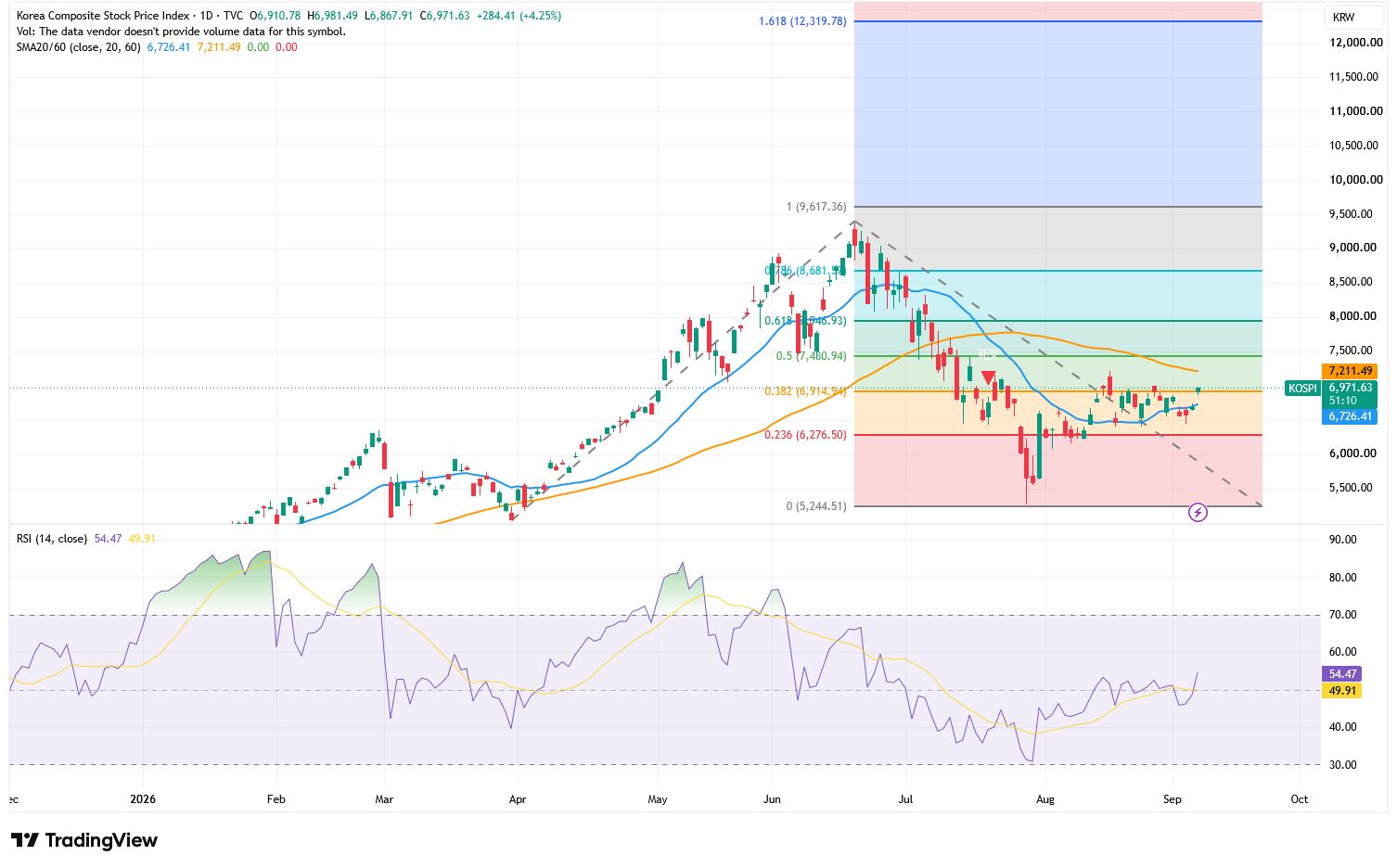
Looking at the daily chart, the KOSPI recently rose 4.25% to close at 6,971.63 points, breaking back above the descending trendline and reclaiming the 20-day moving average of 6,726.41 points, indicating that bearish pressure following the pullback from the June highs is weakening. The 14-day RSI rose to 54.47, above the 50 neutral mark and the signal line of 49.91, showing that short-term momentum has turned in favor of the bulls while remaining outside overbought territory.
However, a medium-term reversal has not yet been fully confirmed. The index has just reclaimed the 0.382 Fibonacci level of 6,914.94 points, but remains below its 60-day moving average of 7,211.49 points. If it can sustain consecutive closes above 6,915 points and further break above 7,211 points, the next target would be 7,480.94 points. A breakthrough above that level would sequentially open up upside potential toward 8,046.93 points and 8,681.17 points.
If AI memory demand continues to drive earnings growth for Samsung Electronics and SK Hynix, a retest of the KOSPI's all-time high of 9,617.36 points is not out of the question. Only a decisive breakthrough above 9,617 points will push the market into a price discovery phase.
The 1.618 Fibonacci extension level sits at 12,319.78 points, very close to Goldman Sachs' target of 12,000 points. Therefore, 12,000 points can serve technically as a long-term bull-case target.
On the downside, initial attention should be paid to 6,915 points and the 20-day moving average at 6,726 points. If the index falls back below 6,726 points, this breakout could turn out to be a fakeout, potentially leading to a retest of 6,276.50 points. If 6,276 points fails to hold, correction risks could expand to 6,000 points or even the previous low of 5,244.51 points.
Recommended Articles


