


a16z says blockchain speed is no longer enough for onchain markets
According to a blog by venture capital company a16z crypto published in September 3, it is becoming less important to regard raw transaction speed as a criteria for determining the viability of a blockchain for heavy trading. The more relevant considerations involve whether transactions arrive on time and in a predictable order.
In the case of banks, asset issuers and market makers transitioning into the on-chain sector, the difference becomes important. Even if a network can carry out thousands of transactions per second, it wouldn’t be a great choice for trading if a particular player causes a delay or reshuffle of the transactions.
Why throughput stopped being the differentiator
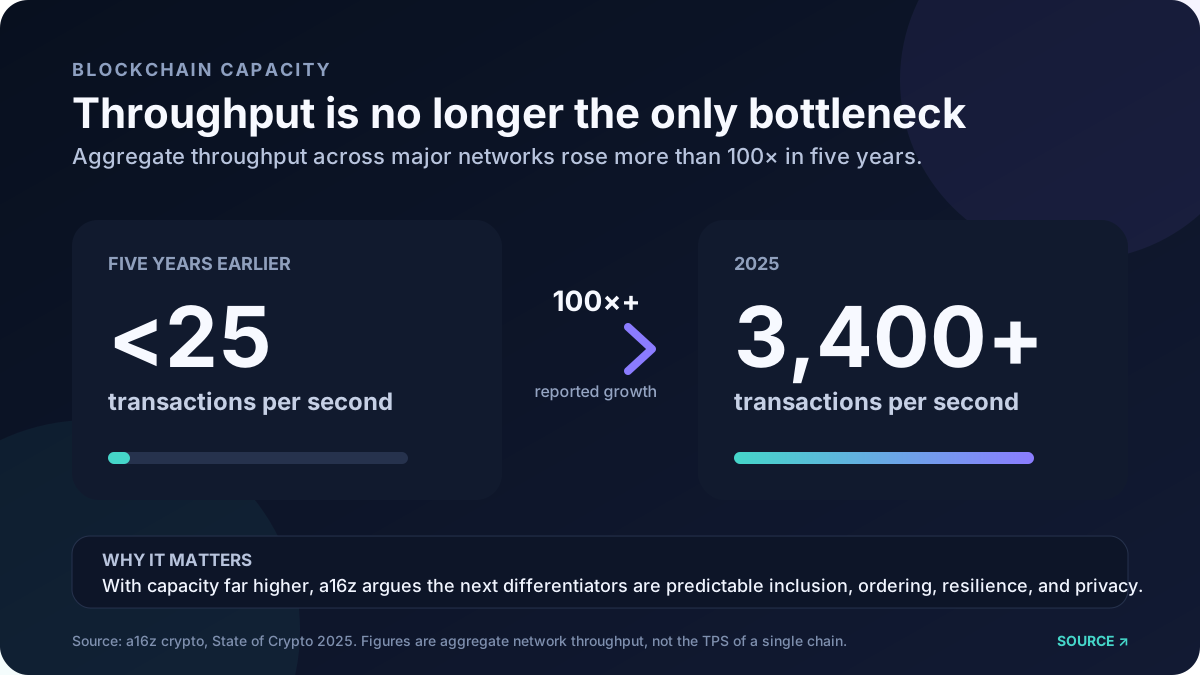
There has been a significant improvement in blockchain capabilities. In its 2025 State of Crypto report, a16z reported that combined throughput across the major networks has increased by more than 100 times over the past five years, going from less than 25 transactions per second to over 3,400 transactions per second. Its September blog post stated that certain production systems were able to process tens of thousands of transactions per second.
However, speed in itself does not tell traders when a transaction will be processed. Payments can cope with a delay of one second, but markets are not able to tolerate it, especially during periods of rapid price changes.
How a fast chain can still execute badly
The issue with using on-chain order books is illustrated by a16z. Suppose the Federal Reserve makes an announcement that causes prices to spike. Market makers will move fast to cancel outdated prices and replace them. If these cancellations are not delivered on time, arbitrageurs will use the information from the old prices to profit before the market makers are able to place their new orders and will incur losses.
The company looked into the matter in its previous study on predictable onchain execution.
This risk raises the possibility of the market makers increasing spreads and hurting participants overall with worse prices and lower liquidity. a16z specifies that the predictability is guaranteed by two criteria: valid transactions would be part of the process and would be placed according to the rules that can be understood in advance by participants.
Researchers of a16z have also come up with the idea of Strong Chain Quality, which allows the stakeholders to have guaranteed access to parts of each block, and thus, limits the influence of one block proposer or other participants in the process.
The reordering risk regulators already flagged
The issue is necessarily linked to maximal extractable value (MEV), whose holders make profits on transactions by changing orders, including or excluding transactions. A well-known example would be a sandwich attack, where an attacker executes a transaction just before and just after a transaction made by an innocent user to profit from the resulting price movement.
In June 2022, the Bank of International Settlements cautioned that validators of blockchain transactions might utilize transaction sequencing in order to engage in front-running and sandwich trades that would not be allowed in traditional markets.
In December 2023, IOSCO also highlighted market integrity and protection of investors through its nine policy recommendations regarding decentralized finance in its report.
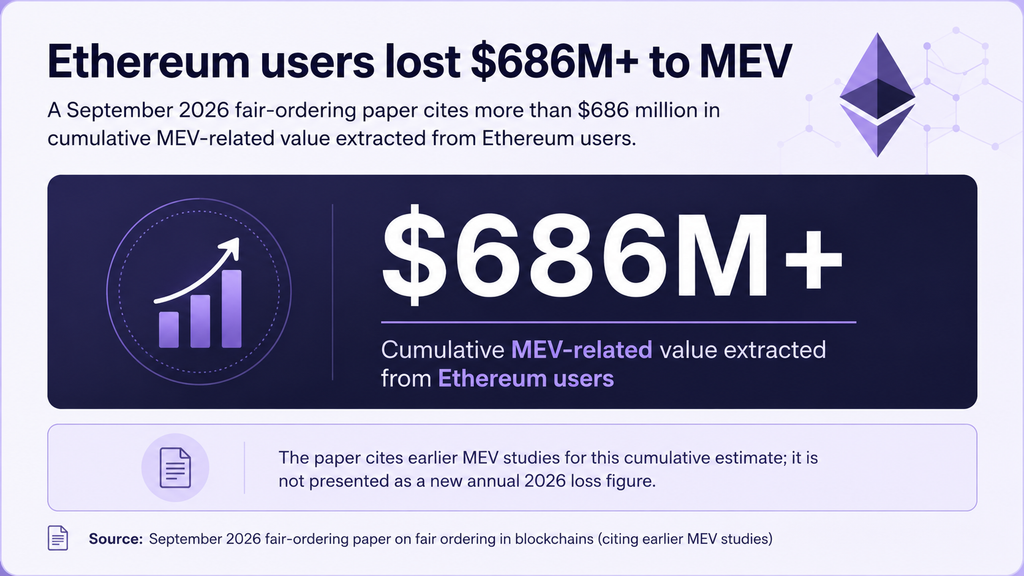
A paper concerning fair ordering written in September 2026 reports the problem of unfair order of transactions and MEV as having stolen more than $686 million from Ethereum users, with this work citing for the cumulative figure a previous MEV study instead of presenting it anew as the 2026 loss total.
What it means for institutions coming onchain
The stakes grow as more capital moves onchain. Cryptopolitan previously reported that malicious sandwich activity had become a small share of Solana blockspace activity as the network adopted more efficient ordering, private transaction routing, and confidential execution.
Malicious extraction now represents a very small fraction of blockspace activity, while the majority of transaction ordering value reflects legitimate competition for inclusion and speed.
— Lucas Bruder, co-founder and CEO of Jito Labs
a16z presents a more generalized argument for this transition. It is likely that only those chains that can provide fairness and efficiency of execution under stress can attract institutional order flow and, thus, deep enough liquidity. a16z argues that the necessary protocols are more complex than the currently employed technologies, while best order execution mechanisms are still ‘work in progress’.
If you're reading this, you’re already ahead. Stay there with our newsletter.
Recommended Articles


