


The 12 Best Crypto API Providers for Developers in 2026
Choosing the right API is a critical decision for any crypto project, whether you’re building a portfolio tracker, a wallet, a DeFi analytics dashboard, or a remittance platform. The best crypto API isn’t just about providing data; it’s about delivering accurate, low-latency, and complete functionality that accelerates development, not hinders it.
This guide breaks down the top 12 crypto API providers, comparing them across the dimensions that matter: data coverage, reliability, developer experience, and cost. We will directly compare market data providers like CoinStats with more specialized services like Transak and MoonPay Commerce. We will also highlight the CoinStats API, detailing its specific offerings in wallet and exchange connection aggregation, portfolio tracking, and real-time market data. We’ll analyze their strengths and weaknesses to help you select the ideal partner for your specific goals.
CoinStats API – Public API Docs
The CoinStats API stands out as a powerful, well-rounded choice for developers seeking the best crypto API for building applications that require deep, aggregated user data. Rather than specializing in a single data vertical, such as market prices or on-chain analytics, CoinStats provides a unified, full-stack platform. It acts as a single integration point for accessing wallet balances, exchange data, DeFi positions, NFT holdings, and market metrics, backed by an ecosystem that already supports millions of users.
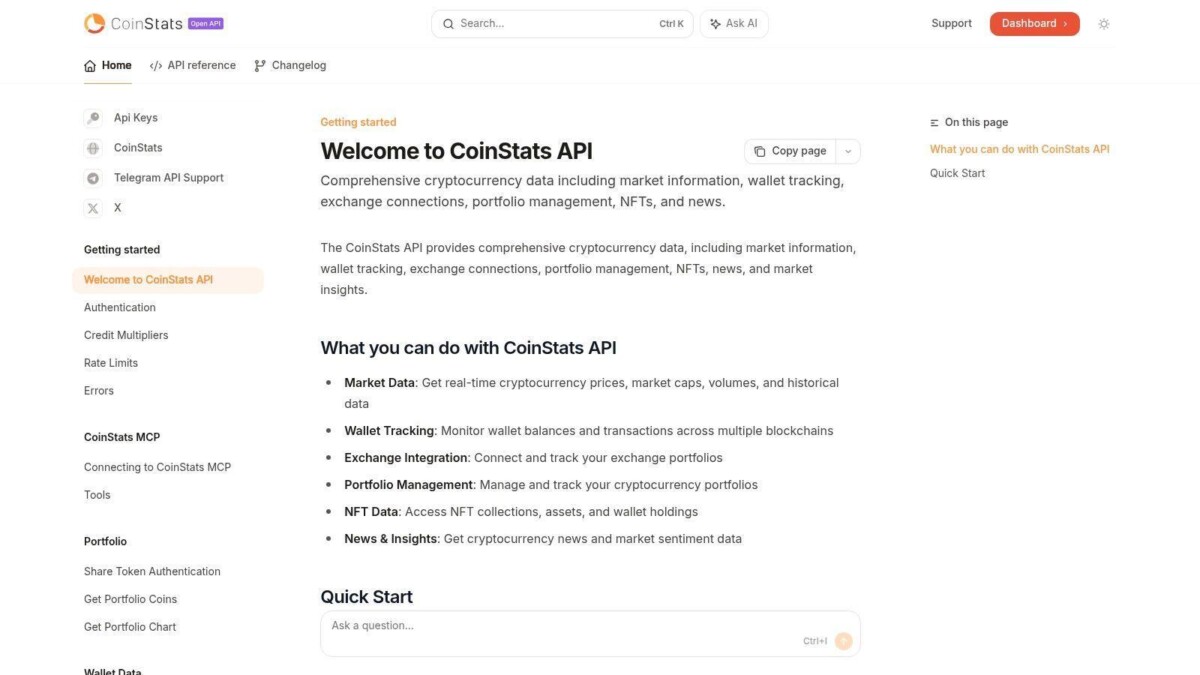
This approach is fundamentally different from many competitors who focus either on raw market data (like price feeds) or siloed on-chain information. CoinStats delivers an application-ready layer, perfect for developers building portfolio trackers, financial dashboards, or any service needing a complete view of a user’s crypto assets. The API directly exposes the infrastructure powering the popular CoinStats app, which connects with over 300 exchanges and wallets and tracks more than 1,000 DeFi protocols.
Key Strengths and Use Cases
The primary advantage is its breadth of data. A single API key unlocks access to:
- Aggregated Portfolio Tracking: Connect EVM, Solana, or Bitcoin xPub addresses to pull balances, transaction histories, and P&L analytics. This is ideal for building custom dashboards or tax reporting tools.
- Real-Time and Historical Market Data: Access live prices, market caps, and historical charts for over 20,000 cryptocurrencies. This data is essential for trading bots, analytics platforms, and alert systems.
- DeFi and NFT Data: Go beyond simple coin balances by retrieving data on staked assets, liquidity pool positions, and NFT valuations from multiple chains.
- News and Sentiment Feeds: Integrate curated crypto news directly into an application to provide users with market context.
The onboarding process is designed to help developers quickly evaluate the platform. The public documentation is clear, with in-page API key generation and direct links to pricing tiers. This transparency allows teams to assess costs and rate limits up front, a critical step in planning production-level applications. This practical approach is a key differentiator from APIs that hide pricing behind sales calls or have opaque usage limits.
Limitations and Considerations
While incredibly powerful, the platform’s scope can introduce complexity. Integrating multiple data points, such as combining a user’s exchange accounts with their self-custody wallets for a complete financial picture, requires careful implementation. Developers new to this type of data aggregation may face a learning curve to correctly map all the moving parts.
Furthermore, while a free trial is available for evaluation, applications with significant user volume or those needing the most advanced features will require a paid plan. Teams must factor these subscription costs into their operational budget.
Our Take: The CoinStats API is the definitive choice for developers building user-facing applications that require a holistic view of crypto assets. Its ability to consolidate data from exchanges, wallets, and DeFi protocols into a single, cohesive API makes it an exceptional tool for anyone serious about crypto portfolio management.
Pros & Cons
| Pros | Cons |
|---|---|
| Broad Ecosystem Coverage: The API connects with over 300 exchanges and over 1,000 DeFi protocols and blockchains, providing an overview of a fragmented portfolio. | API Sync Issues & Disconnects: Users often report occasional data synchronization issues, such as delayed updates. |
| Enhanced Security (Read-Only Access): CoinStats encourages the use of API keys with only read permissions. | Cost Limitations: Advanced API features, including the ability to connect to many exchanges, require a paid Premium subscription. |
| Simplified Tax Reporting: The aggregated API data can be exported, making it easier to prepare tax records and analyze overall portfolio performance. | Setup Complexity: While not technically difficult, configuring multiple API keys across various exchanges and wallets can be time-consuming. |
Visit CoinStats API Docs
ChangeNOW (B2B) API
ChangeNow.io has established itself as a premier instant crypto exchange, and its API is a powerful tool for developers looking to integrate seamless swap functionality into their platforms. It provides a non-custodial gateway for executing cross-chain transactions without requiring users to register or undergo lengthy verification processes.
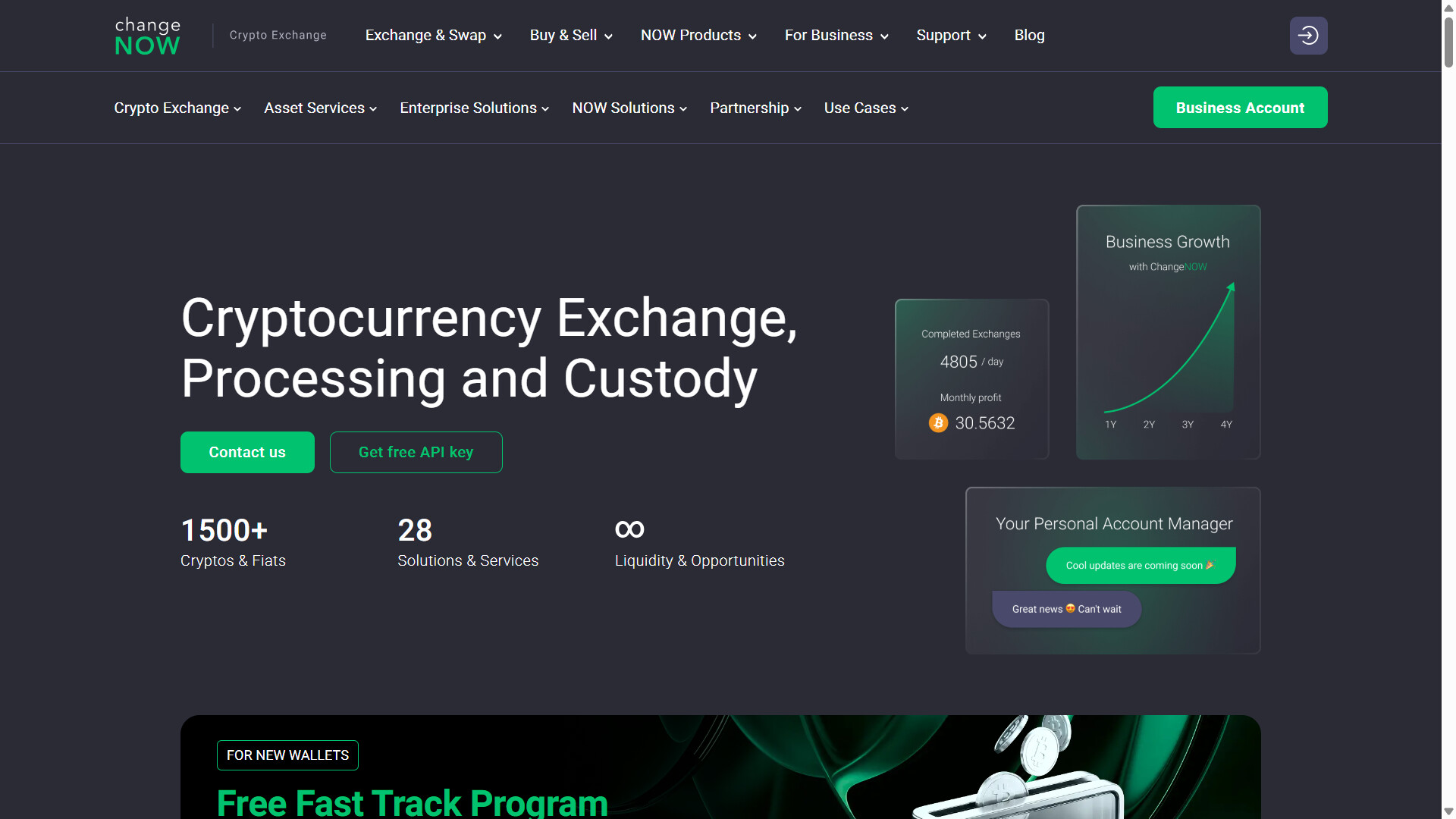
What sets ChangeNow Crypto API apart is its focus on simplicity and “limitless” exchange possibilities, making it a go-to for wallet providers, dApp developers, and payment gateways. The API is built around a clean, developer-friendly RESTful interface designed for high-velocity transaction processing.
Key Features & User Experience
The ChangeNow API enables quick integration of fixed- or floating-rate swaps across hundreds of assets. Unlike market data APIs, ChangeNow is action-oriented. It handles the complex backend logistics of liquidity sourcing and transaction execution across multiple decentralized and centralized platforms.
- Asset Versatility: Supports instant swaps for over 1500+ cryptos, including popular coins and niche tokens, with no hidden fees.
- Ease of Integration: Offers a “white-label” solution, allowing businesses to maintain their brand identity while leveraging ChangeNow’s liquidity and settlement engine.
- Security & Compliance: As a non-custodial service, it does not store user funds, and it features automated risk management systems to ensure transaction safety.
While ChangeNow is an industry leader in instant swaps, it is fundamentally a transactional tool. Developers looking for comprehensive market analytics or deep historical price charts might find it less suitable for those needs than data-heavy aggregators. Instead, it is best paired with a market data provider to create a full-featured trading environment.
Pros & Cons
| Pros | Cons |
| No Registration Required: Provides a frictionless experience for end-users by bypassing KYC for most standard swaps. | Variable Rates: While it offers fixed rates, market volatility can still affect floating-rate transactions. |
| High Liquidity: Aggregates liquidity from multiple sources to ensure competitive rates and fast execution. | Transactional Focus: Does not provide the depth of historical market data found in dedicated data APIs. |
| Generous Asset Support: One of the widest selections of tradable pairs available for instant integration. | Network Fees: Users are still subject to blockchain gas fees, which can be high during periods of network congestion. |
Website: https://changenow.io/api
Transak API
Transak provides financial applications with enterprise-grade payment rails to move value across crypto and fiat currencies. Transak’s artillery includes: customizable white-label on- and off-ramps, named virtual bank accounts, built-in KYC flows, 1-tap checkouts through Apple Pay, headless cards, and handled compliance.
Key Features & User Experience
The Transak API gives you full control over how your application looks and feels while it handles the backend. This is crucial for businesses that want a unique brand identity. The API also provides a KYC verification service that lets you import your KYC via KYC Reliance. Webhooks and WebSockets via the API provide developers with live updates and seamless integration with your system.
- Data Coverage: Delivers on/off ramps for over 136 assets across over 45 networks. Supported fiat payment gateways include Cards, bank transfer, SEPA, Apple Pay, and more.
- Pricing & Access: No predetermined fee tiers; the Transak team reviews your product and business needs to provide a tailored offer.
- Use Cases: Best for global remittance companies, neobanks, crypto wallets, and other applications that require digital assets payment rails.
While Transak is a payments powerhouse, its focus differs from that of market data APIs like CoinStats, which can aggregate complex DeFi positions and transactions. While this may look like a con, it gives Transak a unique positioning in the market.
Pros & Cons
| Pros | Cons |
| Wide coverage: Supports 136+ cryptocurrencies across 45+ blockchains in 165+ countries. | Mandatory KYB: Identity verification is required, which can reduce conversion rates and frustrate privacy-focused users. |
| Trusted integrations: Used by MetaMask, Trust Wallet, Ledger, Phantom, Uniswap, Bitget. | No advanced trading features: no order books, swaps, or margin trading. |
| Multiple fiat payment methods: Cards, bank transfers, Apple Pay, SEPA, and local rails. | Reduced control: Some compliance and flow decisions are dictated by Transak. |
Website: https://transak.com/
Moonpay Commerce
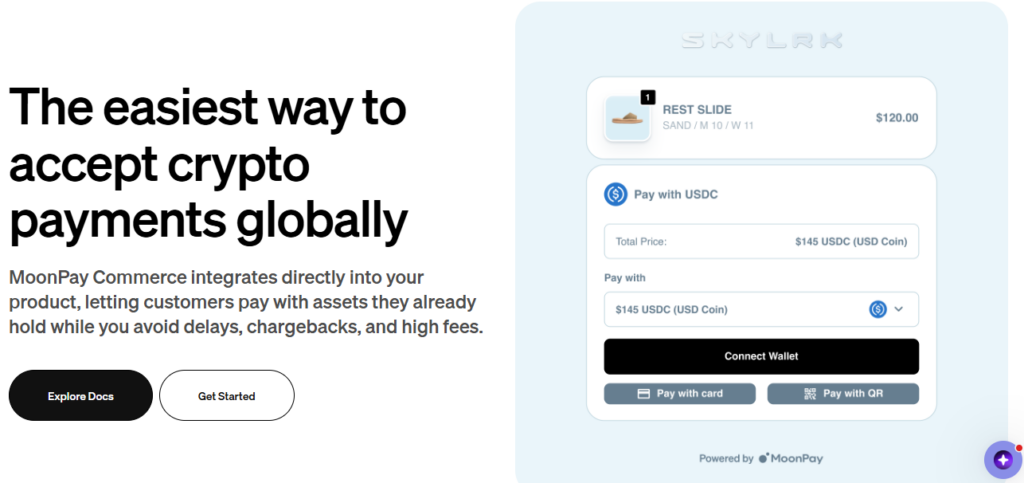
Moonpay Commerce API integrates with your product, letting customers pay with the assets they already hold. On the backend, Moonpay converts crypto to fiat (USD, EUR, GBP) or other crypto, depending on your requirements. Moonpay saves you the hassle of dealing with intermediaries or card routing for payments made. Moonpay APIs are headless, giving developers the flexibility to build apps without being tied to a specific frontend. Webhooks enable real-time conversion updates and seamless integration.
Key Features & User Experience
MoonPay Commerce API helps your business avoid delays, chargebacks, and high fees. In practice, they enable direct buyer-to-merchant payments, reduce processing costs, and help scale your business to over 500 million people who hold crypto.
- Data Coverage: Exposes your business to millions of people who hold crypto. Payments can settle in fiat (USD, EUR, GBP) in supported regions. The platform already boasts over 6,000 integrated businesses.
- Pricing & Access: MoonPay Commerce API integration is free to get started. You only pay fees when you actually process transactions. Fees are charged per transaction (1-2%). High-volume merchants can request custom pricing.
- Use Cases: Best application areas include crypto deposits, crypto checkout, Pay links, and pay-with-card functionality.
Moonpay Commerce gives you everything you need to accept and settle crypto payments under one platform in supported regions.
Pros & Cons
| Pros | Cons |
| Wide payment options: Supports multiple fiat and crypto payment options | Regional restrictions: Some jurisdictions are blocked due to regulations. |
| Fast transactions: Instant settlement for merchants | High fees: 1-2% fees could deter small businesses with low volume |
| 24/7 customer support via chat | Mandatory KYB: Identity verification is required, which can reduce conversion rates and frustrate privacy-focused users. |
Website: https://www.moonpay.com/business/commerce
CCData (formerly CryptoCompare)
CCData, formerly known as CryptoCompare, has established itself as a go-to source for institutional-grade digital asset data. As a regulated, FCA-authorized provider, it delivers market reference pricing, indices, and exchange data via its API, tailored for organizations requiring benchmark-grade datasets and clear licensing for compliance-heavy applications. This focus on regulatory alignment and data integrity makes it a standout choice for financial institutions and commercial projects.

Key Features & User Experience
CCData provides a powerful API for spot, derivatives, and reference pricing products, including its well-regarded CCIX index family. The platform’s main differentiator is its clarity on data usage rights; it offers a free, non-commercial license with specific terms and separate commercial packages for redistribution, providing essential legal certainty for business clients. This approach is distinct from APIs built primarily for individual portfolio management.
- Data Coverage: Specializes in benchmark and reference pricing, historical trade data, and order book feeds across numerous exchanges.
- Pricing & Access: Free usage is permitted for non-commercial purposes under a specific license. Commercial and enterprise packages, which are necessary for redistribution or business use, require contacting the sales team for custom pricing.
- Use Cases: Ideal for financial institutions building trading products, asset managers creating indices, and compliance teams needing auditable data sources.
While CCData is a market leader for regulated, redistributable market data, it serves a different purpose than a portfolio-centric service like the CoinStats API. The CoinStats API, for example, is specifically designed to unify user transaction histories and DeFi positions from a wide array of wallets and exchanges, offering a direct solution for building consumer-facing portfolio trackers rather than institutional benchmarks.
Pros & Cons
| Pros | Cons |
|---|---|
| Strong Institutional Credibility: FCA authorization and benchmark products provide high trust. | Less Transparent Commercial Pricing: Requires direct sales contact for commercial packages. |
| Clear Licensing: Detailed terms for non-commercial and commercial use aid legal compliance. | Not Ideal for Hobbyists: The commercial focus and sales process may be a barrier for individual developers. |
| Benchmark-Grade Data: Provides high-integrity, auditable datasets. | Focus on Market Data: Lacks features for aggregating personal portfolios from various sources. |
Website: https://www.ccdata.io/
CoinAPI
CoinAPI carves out a niche by providing unified, high-fidelity market data for systematic traders and financial institutions. It aggregates information from over 400 exchanges, standardizing it into a single, coherent format. This approach is invaluable for developers building trading bots, backtesting strategies, or performing detailed market analysis, as it removes the significant overhead of integrating with each exchange’s unique API.
Key Features & User Experience
The service delivers data through multiple protocols, including REST, WebSocket, and even FIX, which is a standard in traditional finance. This flexibility makes it adaptable to a range of architectures, from simple web applications to high-frequency trading (HFT) systems. The platform’s core strength is its granular tick-level and order book (L1-L3) data.
- Data Coverage: Delivers trades, quotes, OHLCV, and order book depth. Offers normalized symbology across all supported venues.
- Pricing & Access: Provides a free tier for initial testing, with paid plans based on usage and data requirements. Bulk historical data is available as flat-file downloads for extensive backtesting.
- Use Cases: Perfect for quantitative analysis, algorithmic trading, academic research, and building sophisticated financial instruments that require precise market data.
While CoinAPI is a top contender for market and trade data, it doesn’t serve the same purpose as a portfolio management tool. For developers who need to aggregate user wallet balances, DeFi positions, and transaction histories, the CoinStats API is a more suitable solution, as it is specifically designed for holistic portfolio tracking. CoinAPI remains focused on the market side, making it a powerful yet specialized choice for anyone seeking the best crypto API for trading applications.
Pros & Cons
| Pros | Cons |
|---|---|
| Deep Granularity: Tick-level data is excellent for HFT and quant workflows. | Costly at Scale: Heavy usage of tick-level or long historical data can become expensive. |
| Standardized Symbology: Reduces integration complexity across hundreds of exchanges. | Niche Focus: Less suited for general-purpose apps or portfolio tracking. |
| Multiple Protocols: Supports REST, WebSocket, and FIX for broad compatibility. | User-Portfolio Blind: Does not offer endpoints for tracking individual user assets across wallets. |
Website: https://www.coinapi.io/
Kaiko
Kaiko positions itself as the institutional-grade data backbone for the digital assets industry, a reputation solidified by its acquisition by Deutsche Börse Group. This platform delivers high-fidelity, normalized market data tailored for professional clients, financial institutions, and enterprise-level applications. Its focus is on providing clean, reliable, and granular data streams, including spot, derivatives, and full order book history, making it a premier choice for serious financial analysis and trading operations.
Key Features & User Experience
Kaiko’s offerings are built around delivering enterprise-level data with the compliance and redistribution rights required by regulated entities. The platform provides historical and live trade data, order book snapshots, and calculated analytics like VWAP (Volume-Weighted Average Price) across a huge number of exchanges. This attention to detail makes it one of the best crypto API solutions for institutional-grade products.
- Data Coverage: Deep historical order book and trade data across major centralized and decentralized venues, including derivatives.
- Pricing & Access: Pricing is entirely bespoke, requiring direct contact with the sales team. Plans are customized based on data needs, granularity, and usage rights.
- Use Cases: Ideal for building regulated financial products, quantitative trading strategies, academic research, and risk management systems.
Where Kaiko provides raw, granular market data for institutions, other services target different user needs. For instance, the CoinStats API is designed for developers building applications that require a unified view of a user’s entire crypto portfolio. It aggregates wallet balances, transaction histories, and DeFi positions from countless sources into one simple API call, a task outside Kaiko’s market-focused scope.
Pros & Cons
| Pros | Cons |
|---|---|
| Institutional Credibility: Backed by a major financial exchange group. | Enterprise Focus: Not suitable for hobbyists or small-scale personal projects. |
| High-Fidelity Data: Provides clean, granular order book and trade information. | Bespoke Pricing: No public pricing tiers; requires a sales consultation. |
| Compliance-Ready: Offers data with redistribution rights for commercial use. | High Cost: Assumed to be significantly more expensive than retail-focused APIs. |
Website: https://www.kaiko.com/
Glassnode
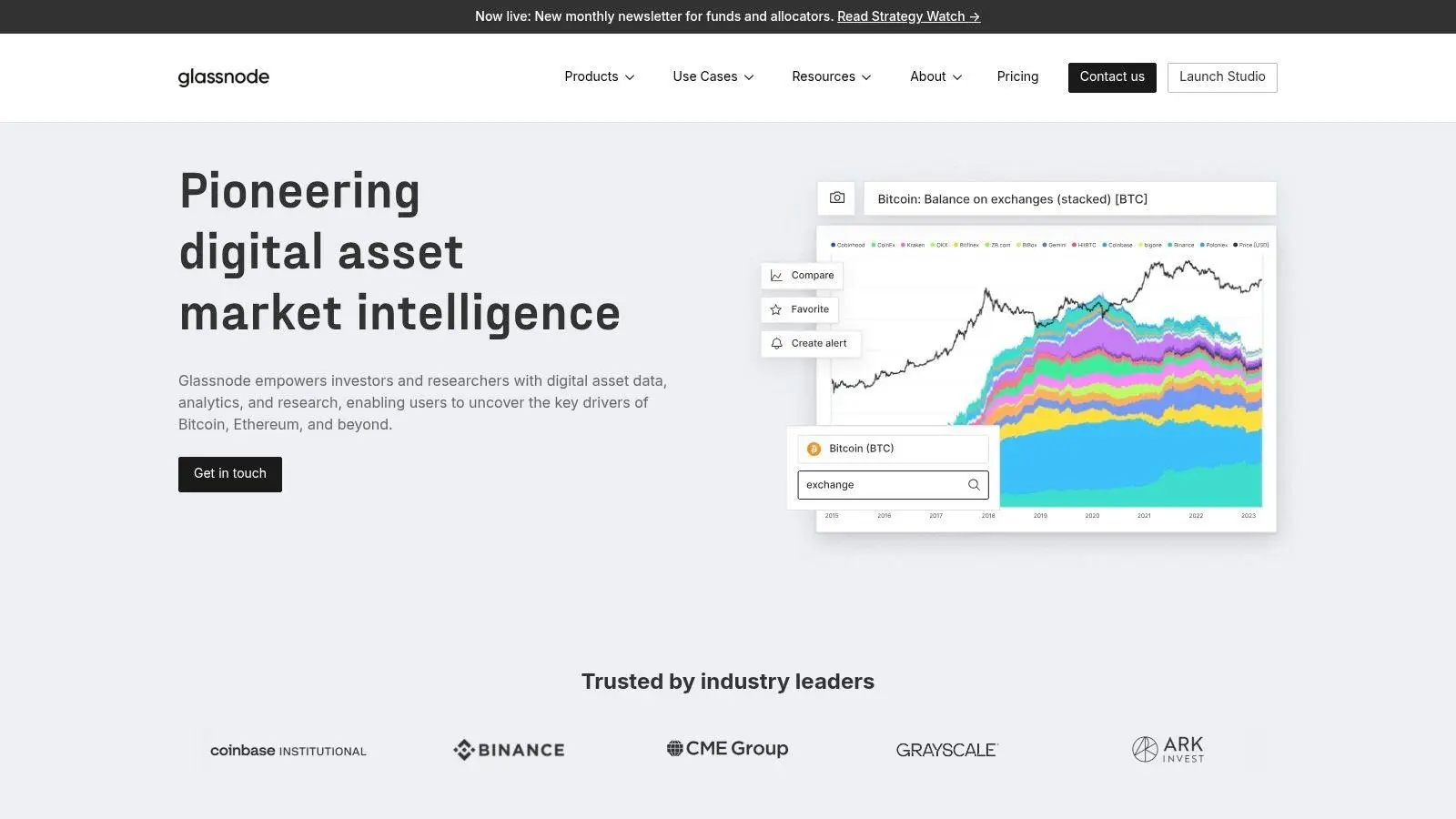
Glassnode is the go-to provider for serious on-chain intelligence, offering an API that serves as a direct pipeline to deep blockchain analytics. It’s a favored tool for institutional researchers, data scientists, and traders who need to look beyond simple price and volume. The platform specializes in creating high-level metrics from raw blockchain data, such as exchange flows, address activity, supply dynamics, and sophisticated indicators, making it an essential resource for understanding network health and macro market sentiment.
Key Features & User Experience
The Glassnode API delivers its powerful metrics via a standard REST interface, enabling programmatic access to the same data that powers its well-known Studio platform. Access is tiered, tied directly to Glassnode Studio subscriptions, which provide a clear path for users to scale their data consumption as their needs grow. This integration makes it simple for existing Studio users to begin pulling data for their own models and dashboards.
- Data Coverage: Focuses on in-depth on-chain metrics for major assets like Bitcoin and Ethereum, including miner data, entity-adjusted flows, and holder behavior.
- Pricing & Access: API access is an add-on to Glassnode’s paid Studio subscriptions (Advanced and Professional tiers). A limited selection of metrics is available for free.
- Use Cases: Perfect for building predictive trading models, conducting academic research on blockchain economics, or creating macro-level market dashboards.
While Glassnode provides unmatched depth in on-chain network analytics, it is not designed for personal portfolio management. For developers wanting to aggregate user wallet balances, transaction histories, and DeFi positions, a service like the CoinStats API is a more direct solution. CoinStats is built specifically for unifying data from countless wallets and exchanges into a single, clean view, a fundamentally different objective from Glassnode’s network-focused approach.
Pros & Cons
| Pros | Cons |
|---|---|
| Deep On-Chain Metrics: Provides access to well-documented, unique analytics not found elsewhere. | High Cost for Full Access: Enterprise-level pricing can be a significant investment. |
| Clear Upgrade Path: API access is cleanly integrated with platform subscriptions. | Limited Free Tier: Many advanced and real-time metrics are gated behind paid plans. |
| Strong Research Focus: Excellent for data-driven signal generation and macro analysis. | Niche Focus: Not suitable for general-purpose price data or personal portfolio tracking. |
Website: https://glassnode.com/
Covalent
Covalent offers a unified API designed to dramatically speed up development for projects needing deep blockchain data. Its core strength is providing decoded and indexed data from over 200 chains, eliminating the complex engineering required to interpret raw blockchain data. This makes it an excellent choice for teams building wallets, portfolio trackers, NFT galleries, and tax reporting tools who need a single, reliable data source.
Key Features & User Experience
The API uses a standard RESTful structure with endpoints that return rich, human-readable data for wallet balances, transaction histories, and token metadata. By providing fully decoded log events, Covalent saves developers significant time and effort, making it one of the more developer-friendly options for complex data retrieval.
- Data Coverage: Offers unified access to balances, transactions, and NFT data across more than 200 supported blockchains.
- Pricing & Access: Operates on a credit-based system. A free tier is available, with premium plans offering more credits and higher rate limits. It’s also accessible through partner marketplaces like QuickNode.
- Use Cases: Perfect for building multi-chain portfolio dashboards, NFT analytics platforms, and tools that require detailed transaction breakdowns.
While Covalent provides extensive decoded data for individual wallets, its focus is on raw blockchain activity. For developers who need a more aggregated and user-centric portfolio view that includes centralized exchange accounts, a service like the CoinStats API might be more suitable. CoinStats specializes in connecting directly to user exchange accounts and wallets, providing a unified financial overview that includes complex DeFi positions and profit/loss calculations, which is a different layer of abstraction. For an in-depth understanding of such positions, you can find more information in our section on DeFi.
Pros & Cons
| Pros | Cons |
|---|---|
| Unified & Decoded Data: Drastically simplifies development for multi-chain applications. | Credit Consumption: Certain queries can consume a significant number of credits, requiring careful management. |
| Broad Chain Support: Covers an extensive list of blockchains with a single API. | Focus on On-Chain Data: Does not natively integrate with centralized exchange accounts. |
| Flexible Access: Available directly or through various infrastructure provider marketplaces. | Requires Aggregation Logic: Developers must still build their own P&L and portfolio analytics layer. |
Website: https://www.covalenthq.com/
Alchemy
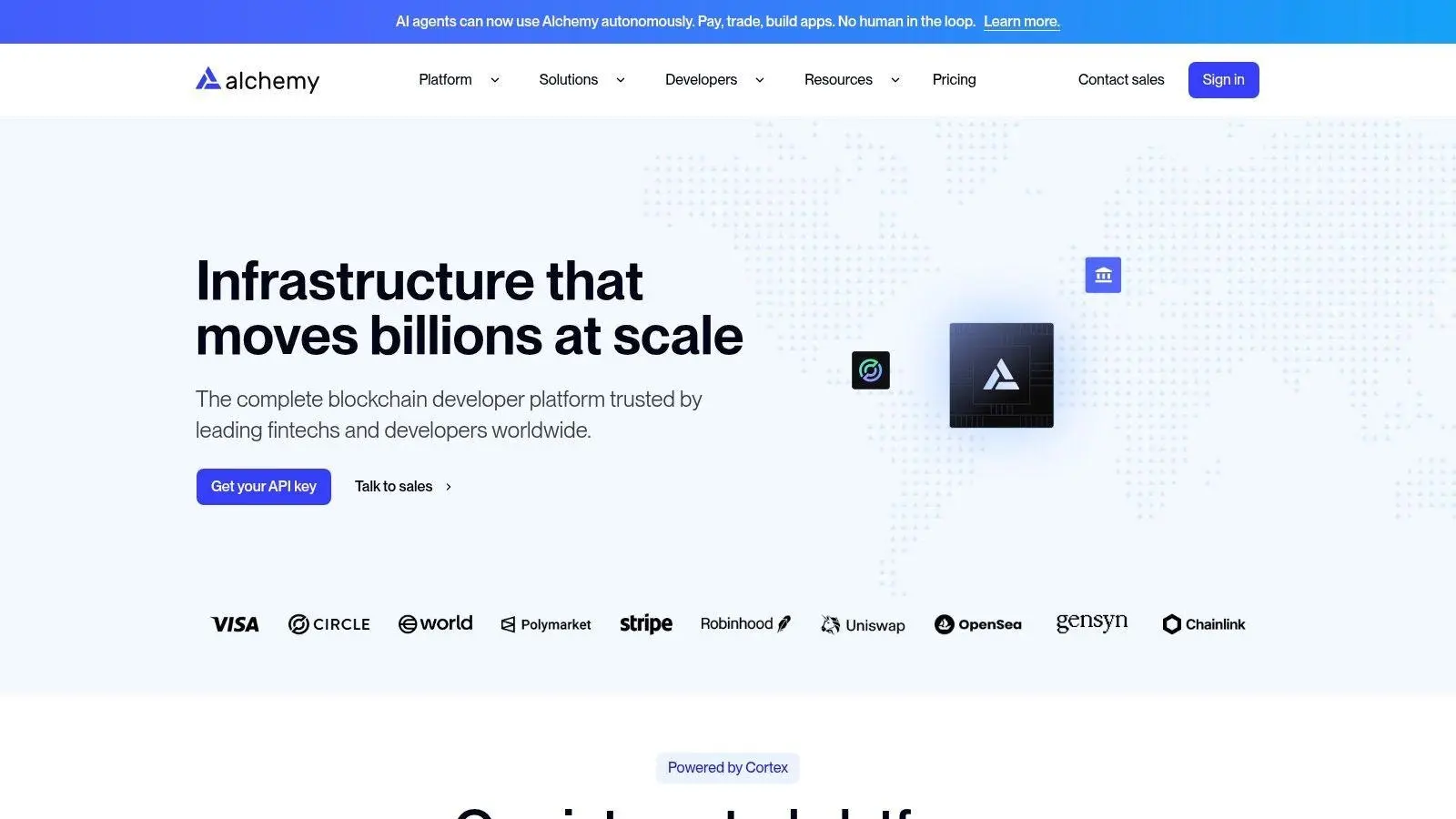
Alchemy is a foundational Web3 developer platform that provides the core infrastructure to build and scale decentralized applications. It’s less a market data provider and more of a supercharged node service, offering fast, reliable access to blockchain data via enhanced RPC endpoints. This makes it a go-to choice for developers building dApps, analytics tools, and DeFi protocols that require dependable blockchain connectivity without the hassle of running their own nodes.
Key Features & User Experience
The platform offers a suite of APIs, including specialized endpoints for NFT data, token metadata, and transaction history, which significantly simplifies common Web3 development tasks. Its developer dashboard provides robust monitoring, debugging, and analytics tools, while its generous free tier allows substantial development and testing before requiring an upgrade.
- Data Coverage: Direct access to raw blockchain data and enhanced APIs for tokens, transactions, and NFTs across multiple chains like Ethereum, Polygon, and Solana.
- Pricing & Access: A large free tier provides 30 million monthly compute units (CUs). Paid plans offer higher rate limits, dedicated throughput, and enterprise-grade support.
- Use Cases: Ideal for powering dApps, fetching wallet transaction histories, minting NFTs, and executing smart contract interactions.
While Alchemy provides the essential building blocks for on-chain data, developers needing a ready-made, unified view of a user’s entire crypto portfolio across wallets and exchanges may find it requires significant development. A service like the CoinStats API is built for that specific purpose, delivering aggregated portfolio balances and DeFi positions with a single integration, whereas Alchemy provides the low-level infrastructure to build such a system from scratch.
Pros & Cons
| Pros | Cons |
|---|---|
| Robust Tooling & SDKs: Simplifies developer operations with excellent dashboards and libraries. | Opaque Billing: The Compute Unit (CU) system can be hard to predict and optimize. |
| Scalable Infrastructure: Easily scales from small projects to enterprise-level applications with SLAs. | Potentially Costly: High-volume applications may see usage costs grow more quickly than with some fixed-price competitors. |
| Generous Free Tier: Excellent for getting started and building initial application versions. | Infrastructure Layer: Does not aggregate data from centralized exchanges. |
Website: https://www.alchemy.com/
Infura
Infura, a Consensys product, is a foundational piece of infrastructure for the Ethereum ecosystem and beyond. It provides developers with reliable and scalable access to blockchain networks without the cost and complexity of running their own nodes. Its long-standing reputation for stability has made it a go-to choice for countless dApps, wallets, and development tools that require a dependable connection to the blockchain.

Key Features & User Experience
Infura’s core offering is its RPC and WebSocket APIs, which allow applications to read blockchain data and submit transactions to the network. The platform’s credit-based pricing model offers clarity and flexibility, allowing users to select a plan that fits their needs and add more capacity as they grow. This makes it one of the best crypto API solutions for developers building directly on-chain.
- Data Coverage: Direct node access for multiple chains including Ethereum, Polygon, Arbitrum, and more, plus IPFS gateway services.
- Pricing & Access: A free Core tier is available for initial development, with paid Developer, Team, and Enterprise plans that scale based on daily request credits.
- Use Cases: Ideal for building dApps, interacting with smart contracts, submitting transactions, and accessing archive node data for deep historical analysis.
While Infura is excellent for direct on-chain interaction, its focus differs from portfolio aggregation APIs. Services like the CoinStats API are built to track and manage user assets across a wide array of wallets and exchanges, providing a unified financial picture. In contrast, Infura provides the raw, low-level access needed to build the applications that generate those transactions in the first place.
Pros & Cons
| Pros | Cons |
|---|---|
| Reliable, Battle-Tested Infrastructure: Proven stability and uptime for production applications. | Credit Model Requires Monitoring: Usage must be tracked to prevent service interruptions or unexpected costs. |
| Strong Documentation: Extensive guides and resources for developers. | High-Throughput Can Be Costly: Very demanding workloads might require custom enterprise plans. |
| Broad Ecosystem Support: Widely integrated across developer tools and frameworks. | Low-Level Focus: Does not provide higher-level abstractions, such as aggregated portfolio value or P&L. |
To effectively build on-chain, developers often need to consult network-specific resources and community forums. For deeper insights into managing assets across these chains, you might find guides on crypto portfolio trackers helpful.
Website: https://www.infura.io/
QuickNode
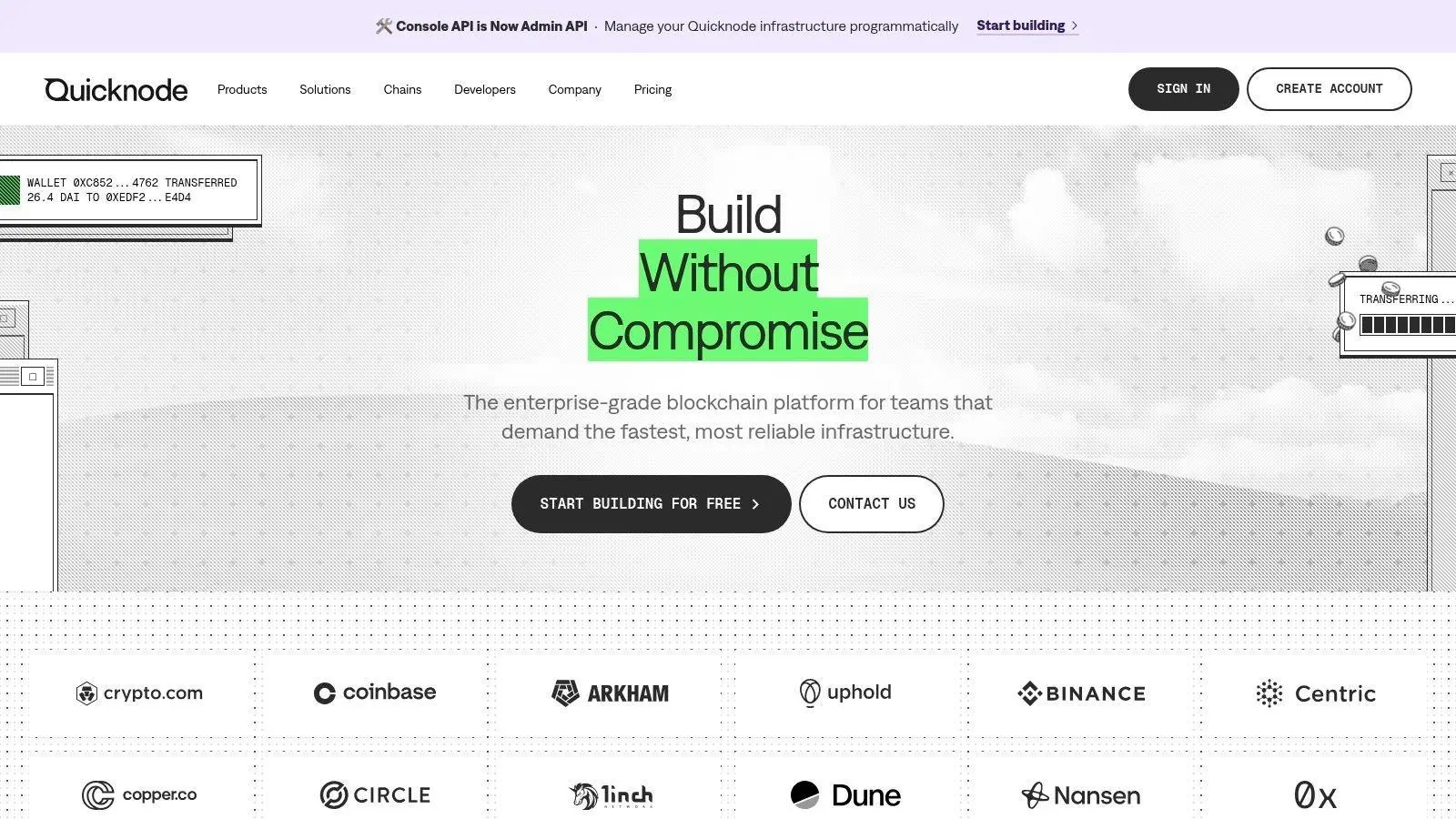
QuickNode has established itself as a premier infrastructure provider for developers requiring high-performance, reliable access to blockchain data. It specializes in offering fast RPC nodes across dozens of chains, making it a go-to choice for building high-throughput dApps, trading bots, and complex analytics platforms that demand speed and stability. Its global network and performance focus ensure low-latency connections for applications operating at scale.
Key Features & User Experience
The platform is praised for its excellent developer experience, with a clean interface, straightforward onboarding, and powerful tools. QuickNode provides dedicated endpoints, WebSocket support for real-time data streams, and an admin API for programmatic management of your infrastructure. This makes it one of the best crypto API solutions for professional teams managing production-grade applications.
- Data Coverage: Specializes in RPC access for a large number of blockchains, including archival data.
- Pricing & Access: Offers a free tier for development and several paid plans. Its models include credit-based usage and unique flat-rate RPS (requests per second) plans for predictable costs under heavy load.
- Use Cases: Ideal for dApp backends, DeFi protocols, NFT marketplaces, and trading bots that need direct, fast communication with blockchain nodes.
While QuickNode excels at providing foundational node infrastructure, its focus is different from portfolio-centric APIs. For instance, the CoinStats API is designed specifically to aggregate and normalize data from countless wallets, exchanges, and DeFi protocols into a unified portfolio view. QuickNode provides the raw access to query a chain, whereas CoinStats delivers the processed, user-level financial summary.
Pros & Cons
| Pros | Cons |
|---|---|
| Excellent Performance & Reliability: Known for fast, stable node connections. | Can Be Costly at Scale: High-throughput usage can become expensive if not on the appropriate plan. |
| Flexible Pricing Models: Flat-rate RPS plans offer predictable billing for high-volume users. | Infrastructure-Focused: Requires more development effort to build user-facing features than abstraction APIs. |
| Strong Developer Experience: Easy onboarding and powerful management tools. | No CEX Integration: Provides node access only; does not connect to centralized exchange accounts. |
Website: https://www.quicknode.com/
Bitquery
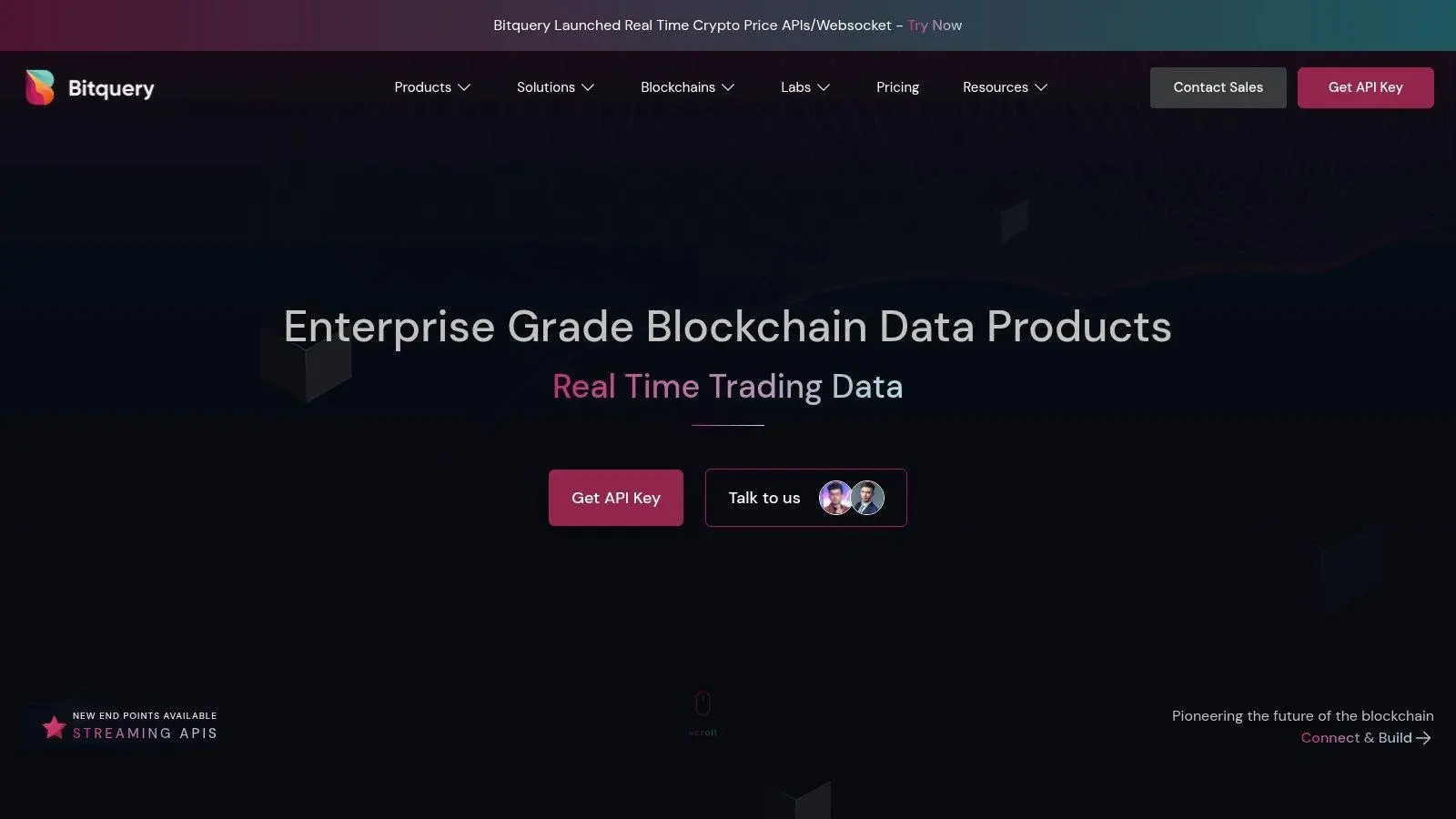
Bitquery positions itself as a powerful, API-first platform designed for deep, on-chain data analysis. It provides access to real-time and historical blockchain information through a flexible GraphQL interface, making it a go-to choice for developers building analytics tools, especially in the DeFi and NFT sectors. Its unique approach to data access through composable, cross-chain queries sets it apart for complex data retrieval tasks.
Key Features & User Experience
The platform’s core strength is its GraphQL API, which allows developers to request precisely the data they need, reducing overhead and complexity. In addition to GraphQL, Bitquery offers Kafka streams for integrating real-time blockchain events directly into data pipelines. This makes it an excellent candidate for building sophisticated monitoring and trading systems that require instant updates.
- Data Coverage: Specializes in detailed on-chain data, including DEX trades, token transfers, smart contract events, and NFT metadata across dozens of blockchains.
- Pricing & Access: Operates on a “Points” based pay-as-you-go model. A free developer tier is provided, and users consume points based on query complexity, offering a scalable pricing structure.
- Use Cases: Perfect for building DeFi analytics dashboards, tracking NFT mints and sales, or conducting academic research on cross-chain protocol interactions.
While Bitquery excels at granular on-chain data, its focus differs from portfolio management solutions. For developers needing to aggregate a user’s complete financial picture from multiple wallets and exchanges, the CoinStats API provides a more direct solution. CoinStats is built specifically to unify disparate transaction histories and DeFi positions into a single, user-centric view, a task distinct from Bitquery’s raw data-centric approach.
Pros & Cons
| Pros | Cons |
|---|---|
| Flexible GraphQL API: Allows for precise and composable data queries across many chains. | Learning Curve: Estimating query costs in “points” can be difficult for new users. |
| Strong DeFi/NFT Focus: Well-suited for detailed analytics of decentralized applications. | Requires Profiling: Complex queries may need optimization to manage point consumption effectively. |
| Real-time Streaming: Kafka integration is a significant benefit for live data pipelines. | No CEX/Portfolio Aggregation: Focuses purely on indexed on-chain data, not user portfolios. |
Website: https://bitquery.io/
Top 12 Crypto APIs Comparison
|
Product |
Core features |
Developer experience & quality ★ |
Pricing & value 💰 |
Target audience 👥 |
|
CoinStats API – Public API Docs 🏆 |
Real-time & historical prices, wallet/portfolio tracking, NFTs, P&L, DeFi (300+ wallets, 1k+ protocols) ✨ |
Strong onboarding: quick-start, in-page API key, public dashboard ★★★★ |
7-day trial; tiered premium (high-volume features) 💰★★★ |
Portfolio trackers, DeFi apps, teams syncing wallets & exchanges 👥 |
|
ChangeNOW API |
Instant crypto swaps, 1500+ assets, non-custodial, no account required |
Straightforward REST API, fast integration, minimal friction ★★★★ |
Free API access, revenue from spread/fees per swap 💰★★★ |
Developers building wallets, exchanges, or apps needing quick, KYC-free swap functionality 👥 |
|
Transak API |
Global fiat on/off-ramps, 136+ assets, 45+ chains, KYC/AML compliance, Virtual IBANs, Webhooks |
Enterprise-grade, whitelabel widget/API, trusted by 600+ platforms ★★★★ |
~0.6%+ buy fees, ~1% sell fees, enterprise pricing tiers 💰★★★ |
Wallets, exchanges, neobanks, remittance apps, platforms needing compliant fiat ramps 👥 |
|
MoonPay Commerce |
Fiat-to-crypto payments, Pay Links, Subscriptions, Wallet-to-wallet deposits, Checkout widgets |
Clean SDKs, strong documentation, easy integration for web & mobile ★★★★ |
Transaction-based fees (varies by region), free dev sandbox 💰★★★ |
Merchants, SaaS platforms, gaming apps, and e-commerce for crypto checkout 👥 |
|
CCData (CryptoCompare) |
Benchmark pricing, indices, exchange & derivatives data |
Institutional-grade, compliance-focused docs ★★★ |
Enterprise/bespoke pricing; sales contact required 💰★ |
Institutions, compliance-heavy redistributors 👥 |
|
CoinAPI |
Normalized trades, order books (L1–L3), ticks, REST/WS/FIX |
Deep granularity for HFT/quant workflows ★★★★ |
Usage-based; can be costly for tick/long history 💰★★ |
Quant trading, backtesting, low-latency systems 👥 |
|
Kaiko |
Normalized spot/derivatives/order-book, benchmarks & indices |
Enterprise integrations, high data quality ★★★ |
Custom enterprise contracts; contact sales 💰★ |
Institutional desks, asset managers, exchanges 👥 |
|
Glassnode |
On-chain metrics: flows, supply, addresses, fees, indicators |
Well-documented on-chain analytics ★★★ |
Studio tiers + API addons; premium metrics gated 💰★★ |
Researchers, macro analysts, on-chain data teams 👥 |
|
Covalent |
Decoded transactions/logs, balances, NFT & token metadata (200+ chains) ✨ |
Unified REST + SDKs makes integration fast ★★★ |
Credit-based quotas; marketplace offers (QuickNode) 💰★★ |
Wallets, portfolio trackers, tax & DeFi analytics 👥 |
|
Alchemy |
Enhanced RPC, NFT/token APIs, webhooks, monitoring & dashboards |
Robust tooling, generous free CUs, great DX ★★★★ |
CU-based billing; scalable but can feel opaque 💰★★ |
dApp devs, NFT/DeFi platforms needing reliable infra 👥 |
|
Infura |
RPC/WebSocket/archive access, IPFS gateway, gas API |
Battle-tested infra, clear tiers & add-ons ★★★★ |
Credit tiers + add-ons; monitor usage to avoid overage 💰★★ |
dApp infra, archive access, Ethereum-heavy apps 👥 |
|
QuickNode |
Flat-rate RPS, WebSocket, dedicated endpoints, global network |
Easy onboarding, admin API, predictable throughput ★★★★ |
Flat RPS plans or credits; predictable pricing 💰★★★ |
High-throughput dApps, trading bots, analytics 👥 |
|
Bitquery |
GraphQL + streams, cross-chain prices, DEX trades, NFTs |
Composable GraphQL; strong cross-chain querying ★★★ |
Points pay-for-use model; free dev tier 💰★★ |
DeFi/NFT analytics, cross-chain research & pipelines 👥 |
Integrating the Best Crypto API for Your Use Case
Selecting the right crypto API from a crowded field can feel daunting, but as we’ve explored, the decision boils down to your specific project needs. The market offers a wide spectrum of solutions, each with its own strengths and ideal applications.
Providers like CoinStats remain go-to choices for general market data, offering reliable price feeds and broad coin coverage that suit many basic applications. For those requiring deeper, more granular intelligence, specialized APIs like Glassnode for on-chain metrics or Kaiko for institutional-grade trade and order book data provide invaluable, focused insights. Meanwhile, node providers such as Alchemy, QuickNode, and Infura offer the foundational infrastructure for dApp development, providing direct, high-performance access to raw blockchain data.
Making the Right Choice: A Practical Framework
Your final selection should be strategic, based on a clear-eyed assessment of your goals. Avoid choosing an API simply because it’s popular; instead, align its capabilities with your project’s core function.
To find the best crypto API for your unique situation, consider these key questions:
- What is my primary use case? Are you building a simple price tracker, a complex DeFi analytics platform, a trading bot, or an NFT gallery? The answer will immediately narrow your options. A retail tracker needs broad market data, whereas a DeFi protocol requires granular on-chain state information.
- What data types are non-negotiable? List your essential data points: real-time prices, historical OHLCV, order book depth, wallet balances, transaction histories, NFT metadata, or specific on-chain metrics. Cross-reference this list against each API’s documentation to filter out non-starters.
- What is my development capacity and budget? Some APIs, like node providers, offer immense power but require more development effort to parse raw data. Aggregator APIs like CoinStats can significantly reduce development time by providing pre-processed, unified data. Factor in the long-term costs associated with pricing tiers, rate limits, and potential overage fees.
- How important is portfolio tracking? If your application needs to connect to user wallets and exchanges to provide a holistic view of their assets, an aggregator API is almost certainly the most efficient path. Building and maintaining individual integrations with hundreds of exchanges and dozens of blockchains is a massive undertaking. The CoinStats API, for instance, specializes in this, consolidating data from over 300 sources into a single, manageable endpoint.
From Selection to Integration
Once you’ve made your choice, the work shifts to implementation. Pay close attention to the documentation, rate limits, and authentication methods. Start with the free tier or trial to test the API’s reliability, latency, and data accuracy before committing to a paid plan. A well-documented API with active developer support and clear SDKs will make this process significantly smoother.
Ultimately, the best crypto API is not a one-size-fits-all solution. It’s the tool that provides the precise data you need, fits within your budget, and allows your team to build and scale efficiently. By methodically evaluating your requirements against the robust options available, you can confidently integrate a data solution that powers your application and delivers real value to your users. The right data feed is the foundation upon which great crypto products are built.
Recommended Articles


