


Bitcoin Weekly Forecast: Strategy sells, the market doesn’t care
- Bitcoin recovers modestly through Friday, trading near $64,000, holding strong around the 200-week SMA.
- Mixed spot ETF flows so far this week indicate indecisiveness while traders digest Strategy’s latest BTC sale.
- Geopolitical uncertainty persists despite a modest improvement, limiting BTC upside.
Bitcoin (BTC) reclaims $64,000 on Friday, extending a modest recovery while holding firmly above the key technical support zone so far this week. Mixed spot Exchange Traded Funds (ETFs) flows through Thursday reflect cautious institutional positioning. Meanwhile, traders have digested headlines about Strategy’s recent Bitcoin sale, highlighting the Crypto King’s resilience and deep liquidity. Easing US-Iran tensions improved risk sentiment toward the end of the week, while the fragile situation continues to weigh on market sentiment, capping BTC’s upside potential.
Mixed geopolitical sentiment offers limited relief to risk assets
Market sentiment remained mixed and cautious throughout the week as geopolitical developments in the Middle East continued to shape risk appetite. The week began on a negative note after Iran plans to introduce new service fees for ships passing through the strategically important waterway. Despite strong opposition from the US, Iran insisted that the fees are for security, vessel supervision, and environmental protection, rather than tolls.
Risk sentiment deteriorated further on Tuesday after an oil tanker was struck by an unidentified projectile, but later identified as Iranian, while passing through the Strait of Hormuz. US military unleashed a new wave of strikes against Iran in retaliation for Tehran’s attacks on commercial ships in the strategic waterway.
Iran retaliated by targeting US military installations and assets across Bahrain and Kuwait. Meanwhile, US President Donald Trump said on Wednesday that the ceasefire agreement with Iran was “over”, further fueling market uncertainty.
Market anxiety eased later in the week after Trump claimed on Thursday that Iran had called to make a deal with the US, raising hopes for a potential de-escalation in tensions. This modest improvement in sentiment erased BTC’s earlier-in-the-week losses as it extended its recovery toward $64,000 on Friday. However, traders should keep an eye on developments in the Middle East, as the fragile situation continues to pose a risk to market sentiment. Any renewed clashes between the US and Iran over the weekend could bring fresh selling pressure to risk-sensitive assets such as BTC.
Strategy’s sale tests Bitcoin market resilience
Strategy announced on Monday that it sold 3,588 BTC for $216 million to fund dividends on its Digital Credit. This news initially weighed on BTC, which corrected roughly 4%. However, the Crypto King recovered and closed Monday with mild gains, suggesting the selling pressure was largely absorbed.
Crypto Finance reported on Tuesday that transactions of this size are typically executed over-the-counter (OTC) and extensively hedged well before public disclosure. By the time the market receives the announcement, the underlying exposure has usually already been absorbed.
The report further noted that Bitcoin’s deep liquidity enables it to absorb sizeable transactions without causing significant market disruption, explaining the short-lived price correction.
In an exclusive interview, Dean Chen, Analyst at Bitunix Exchange, told FXStreet that “Strategy didn’t weaken the Bitcoin treasury model—it matured it. Selling a fraction of its holdings wasn’t a loss of conviction; it was proof that Bitcoin can function as a liquid corporate treasury asset.”
Chen, however, remains cautiously bearish on BTC in the short term, citing elevated US Treasury yields and stronger returns in equities; AI-related investments and IPOs still offer stronger return narratives and still-weak institutional inflows despite a modest improvement in spot Bitcoin ETF demand. He believes Bitcoin’s broader trend will depend on whether global investors increase allocations to risk assets rather than on Strategy’s sale alone.
In the long term, Chen expects Bitcoin to remain range-bound with a slight downside bias this week, as the market still lacks meaningful incremental capital and competition for global liquidity remains intense.
“I see $68,500 as the key near-term resistance level and $62,000 as the primary support. Unless macro conditions improve materially, I expect Bitcoin to finish the month modestly below current levels,” Chen concluded.
Indecision among institutional investors
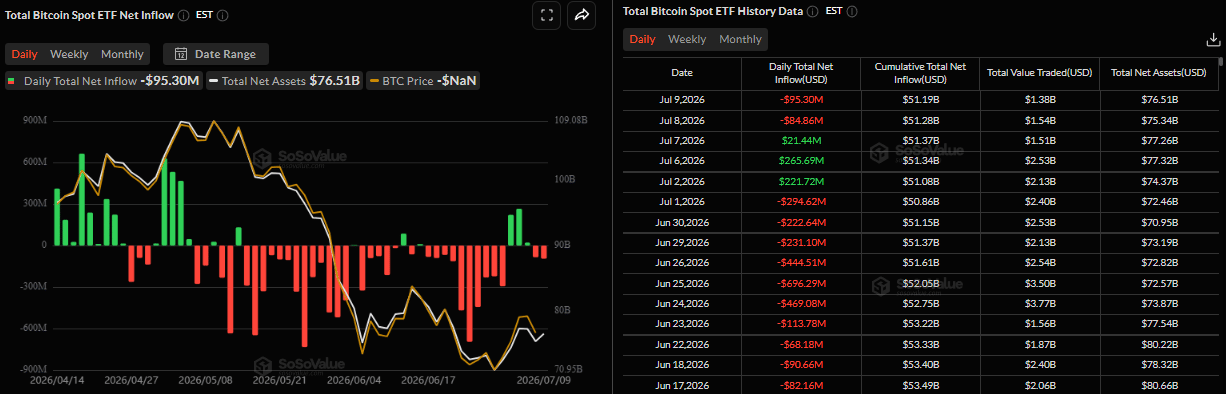
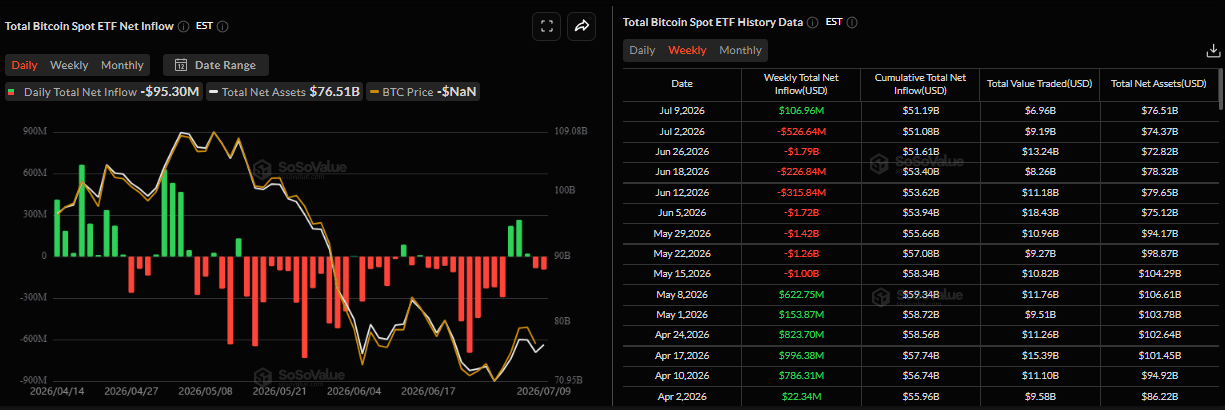
Institutional demand revived slightly over the first two days of this week, following several weeks of outflows. However, later in the week, SoSoValue data showed that spot BTC ETFs recorded two days of outflows, bringing net flows to a positive $106.96 million through Thursday, marking a slight improvement. If Friday’s flows remain positive, BTC would break the eighth week of steady withdrawals. This is an early sign of improving institutional demand, which could lift prices.
Cautious Fed limits BTC
On the macroeconomic front, the Federal Open Market Committee (FOMC) Minutes from the June 16–17 meeting were released this week and revealed that policymakers were divided over the direction of interest rates. The minutes reflected growing concern among Federal Reserve (Fed) officials over inflation just as worries about the labor market slightly receded.
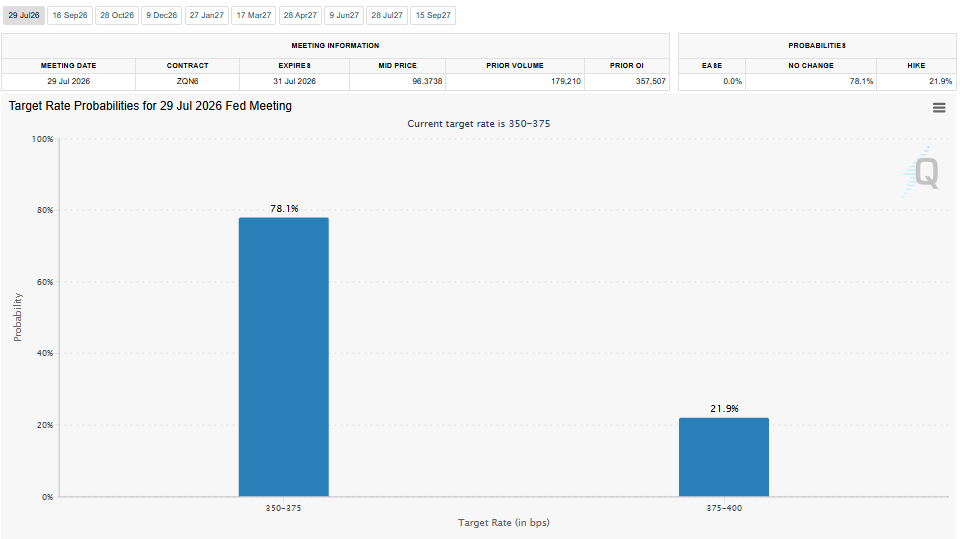
Following the release, swap traders are now pricing in roughly a 21.9% chance of a rate hike at the next Fed meeting in July, according to the CME FedWatch tool. The cautious policy outlook kept investors on the sidelines, limiting demand for risk assets, and Bitcoin has traded sideways so far this week.
Technical outlook: Still early to call a bottom
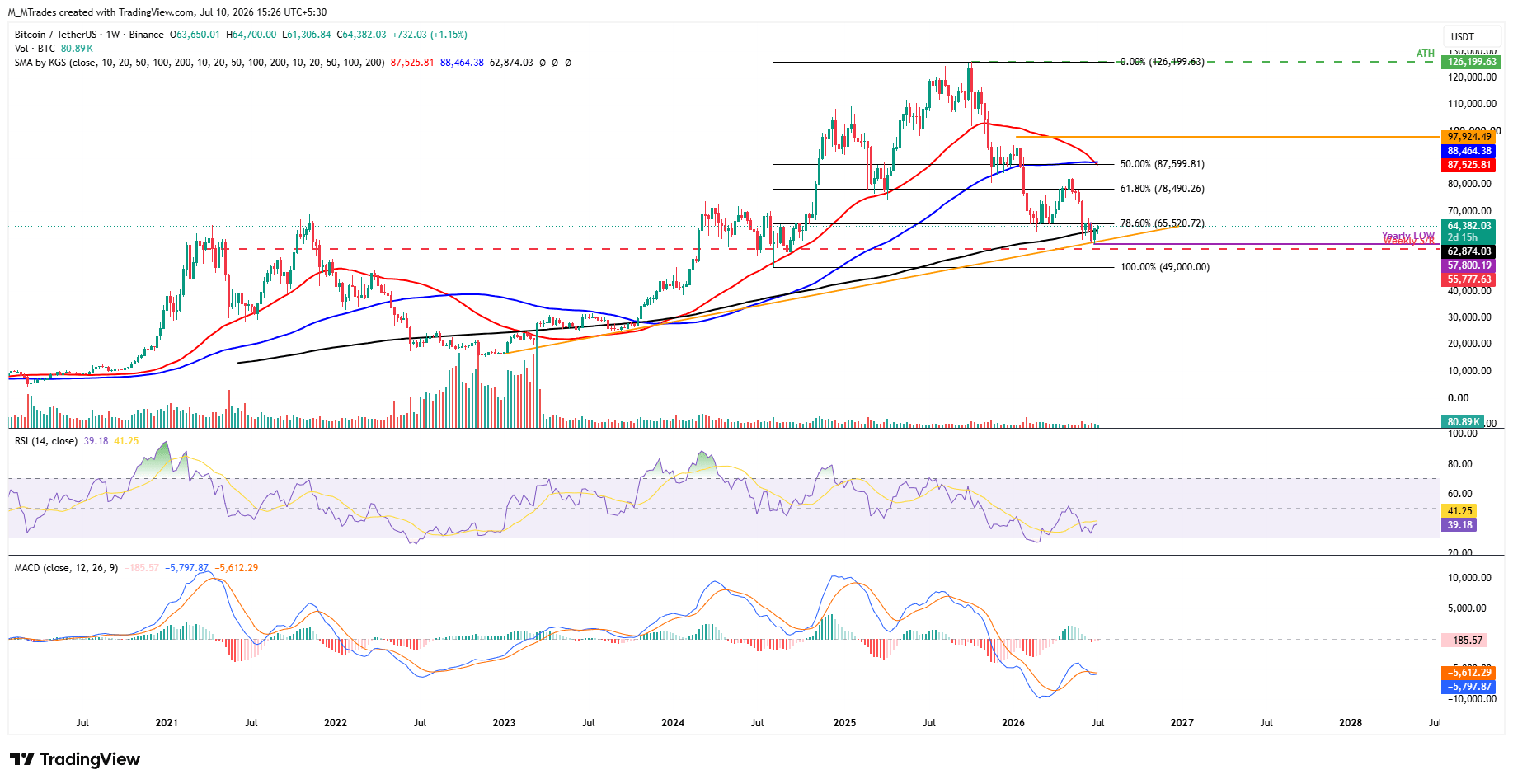
Bitcoin extends its slight recovery, reclaiming $64,000 on Friday after a 6.84% rebound in the previous week. BTC is finding support around the 200-week Simple Moving Average (SMA) at $62,874 after finding support around the ascending trendline (drawn by connecting multiple lows since January 2023) in the previous week.
If the 200-week SMA at $62,874 holds as support, BTC could extend gains toward the 78.60% Fibonacci retracement level at $65,520 (from the August 2024 low of $49,000 to the October 2025 record high of $126,199).
Momentum indicators on the weekly chart show signs of improvement: The Relative Strength Index (RSI) is hovering near 39, and a slightly negative but improving Moving Average Convergence Divergence (MACD) suggests downside momentum is losing intensity.
However, if BTC continues its correction and closes below the 200-Week SMA at $62,874, it could extend the decline toward the ascending trendline support at roughly $58,000.
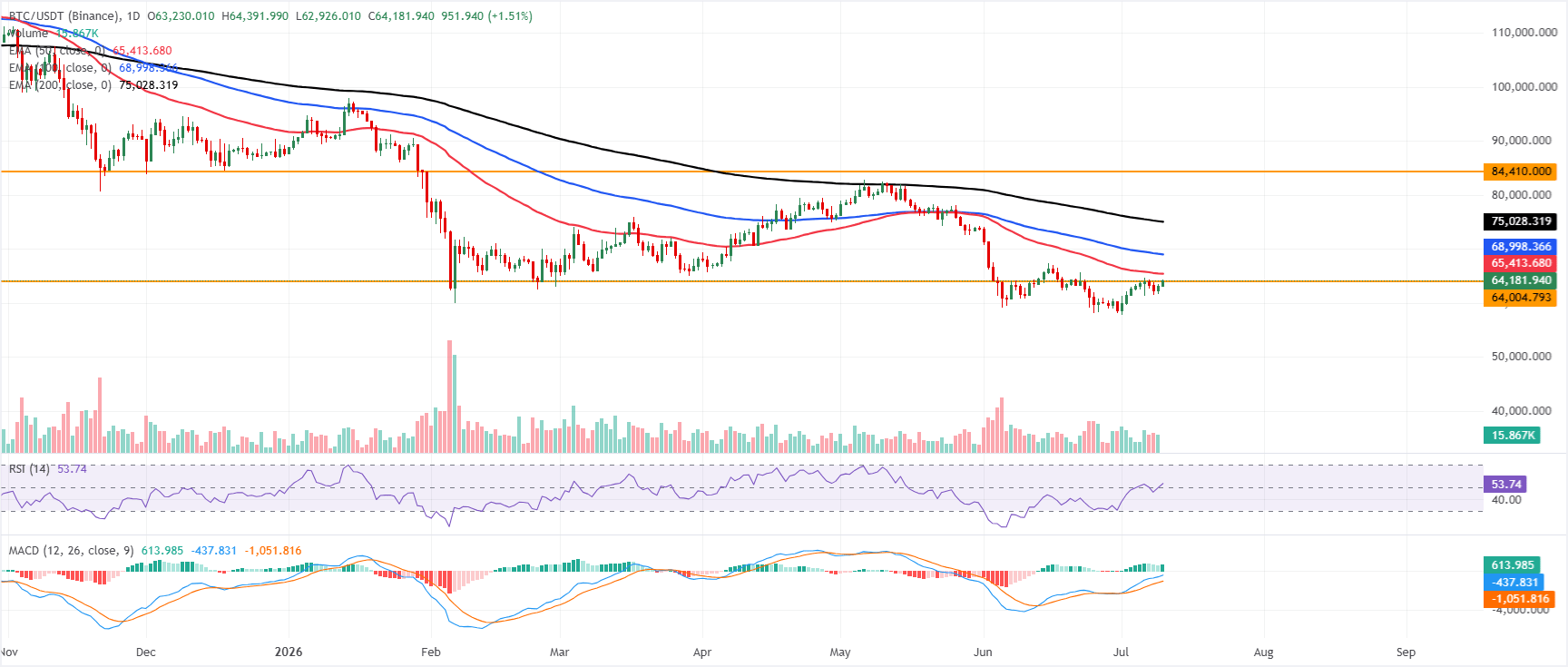
On the daily chart, the Crypto King is maintaining a capped tone, remaining below the 50-day, 100-day, and 200-day Exponential Moving Averages (EMAs), which all sit well overhead and continue to frame a still-dominant medium-term downtrend.
BTC is hovering just above horizontal support around $64,004. At the same time, a mildly positive RSI near 53 and a bullish MACD reading above zero suggest recovering momentum that has yet to overcome the prevailing overhead supply.
On the topside, initial resistance is seen at the 50-day EMA near $65,413, with further barriers at the 100-day EMA near $69,000 and the 200-day EMA near $75,029, ahead of a stronger horizontal cap at $84,410.
On the downside, immediate support comes at the horizontal level around $64,004; a sustained break below this floor would expose the $60,000 key psychological level on the chart as a potential demand zone.
(The technical analysis of this story was written with the help of an AI tool. Know more.)
Cryptocurrency metrics FAQs
The developer or creator of each cryptocurrency decides on the total number of tokens that can be minted or issued. Only a certain number of these assets can be minted by mining, staking or other mechanisms. This is defined by the algorithm of the underlying blockchain technology. On the other hand, circulating supply can also be decreased via actions such as burning tokens, or mistakenly sending assets to addresses of other incompatible blockchains.
Market capitalization is the result of multiplying the circulating supply of a certain asset by the asset’s current market value.
Trading volume refers to the total number of tokens for a specific asset that has been transacted or exchanged between buyers and sellers within set trading hours, for example, 24 hours. It is used to gauge market sentiment, this metric combines all volumes on centralized exchanges and decentralized exchanges. Increasing trading volume often denotes the demand for a certain asset as more people are buying and selling the cryptocurrency.
Funding rates are a concept designed to encourage traders to take positions and ensure perpetual contract prices match spot markets. It defines a mechanism by exchanges to ensure that future prices and index prices periodic payments regularly converge. When the funding rate is positive, the price of the perpetual contract is higher than the mark price. This means traders who are bullish and have opened long positions pay traders who are in short positions. On the other hand, a negative funding rate means perpetual prices are below the mark price, and hence traders with short positions pay traders who have opened long positions.
Recommended Articles


