


Bitcoin ETFs Score $167 Million as Wall Street Pulls Billions From Gold
US spot Bitcoin (BTC) ETFs recorded $167 million in net inflows on March 23, ending a three-day outflow streak, while SPDR Gold Shares (GLD) posted record monthly outflows.
SoSoValue data shows the daily figure, which extended a four-week positive streak for BTC spot products totaling approximately $1.53 billion through March 20.
The Correlation Flip Between BTC and Gold
CryptoQuant data showed the Bitcoin-to-gold correlation dropped to -0.88 on March 18. That marks the most negative reading since the FTX collapse in November 2022.
However, the context has reversed. In 2022, BTC was in freefall. Today, BTC is holding above $70,000 while gold is entering a bear market.
The Federal Reserve held rates in March and projected the benchmark at 3.4% through end of 2026. Elevated real rates raise the opportunity cost of holding non-yielding gold, pushing institutional capital toward assets with different risk profiles.
GLD recorded its largest single-day outflow since 2016 on March 4, with $2.91 billion exiting in one session. LSEG Lipper data showed global gold funds lost roughly $5.19 billion in the week through March 18. Money market funds absorbed $32.57 billion in the same period.
Institutional Flows Tell a Split Story
While Bitcoin ETFs saw $167 million inflows on Monday, their Ethereum counterparts saw $16.18 million in net outflows on the same day, marking four consecutive days of losses.
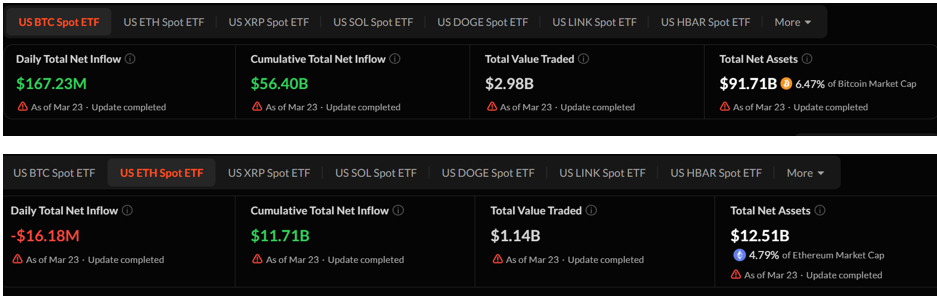 Bitcoin ETF vs Ethereum ETF Flows on Monday. Source: SoSoValue
The divergence between BTC inflows and ETH outflows adds a layer to the institutional rotation story.
Bitwise reported BTC and major crypto assets outperformed US equities and gold since March 1.
Meanwhile, the World Gold Council reported global gold demand exceeded 5,000 metric tons for the first time in 2025, with central banks buying 863 tons.
Bitwise flagged that gold has historically led BTC by four to seven months. Whether the current divergence represents a structural rotation or a borrowed rally will depend on how the Fed’s rate path and Middle East conflict develop through Q2.
Recommended Articles


