


Investing During Political Uncertainty: What History Actually Tells Long-Term Investors
Key Points
Stock prices are plunging, and recession risks are increasing.
However, the market's long-term outlook remains promising.
The right investment strategy can help you maximize your long-term returns, even if a recession is looming.
- 10 stocks we like better than S&P 500 Index ›
There's a lot going on in the world right now, and if you're feeling rattled by it all, you're not alone.
Stock prices are falling, recession fears are ramping up, and many investors are worried about what this means for their finances. Is it still safe to invest? Or should you hold off until the market stabilizes?
Will AI create the world's first trillionaire? Our team just released a report on the one little-known company, called an "Indispensable Monopoly" providing the critical technology Nvidia and Intel both need. Continue »
While no two bear markets or recessions are the same, history can give us an idea of how the market tends to perform during periods of political uncertainty -- and it has good news for investors.
Image source: Getty Images.
Is the U.S. headed for a recession in 2026?
Top economists at Moody's recently predicted a 49% chance for a U.S. recession to begin in the next 12 months, but whether it actually occurs will largely depend on oil prices and the war in Iran.
While we're in a unique political situation right now, many investors are drawing parallels to the early 2000s. Not only was the U.S. in another war in the Middle East at the time, but we also experienced the dot-com bubble burst after years of hype surrounding internet companies.
To be clear, we don't know whether an AI bubble is looming, and even if it is, it may not mirror the dot-com meltdown. We also don't know how long the war in Iran might last. But it could still be helpful to see how the market fared during the early 2000s to get an idea of what might happen next.
There's good and bad news for investors
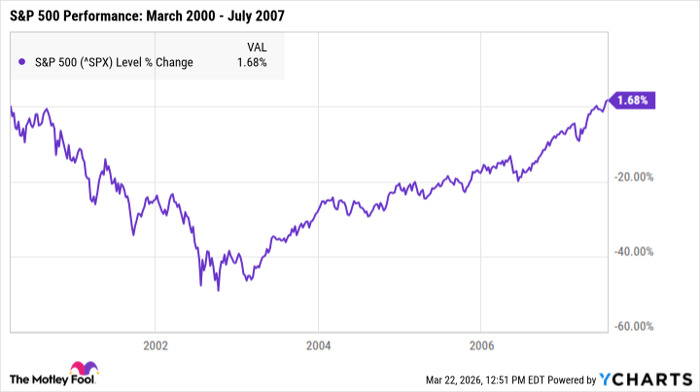
The bear market following the dot-com bubble burst in the early 2000s was one of the longest in U.S. history. The S&P 500 (SNPINDEX: ^GSPC) lost nearly half of its value between March 2000 and October 2002, and it wouldn't reach a new all-time high until mid-2007.
^SPX data by YCharts
Again, this was a particularly long bear market. The average S&P 500 bear market since 1929 has lasted approximately nine months, according to research from Bespoke Investment Group.
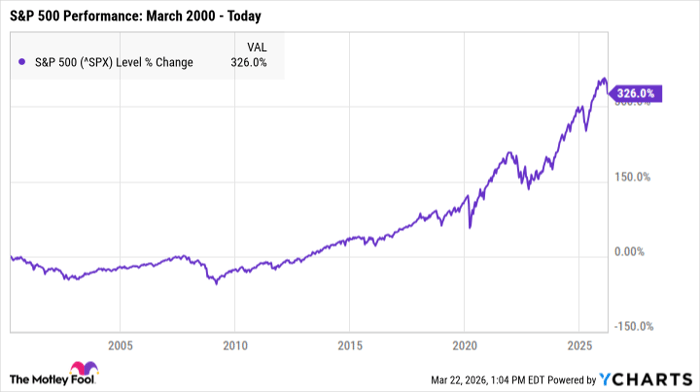
The good news for investors, though, is that even the worst recessions and bear markets are only temporary. Since March 2000, the S&P 500 has soared by 326%. In other words, if you'd invested $10,000 in an S&P 500-tracking fund at the very beginning of the dot-com bear market, you'd have around $42,600 by today.
^SPX data by YCharts
This isn't to minimize the impact of volatility in the early 2000s, as those years were rough for investors. But the market has proven time and time again that it can recovery from even the most severe recessions, going on to reach new record highs.
The best thing investors can do right now, then, is maintain a long-term outlook. If we're headed for a bear market or recession in 2026, it could potentially take years for the market to recover. But it will recover eventually, and those who ride out the storm will be well positioned to take advantage of the lucrative recovery period.
A silver lining right now
Nobody particularly enjoys market downturns. But the silver lining for investors is that they provide an opportunity to stock up on high-quality investments for a fraction of the price.
During the dot-com bubble burst in the early 2000s, the S&P 500 fell by nearly 50%. Another way of thinking of that, however, is that investors could buy S&P 500 index funds for 50% off their highest price. The further a stock's price drops, the deeper the discounts investors can snag.
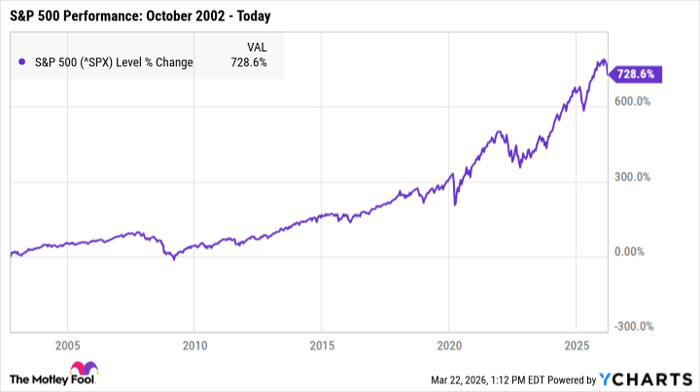
Those who continue to invest during recessions can not only save money by investing at lower prices, but they can also earn greater returns when the market bounces back. If you'd invested in an S&P 500 index fund in October 2002 -- when the index bottomed out -- you'd have earned total returns of nearly 730% by today.
^SPX data by YCharts
It's tempting to tap out of the market right now and wait for prices to rebound, but market slumps are incredible buying opportunities. By continuing to invest even when things are shaky, you can earn far more than if you only invest when the market is thriving.
The short-term future is uncertain, and that's intimidating. But if history proves one thing, it's that the market's long-term potential is lucrative. By staying invested for the long haul, you can set yourself up for potentially life-changing gains.
Should you buy stock in S&P 500 Index right now?
Before you buy stock in S&P 500 Index, consider this:
The Motley Fool Stock Advisor analyst team just identified what they believe are the 10 best stocks for investors to buy now… and S&P 500 Index wasn’t one of them. The 10 stocks that made the cut could produce monster returns in the coming years.
Consider when Netflix made this list on December 17, 2004... if you invested $1,000 at the time of our recommendation, you’d have $495,179!* Or when Nvidia made this list on April 15, 2005... if you invested $1,000 at the time of our recommendation, you’d have $1,058,743!*
Now, it’s worth noting Stock Advisor’s total average return is 898% — a market-crushing outperformance compared to 183% for the S&P 500. Don't miss the latest top 10 list, available with Stock Advisor, and join an investing community built by individual investors for individual investors.
See the 10 stocks »
*Stock Advisor returns as of March 24, 2026.
Katie Brockman has no position in any of the stocks mentioned. The Motley Fool has no position in any of the stocks mentioned. The Motley Fool has a disclosure policy.
Recommended Articles


