

How To Trade The XRP Price In The Short Term After The Massive Crash

Source Newsbtc

The XRP price recently entered a volatile contraction phase after a sharp drawdown from multi-month highs, leaving traders questioning whether the recent crash represents a distribution top or a structurally valid buying opportunity. With price confined to a clearly defined range and macro pressures still in play, actionable short-term trading requires disciplined structure analysis, risk management, and clarity on key levels rather than guesswork.

Trading XRP Price After The Crash: Structure, Levels, And Range Execution

During the most recent price cycle, XRP fell sharply from early-January 2026 highs near $2.39, breaking below the $2.00 level and printing lows in the $1.58–$1.60 region. That move flushed excess leverage and forced short-term positioning out of the market, creating conditions for consolidation. For traders, this transition is critical because it shifts the playbook from trend-following strategies to range-based execution.

Recent short-term commentary from market analyst Luke Suther helps frame this phase by emphasizing structure over prediction. His technical read aligns with the chart now showing a compressed range, with higher-timeframe resistance still anchored around $1.95–$2.00 while the visible local supply zone sits closer to $1.67–$1.70. On the downside, repeated defenses in the $1.58–$1.60 region highlight where demand continues to stabilize price despite broader uncertainty.
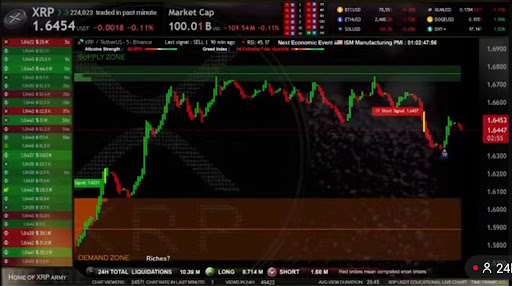
XRP Price massive crash

Trading XRP in this environment requires respecting those boundaries. Long exposure becomes favorable near the lower end of the structure, where consistent reactions indicate that sellers are failing to accelerate momentum. Entries should remain confirmation-based, supported by observable demand, with tight invalidation below support to maintain risk control. 

On the upside, moves into resistance, both the local supply zone and the broader $2.00 region, serve as tactical exit or risk-reduction areas rather than breakout signals. XRP has repeatedly failed to sustain progress through these ceilings, highlighting weak upside conviction. Until price reclaims resistance with meaningful volume, short-term strategies continue to favor mean reversion over trend continuation.

Managing XRP Trades Around Catalysts And Volatility Risk

Because XRP is in compression, Suther believes that external catalysts carry outsized influence. Short-term traders must actively factor these into execution and sizing. Ongoing Epstein-related developments risk undermining institutional confidence, which can pressure broader crypto markets through Bitcoin correlation. Elevated US fiscal risk, including shutdown concerns, increases volatility and makes false breakouts more likely. Any progress or commentary around the CLARITY Act is particularly relevant for XRP and can rapidly shift sentiment, while geopolitical tensions involving Iran remain a wildcard for risk assets.

In practical terms, this means reducing leverage, tightening stops, and avoiding oversized positions ahead of high-risk news windows. Catalyst-driven moves should trigger reassessment, not emotional reaction. A confirmed break above resistance with sustained volume would shift the short-term bias toward continuation, while a loss of the $1.50 support zone would invalidate the current range and reopen downside risk.

Until structure resolves, the most effective way to trade XRP after the crash is disciplined range execution, strict risk control, and patience. 

XRP price chart from Tradingview.com
Disclaimer: For information purposes only. Past performance is not indicative of future results.
placeholder
Elon Musk’s xAI and Neuralink Launch New Funding Rounds​Billionaire Elon Musk recently raised funds for his two high-profile tech companies, xAI and Neuralink.
Author  Insights
Jun 03, 2025
​Billionaire Elon Musk recently raised funds for his two high-profile tech companies, xAI and Neuralink.
placeholder
Bitcoin briefly loses 2025 gains as crypto plunges over the weekend.Bitcoin experienced a sharp decline this weekend, briefly erasing its 2025 gains and dipping below its year-opening value of $93,507. The cryptocurrency fell to a low of $93,029 on Sunday, representing a 25% drop from its all-time high in October. Although it has rebounded slightly to around $94,209, the pressures on the market remain significant. The downturn occurred despite the reopening of the U.S. government on Thursday, which many had hoped would provide essential support for crypto markets. This year initially appeared promising for cryptocurrencies, particularly after the inauguration of President Donald Trump, who has established the most pro-crypto administration thus far. However, ongoing political tensions—including Trump's tariff strategies and the recent government shutdown, lasting a historic 43 days—have contributed to several rapid price pullbacks for Bitcoin throughout the year. Market dynamics are also being influenced by Bitcoin whales—investors holding large amounts of Bitcoin—who have been offloading portions of their assets, consequently stalling price rallies even as positive regulatory developments emerge. Despite these sell-offs, analysts from Glassnode argue that this behavior aligns with typical patterns seen among long-term investors during the concluding stages of bull markets, suggesting it is not indicative of a mass exodus. Notably, Bitcoin is not alone in its struggles, as Ethereum and Solana have also recorded declines of 7.95% and 28.3%, respectively, since the start of the year, while numerous altcoins have faced even steeper losses. Looking ahead, questions linger regarding the viability of the four-year cycle thesis, particularly given the increasing institutional support and regulatory frameworks now in place in the crypto landscape. Matt Hougan, chief investment officer at Bitwise, remains optimistic, suggesting a potential Bitcoin resurgence in 2026 driven by the “debasement trade” thesis and a broader trend toward increased adoption of stablecoins, tokenization, and decentralized finance. Hougan emphasized the soundness of the underlying fundamentals, pointing to a positive outlook for the sector in the longer term.
Author  Mitrade
Nov 17, 2025
Bitcoin experienced a sharp decline this weekend, briefly erasing its 2025 gains and dipping below its year-opening value of $93,507. The cryptocurrency fell to a low of $93,029 on Sunday, representing a 25% drop from its all-time high in October. Although it has rebounded slightly to around $94,209, the pressures on the market remain significant. The downturn occurred despite the reopening of the U.S. government on Thursday, which many had hoped would provide essential support for crypto markets. This year initially appeared promising for cryptocurrencies, particularly after the inauguration of President Donald Trump, who has established the most pro-crypto administration thus far. However, ongoing political tensions—including Trump's tariff strategies and the recent government shutdown, lasting a historic 43 days—have contributed to several rapid price pullbacks for Bitcoin throughout the year. Market dynamics are also being influenced by Bitcoin whales—investors holding large amounts of Bitcoin—who have been offloading portions of their assets, consequently stalling price rallies even as positive regulatory developments emerge. Despite these sell-offs, analysts from Glassnode argue that this behavior aligns with typical patterns seen among long-term investors during the concluding stages of bull markets, suggesting it is not indicative of a mass exodus. Notably, Bitcoin is not alone in its struggles, as Ethereum and Solana have also recorded declines of 7.95% and 28.3%, respectively, since the start of the year, while numerous altcoins have faced even steeper losses. Looking ahead, questions linger regarding the viability of the four-year cycle thesis, particularly given the increasing institutional support and regulatory frameworks now in place in the crypto landscape. Matt Hougan, chief investment officer at Bitwise, remains optimistic, suggesting a potential Bitcoin resurgence in 2026 driven by the “debasement trade” thesis and a broader trend toward increased adoption of stablecoins, tokenization, and decentralized finance. Hougan emphasized the soundness of the underlying fundamentals, pointing to a positive outlook for the sector in the longer term.
placeholder
Gold Price Forecast: XAU/USD opens lower around $4,450 on fears of widening Iran conflictsGold price (XAU/USD) opens over 1% lower to near $4,445.00 on Monday, as oil prices have rallied further on fears of further widening of conflicts in the Middle East. WTI Oil price is up almost 3% above $102.50 in the opening trade, increasing fears of higher inflation expectations globally.
Author  FXStreet
Mar 30, Mon
Gold price (XAU/USD) opens over 1% lower to near $4,445.00 on Monday, as oil prices have rallied further on fears of further widening of conflicts in the Middle East. WTI Oil price is up almost 3% above $102.50 in the opening trade, increasing fears of higher inflation expectations globally.
placeholder
Silver Price Forecast: XAG/USD falls to near $72.00 amid fading safe-haven demandSilver price (XAG/USD) continues to lose ground after registering tiny losses in the previous day, trading around $72.90 during the Asian hours on Thursday. The safe-haven demand for the precious metal fades amid rising optimism over Middle East peace.
Author  FXStreet
Yesterday 08: 19
Silver price (XAG/USD) continues to lose ground after registering tiny losses in the previous day, trading around $72.90 during the Asian hours on Thursday. The safe-haven demand for the precious metal fades amid rising optimism over Middle East peace.
placeholder
Gold retreats sharply from two-week top/$4,800 as Trump’s Iran comments boost USDGold (XAU/USD) witnessed an intraday turnaround from the $4,800 mark, or a fresh two-week high set earlier this Thursday, and for now, seems to have snapped a four-day winning streak amid resurgent US Dollar (USD) demand.
Author  FXStreet
Yesterday 07: 03
Gold (XAU/USD) witnessed an intraday turnaround from the $4,800 mark, or a fresh two-week high set earlier this Thursday, and for now, seems to have snapped a four-day winning streak amid resurgent US Dollar (USD) demand.
goTop
quote