




A Stock Market Crash in 2026? These Warning Signs Make the Answer Seem Obvious.
Key Points
The S&P 500 looks expensive today by historical metrics.
Its forward P/E is as high today as it was in the months leading up to two major stock market crashes.
Analysts are forecasting another double-digit gain in 2026, but investors should be cautious.
- 10 stocks we like better than S&P 500 Index ›
The S&P 500 (SNPINDEX: ^GSPC) posted double-digit gains in each of the last three years. The benchmark index has already added 1.4% year to date, and many Wall Street analysts expect it to end 2026 with another double-digit return.
However, quite a few signals are flashing a warning right now that investors would do well to pay attention to.
Where to invest $1,000 right now? Our analyst team just revealed what they believe are the 10 best stocks to buy right now, when you join Stock Advisor. See the stocks »
The benchmark index is, by historical standards, trading at a high premium. Its forward price-to-earnings (P/E) is about 22, a much pricier figure than its 30-year average of about 17, according to research compiled by investment firm J.P. Morgan. The last time the forward P/E was this high, it was just before the tech sell-off in 2021. Before that, it broke the 20-mark plane in the late '90s as dot-com fever was about to crash.
Image source: Getty Images.
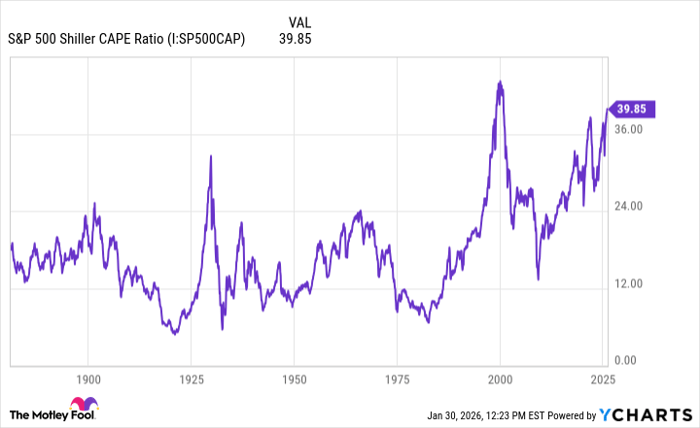
Perhaps more troubling is a second signal from the market's CAPE ratio, which estimates an index's long-term growth by using a decade of inflation-adjusted earnings. It's had a 30-year average of about 28.5. Today, that valuation metric is close to 40 (about 39.85), which makes it now only the second time in 153 years of data that the market's CAPE has been this high.
The last time the CAPE exceeded 40, it was followed by the market crash of 2000.
Data by YCharts.
Do these metrics mean the market will crash in 2026? Not necessarily. What they do suggest, however, is that the S&P 500 has risen much higher than the ground below it can stabilize.
Put differently, it wouldn't be surprising if the market crashed in 2026. It would be historically resonant if it did.
The market has proven its resilience, and it will likely continue its tenacity over the long run. But these two signals are flashing a warning that investors should pay attention to. A rapid sell-off of one's holdings is probably not the best answer. But a careful selection of investments that could weather a potential storm might be wise at this point.
Should you buy stock in S&P 500 Index right now?
Before you buy stock in S&P 500 Index, consider this:
The Motley Fool Stock Advisor analyst team just identified what they believe are the 10 best stocks for investors to buy now… and S&P 500 Index wasn’t one of them. The 10 stocks that made the cut could produce monster returns in the coming years.
Consider when Netflix made this list on December 17, 2004... if you invested $1,000 at the time of our recommendation, you’d have $450,256!* Or when Nvidia made this list on April 15, 2005... if you invested $1,000 at the time of our recommendation, you’d have $1,171,666!*
Now, it’s worth noting Stock Advisor’s total average return is 942% — a market-crushing outperformance compared to 196% for the S&P 500. Don't miss the latest top 10 list, available with Stock Advisor, and join an investing community built by individual investors for individual investors.
See the 10 stocks »
*Stock Advisor returns as of February 2, 2026.
JPMorgan Chase is an advertising partner of Motley Fool Money. Steven Porrello has no position in any of the stocks mentioned. The Motley Fool has positions in and recommends JPMorgan Chase. The Motley Fool has a disclosure policy.
Recommended Articles


