




This Cardano Setup Triggered a 32% Rally Before —On-Chain Metrics Hint at a Repeat?
Cardano price may be approaching a decision point. While price remains under pressure, a familiar technical setup is forming beneath the surface. The same structure that preceded a 32% rally late last year is appearing again, but this time it is being reinforced by specific on-chain behavior from whales and long-term holders.
The question is no longer whether a signal exists. It is whether the supporting behavior is strong enough to carry it through.
A Familiar Bullish Setup Is Reappearing — And Whales Are Positioning Early
Cardano is in the process of forming a bullish divergence on the daily chart. A bullish divergence occurs when the price makes a lower low, but momentum, measured by the Relative Strength Index (RSI), trends higher. RSI compares recent gains to recent losses to assess whether selling pressure is weakening.
This setup has mattered for Cardano before.
Between November 4 and December 31, 2025, ADA printed a lower low while RSI formed a higher low. That divergence marked exhaustion in selling pressure and was followed by a 32% rally. A similar structure is now developing between November 4, 2025, and January 19, 2026, provided the price continues to hold above the $0.35 area.
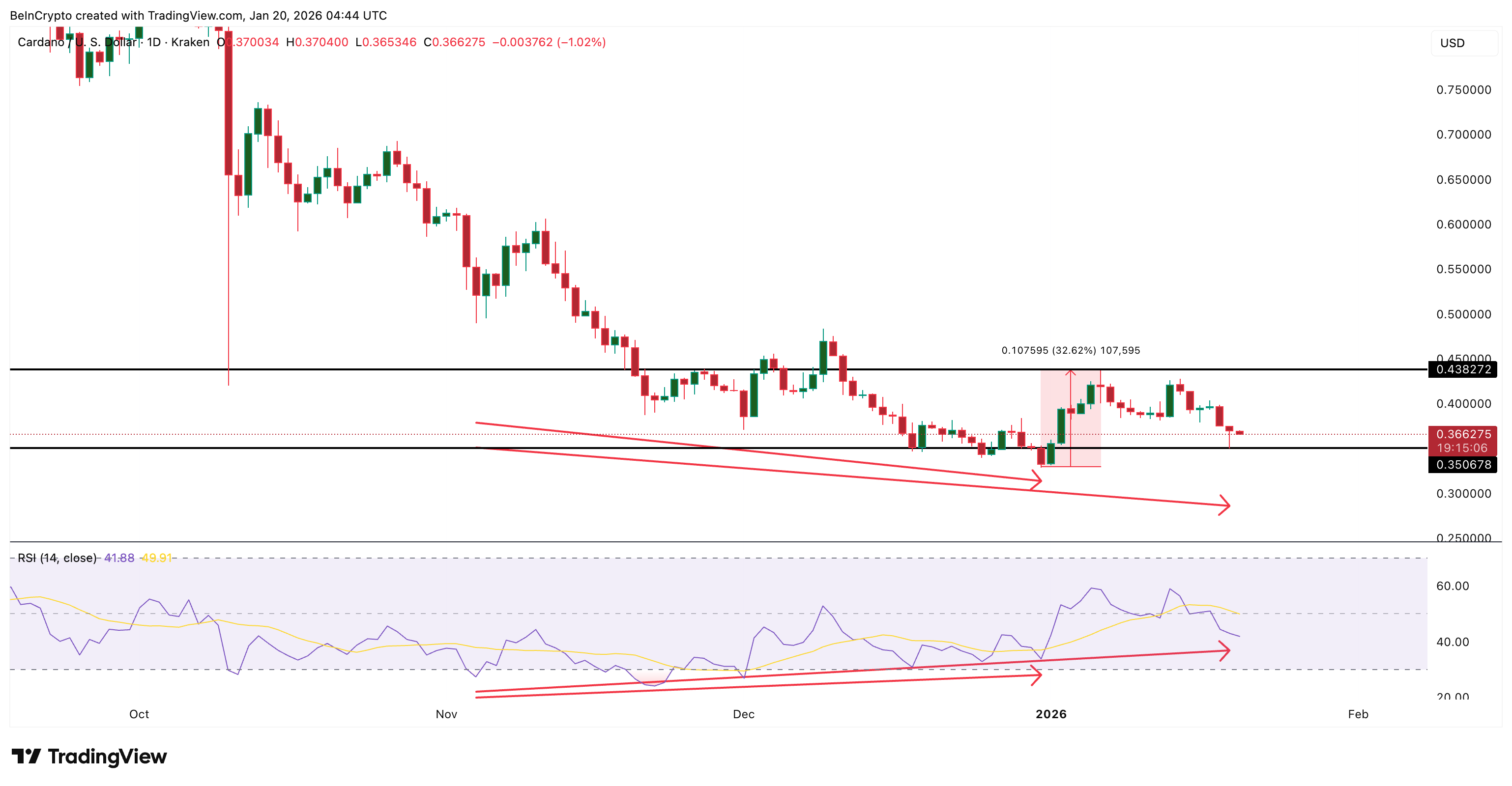 Bullish Divergence Forming: TradingView
Want more token insights like this? Sign up for Editor Harsh Notariya’s Daily Crypto Newsletter here.
What strengthens this signal is whale behavior.
Wallets holding between 1 million and 10 million ADA have been accumulating since January 12. Their combined holdings rose from roughly 5.51 billion ADA to 5.61 billion ADA, an increase of about 100 million ADA, or 1.8%, in less than two weeks. At the current price, that represents over $36 million in added exposure.
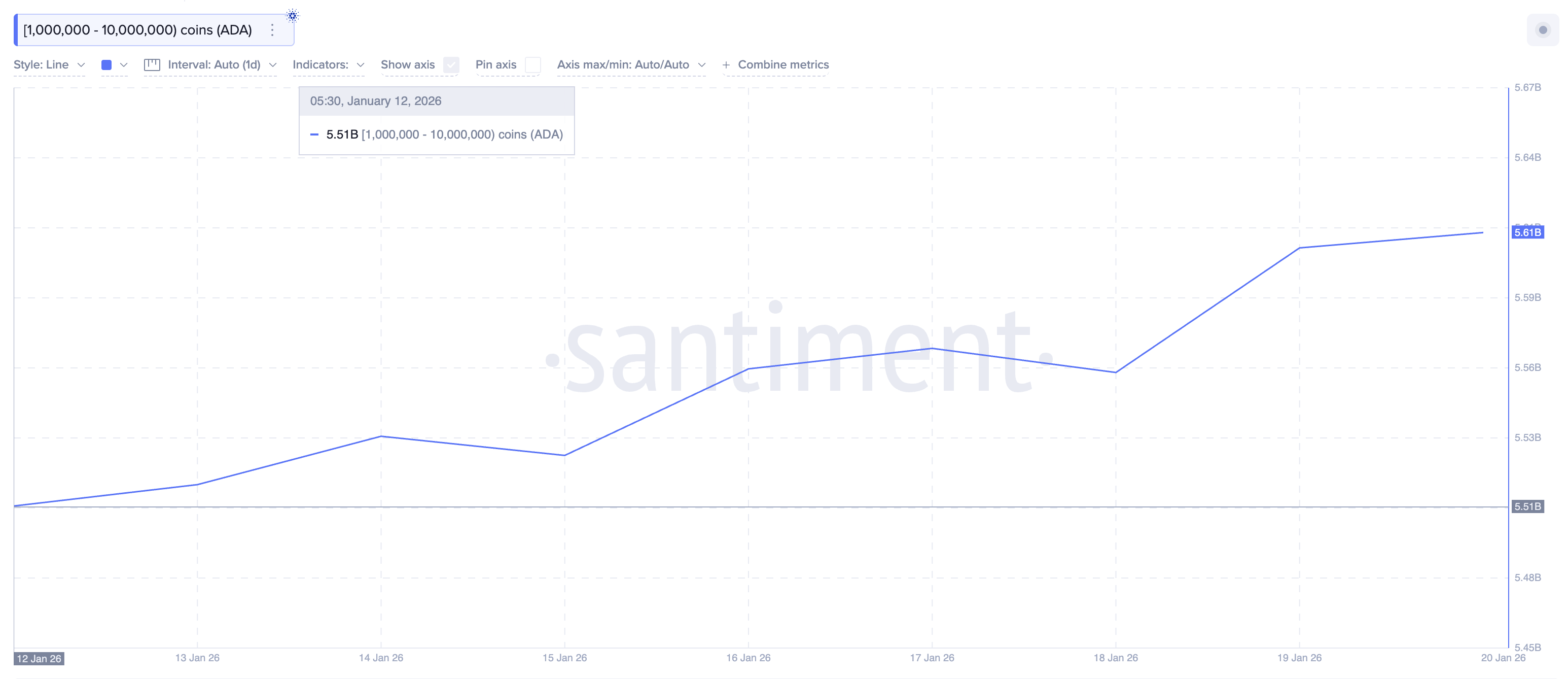 Cardano Whales: Santiment
This kind of accumulation typically appears ahead of momentum shifts, not after them. But momentum alone is not enough. The behavior of other holder groups determines whether the setup can follow through.
Hodlers Are Staying Put While Short-Term Activity Surges — A Mixed Signal
To understand the risk beneath the setup, it helps to look at spent coin activity. Spent coin activity tracks how many coins are being moved on-chain, giving insight into who is selling and who is staying inactive.
Long-term holders, defined here as wallets holding ADA for 180 to 365 days, are showing strong conviction. Their spent coin activity has collapsed from roughly 67.47 million ADA on January 14 to around 174,000 ADA recently. That is a decline of more than 99%, pushing activity to a monthly low. In simple terms, long-term holders are not selling into weakness.
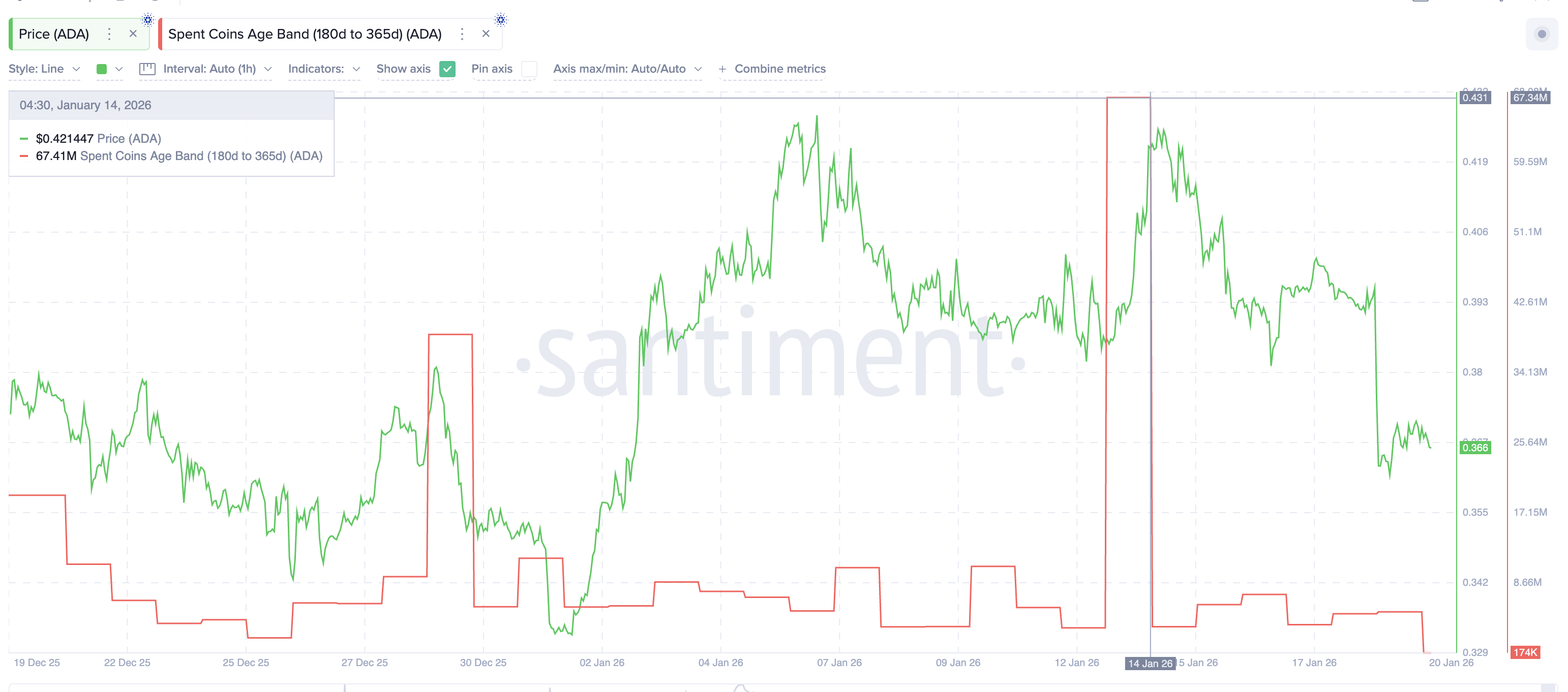 HODLers Not Moving ADA: Santiment
Short-term holders tell a very different story.
Coins held for 30 to 60 days have suddenly become much more active as the bullish pattern forms. Spent coin activity for this group jumped from about 3.6 million ADA on January 18 to approximately 14.84 million ADA, an increase of roughly 312% in a short span.
This divergence matters.
Strong Hodler inactivity supports the downside and reduces panic risk. At the same time, rising short-term activity introduces supply risk if the price starts to bounce. This exact imbalance could have capped Cardano’s previous RSI-driven rally before it could turn into a sustained trend.
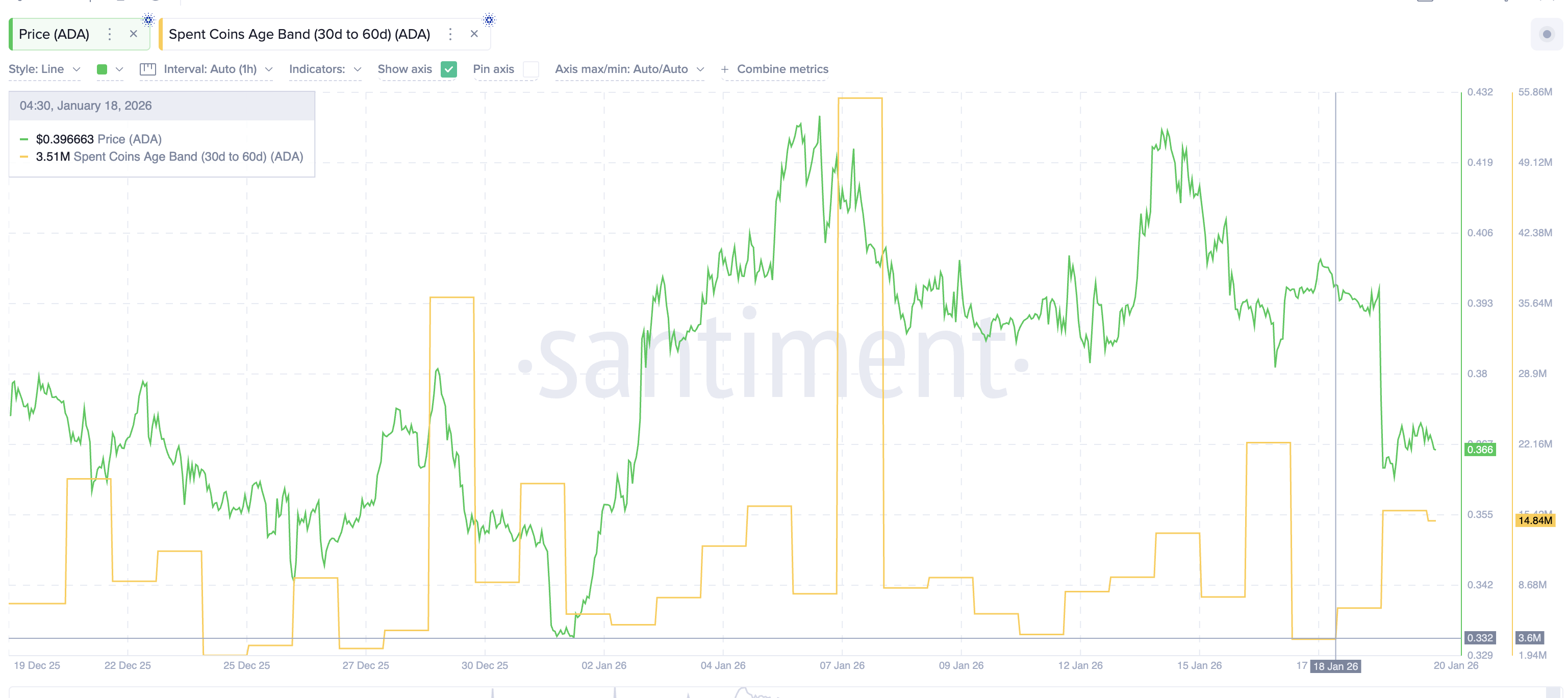 Short-Term Cohort: Santiment
Whether this setup leads to the bounce now depends on how the price reacts at key levels.
Cardano Price Levels And Two Other Metrics Decide If History Repeats
The last time Cardano rallied 32%, the move ultimately failed because the ADA price could not reclaim the 50-day exponential moving average (EMA). An EMA gives more weight to recent prices, making it more sensitive to trend shifts. During that rally, ADA stalled near the 50-day EMA, which now sits near $0.41.
That level is the first major hurdle again.
If the current RSI divergence confirms and price pushes higher, a clean daily close above $0.41 would signal that short-term momentum is finally aligning with the setup. Above that, $0.43 becomes the next resistance, followed by $0.48, which aligns closely with the 200-day EMA and would mark a more meaningful trend shift.
Capital flow adds an important difference this time.
Chaikin Money Flow (CMF), which tracks whether capital is entering or leaving an asset, is trending higher even as the price has drifted lower. Previously, CMF failed to hold above the zero line during rallies, signaling weak inflows. This time, CMF has pushed higher and stayed positive, suggesting accumulation was happening even when the Cardano price trended lower.
Whale buying, discussed earlier, also had a role to play in pushing the CMF higher.
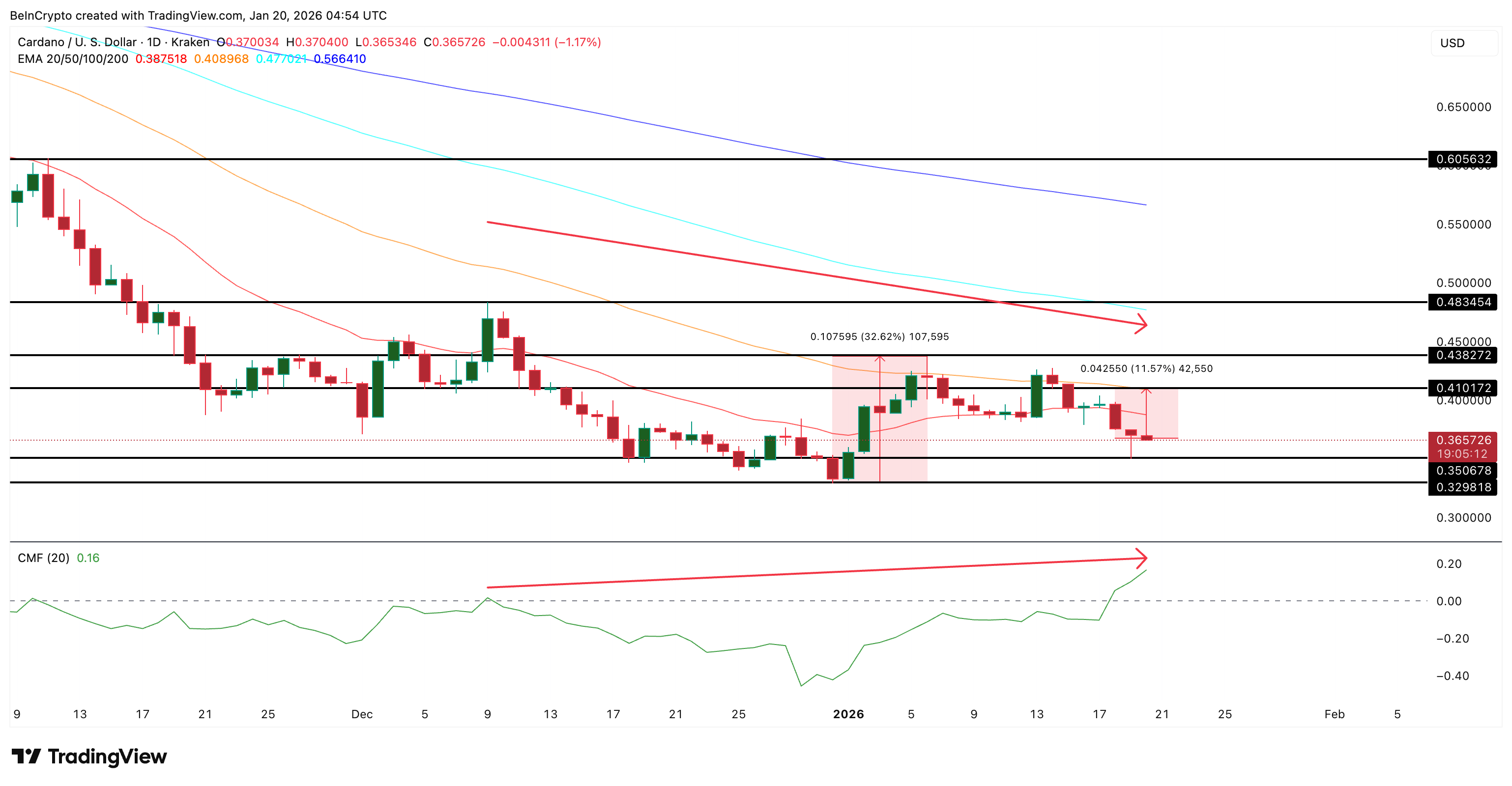 Cardano Price Analysis: TradingView
On the downside, the setup remains conditional. A sustained break below $0.35 would weaken the bullish divergence and reopen the path toward $0.32, delaying any repeat scenario.
Recommended Articles


