


Gold price slips as US Dollar ignores Fed rate cut
- Gold declines as Trump’s win reduces political risk; focus on potential inflationary policies.
- US Dollar recovery pressures Bullion despite lower Treasury yields.
- Powell signals gradual rate adjustments, leaving Fed’s future path open amid economic strength.
Gold prices had fallen on Friday as the Greenback stages a recovery despite falling US Treasury yields. Traders continued to digest Donald Trump’s victory in the US election, and they reduced their exposure on the so-called “Trump trade” due to uncertainty over tariffs. The XAU/USD trades at $2,688, down over 0.67%.
US equities extended their gains, shrugging off election jitters, which were the main drivers of the Bullion’s advance. However, risk over US politics has faded, and market participants would look toward Trump’s policies.
Following his victory, the US Dollar strengthened, even though investors expect a less dovish Federal Reserve (Fed). Some of Trump’s policies are seen as inflation prone, which would exert pressure on the US central bank.
On Thursday, the Fed reduced interest rates, acknowledging a strong economy, a cooling labor market, and an evolving disinflation process. However, Fed officials commented that inflation “remains somewhat elevated” despite approaching the 2% target.
Fed Chair Jerome Powell failed to provide forward guidance on monetary policy and kept his options open at upcoming meetings. He emphasized that the Fed could afford to take its time to lower rates due to the strong economy. He acknowledged that policy remains restrictive, even after today’s rate cut, as officials aim to bring rates to neutral levels.
The US economic schedule featured the release of the University of Michigan (UoM) Consumer Sentiment for November, which crushed October’s final reading. The same report revealed Americans mixed views on inflation expectations in the short and long term.
Next week, the US economic docket will influence Gold’s path. Traders will eye comments from Federal Reserve officials, along with key data releases on consumer and producer inflation and retail sales.
Daily Digest Market Movers: Gold price slumps as data boosts the Greenback
- Gold prices fell as US real yields, which inversely correlate against Bullion, had recovered and climbed two basis points to 1.978%.
- The US Dollar Index (DXY), which tracks the buck’s performance against six peers, rallies 0.70% to 105.09 on Friday. Yields, particularly the 10-year benchmark note coupon, fall two basis points to 4.30%.
- The preliminary November reading for UoM Consumer Sentiment rose from 70.5 to 73.0, marking a 3.5% increase. Survey Director Joanne Hsu noted, “While current conditions saw minimal change, the expectations index surged across all aspects, hitting its highest level since July 2021.”
- One-year inflation expectations dipped slightly, from 2.7% to 2.6%, while the five-year outlook inched up from 3.0% to 3.1%.
- According to the Chicago Board of Trade’s December fed funds futures contract, investors currently expect around 24.5 basis points of Fed easing by year-end.
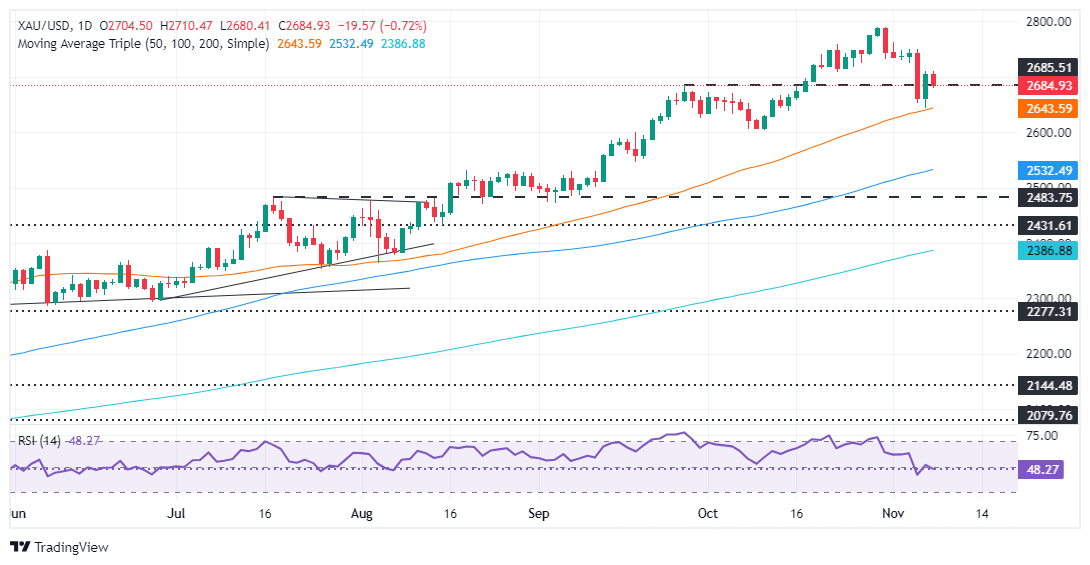
XAU/USD Technical Outlook: Gold price tumbles with sellers eyeing $2,650
Gold price retreats from two-day peak near $2,700, a crucial level which was broken on Wednesday and buyers had remained unable to crack. If sellers keep holding firm and send prices below the November 6 low of $2,652, look for a push to challenge $2,639, ahead of testing the October 10 low of $2,603.
On the other hand, if Gold clears $2,700, buyers would eye the 20-day SMA at $2,718, ahead of $2,750, followed by the October 23 high at $2,758.
Momentum remains neutral as the Relative Strength Index (RSI) fluctuates around its neutral line, a sign that XAU/USD might lack clear direction and consolidate.
Gold FAQs
Gold has played a key role in human’s history as it has been widely used as a store of value and medium of exchange. Currently, apart from its shine and usage for jewelry, the precious metal is widely seen as a safe-haven asset, meaning that it is considered a good investment during turbulent times. Gold is also widely seen as a hedge against inflation and against depreciating currencies as it doesn’t rely on any specific issuer or government.
Central banks are the biggest Gold holders. In their aim to support their currencies in turbulent times, central banks tend to diversify their reserves and buy Gold to improve the perceived strength of the economy and the currency. High Gold reserves can be a source of trust for a country’s solvency. Central banks added 1,136 tonnes of Gold worth around $70 billion to their reserves in 2022, according to data from the World Gold Council. This is the highest yearly purchase since records began. Central banks from emerging economies such as China, India and Turkey are quickly increasing their Gold reserves.
Gold has an inverse correlation with the US Dollar and US Treasuries, which are both major reserve and safe-haven assets. When the Dollar depreciates, Gold tends to rise, enabling investors and central banks to diversify their assets in turbulent times. Gold is also inversely correlated with risk assets. A rally in the stock market tends to weaken Gold price, while sell-offs in riskier markets tend to favor the precious metal.
The price can move due to a wide range of factors. Geopolitical instability or fears of a deep recession can quickly make Gold price escalate due to its safe-haven status. As a yield-less asset, Gold tends to rise with lower interest rates, while higher cost of money usually weighs down on the yellow metal. Still, most moves depend on how the US Dollar (USD) behaves as the asset is priced in dollars (XAU/USD). A strong Dollar tends to keep the price of Gold controlled, whereas a weaker Dollar is likely to push Gold prices up.
Recommended Articles


