

Gold stuck in a range after collapse of aggressive Fed bets, haven demand underpins

Source Fxstreet
  • Gold oscillates in a tight range after bets fade that the Fed will continue slashing interest rates aggressively.
  • Support for Gold comes from increasing geopolitical risks and lower interest rates globally. 
  • Technically, XAU/USD begins a leg lower within a tight range.  

Gold (XAU/USD) edges lower to trade in the $2,640s per troy ounce on Thursday as it continues its line dance below the record high of $2,685 set last week. Sellers have the edge over buyers as bets fade that the Federal Reserve (Fed) will continue slashing interest rates aggressively in the United States (US), which, in turn, takes the shine off non-interest-bearing assets like Gold. 

The downside is limited, however, by support from two key factors: safe-haven flows into Gold due to the fear of an escalation of the conflict in the Middle East and the general trend lower in global interest rates – notwithstanding the Fed’s newfound caution – which enables Gold to still retain its overall attractiveness to investors. 

Gold stalls in its ascent as Fed backtracks

Gold continues to see upside capped by seesawing expectations regarding the future course of interest rates in the US. From the chances of the Fed cutting interest rates by another double-dose 50 basis points (0.50%) again in November, standing above 60% last week, these have now fallen to a much less certain level of around mid-30%. 

The fall in market bets comes after the release of stronger-than-expected US jobs data, which suggests the US economy is not tilting on a cliff edge. This, in turn, has enabled the Dollar to resurface from its deep dive in August, providing a further headwind to Gold, which is mostly priced and traded in USD. Regarding the health of the US labor market, the release of the most important US employment report, the Nonfarm Payrolls (NFP), will be a critical deciding factor on Friday. 

Technical Analysis: Gold enters short-term sideways mode

Gold enters a sideways market mode on the 4-hour chart (below) between the all-time high of $2,685 and a floor at around Monday’s low of $2,625. The short-term trend is unclear and could now possibly be sideways. It would require a breakout either above the top of the range or below the bottom to confirm a new directional bias.

XAU/USD 4-hour Chart
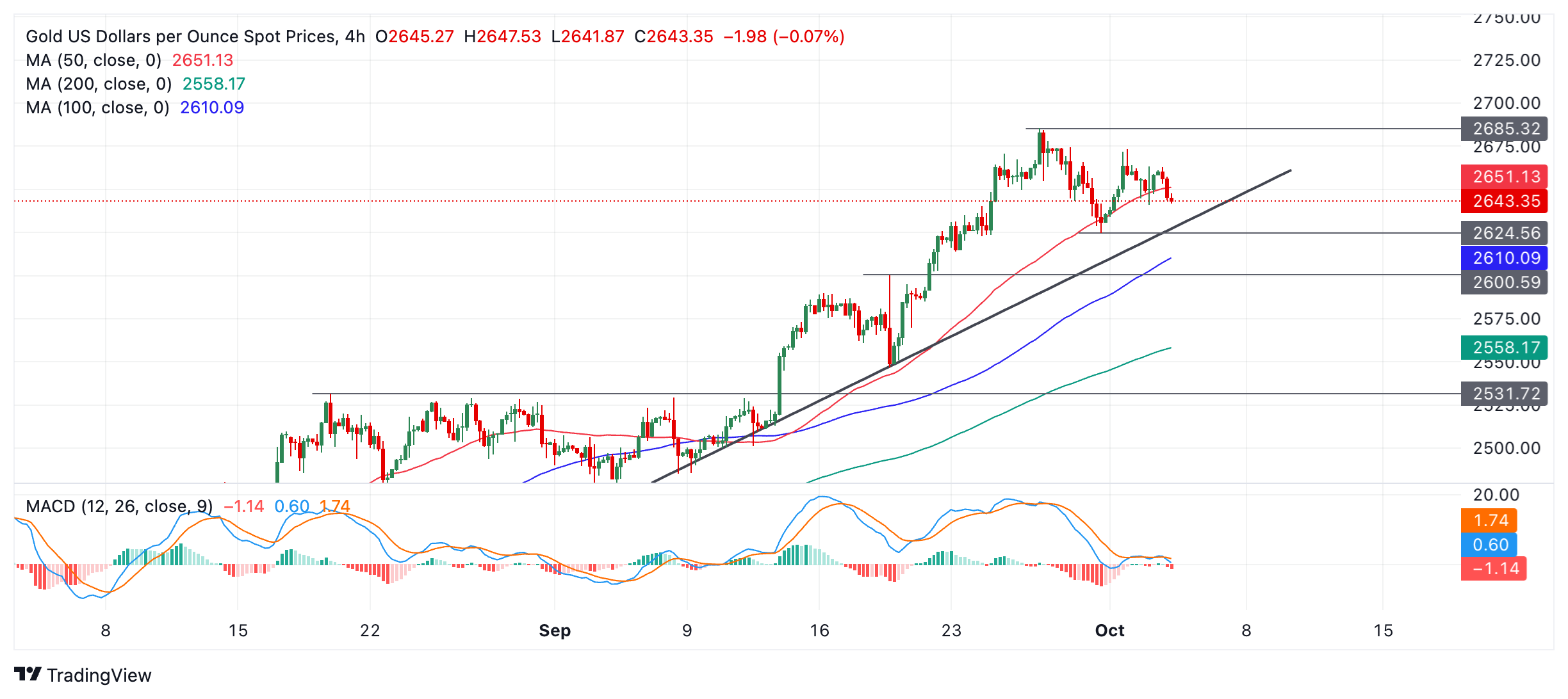
A break above the $2,673 Tuesday’s high would, however, increase the odds of a resumption of the old uptrend, probably leading to a continuation up to the round-number target at $2,700.

Gold is attempting to pierce the red 50-period Simple Moving Average (SMA) on the chart above, however, which suggests building downside pressure. 

If a break through the SMA ensues, it will probably take prices down to support from the trendline at $2,630. A break below the $2,625 swing low would likely see prices give way to support at $2,600 (August 20 high, round number). 

On a medium and long-term basis, Gold remains in an uptrend and, since it is a foundational principle of technical analysis that “the trend is your friend,” the odds favor resumption higher eventually once the current period of consolidation has ended.

Economic Indicator

Nonfarm Payrolls

The Nonfarm Payrolls release presents the number of new jobs created in the US during the previous month in all non-agricultural businesses; it is released by the US Bureau of Labor Statistics (BLS). The monthly changes in payrolls can be extremely volatile. The number is also subject to strong reviews, which can also trigger volatility in the Forex board. Generally speaking, a high reading is seen as bullish for the US Dollar (USD), while a low reading is seen as bearish, although previous months' reviews ​and the Unemployment Rate are as relevant as the headline figure. The market's reaction, therefore, depends on how the market assesses all the data contained in the BLS report as a whole.

Read more.

Next release: Fri Oct 04, 2024 12:30

Frequency: Monthly

Consensus: 140K

Previous: 142K

Source: US Bureau of Labor Statistics

America’s monthly jobs report is considered the most important economic indicator for forex traders. Released on the first Friday following the reported month, the change in the number of positions is closely correlated with the overall performance of the economy and is monitored by policymakers. Full employment is one of the Federal Reserve’s mandates and it considers developments in the labor market when setting its policies, thus impacting currencies. Despite several leading indicators shaping estimates, Nonfarm Payrolls tend to surprise markets and trigger substantial volatility. Actual figures beating the consensus tend to be USD bullish.


Disclaimer: For information purposes only. Past performance is not indicative of future results.
placeholder
Bitcoin CME gaps at $35,000, $27,000 and $21,000, which one gets filled first?Prioritize filling the $27,000 gap and even try higher.
Author  FXStreet
Aug 22, 2023
Prioritize filling the $27,000 gap and even try higher.
placeholder
Pinduoduo Earnings Incoming: Morgan Stanley Sees Long-Term Profit Potential​Insights – On November 21, Chinese e-commerce giant Pinduoduo (PDD) will release its Q3 2024 earnings.
Author  Mitrade
Nov 20, 2024
​Insights – On November 21, Chinese e-commerce giant Pinduoduo (PDD) will release its Q3 2024 earnings.
placeholder
Elon Musk’s xAI and Neuralink Launch New Funding Rounds​Billionaire Elon Musk recently raised funds for his two high-profile tech companies, xAI and Neuralink.
Author  Insights
Jun 03, 2025
​Billionaire Elon Musk recently raised funds for his two high-profile tech companies, xAI and Neuralink.
placeholder
Bitcoin briefly loses 2025 gains as crypto plunges over the weekend.Bitcoin experienced a sharp decline this weekend, briefly erasing its 2025 gains and dipping below its year-opening value of $93,507. The cryptocurrency fell to a low of $93,029 on Sunday, representing a 25% drop from its all-time high in October. Although it has rebounded slightly to around $94,209, the pressures on the market remain significant. The downturn occurred despite the reopening of the U.S. government on Thursday, which many had hoped would provide essential support for crypto markets. This year initially appeared promising for cryptocurrencies, particularly after the inauguration of President Donald Trump, who has established the most pro-crypto administration thus far. However, ongoing political tensions—including Trump's tariff strategies and the recent government shutdown, lasting a historic 43 days—have contributed to several rapid price pullbacks for Bitcoin throughout the year. Market dynamics are also being influenced by Bitcoin whales—investors holding large amounts of Bitcoin—who have been offloading portions of their assets, consequently stalling price rallies even as positive regulatory developments emerge. Despite these sell-offs, analysts from Glassnode argue that this behavior aligns with typical patterns seen among long-term investors during the concluding stages of bull markets, suggesting it is not indicative of a mass exodus. Notably, Bitcoin is not alone in its struggles, as Ethereum and Solana have also recorded declines of 7.95% and 28.3%, respectively, since the start of the year, while numerous altcoins have faced even steeper losses. Looking ahead, questions linger regarding the viability of the four-year cycle thesis, particularly given the increasing institutional support and regulatory frameworks now in place in the crypto landscape. Matt Hougan, chief investment officer at Bitwise, remains optimistic, suggesting a potential Bitcoin resurgence in 2026 driven by the “debasement trade” thesis and a broader trend toward increased adoption of stablecoins, tokenization, and decentralized finance. Hougan emphasized the soundness of the underlying fundamentals, pointing to a positive outlook for the sector in the longer term.
Author  Mitrade
Nov 17, 2025
Bitcoin experienced a sharp decline this weekend, briefly erasing its 2025 gains and dipping below its year-opening value of $93,507. The cryptocurrency fell to a low of $93,029 on Sunday, representing a 25% drop from its all-time high in October. Although it has rebounded slightly to around $94,209, the pressures on the market remain significant. The downturn occurred despite the reopening of the U.S. government on Thursday, which many had hoped would provide essential support for crypto markets. This year initially appeared promising for cryptocurrencies, particularly after the inauguration of President Donald Trump, who has established the most pro-crypto administration thus far. However, ongoing political tensions—including Trump's tariff strategies and the recent government shutdown, lasting a historic 43 days—have contributed to several rapid price pullbacks for Bitcoin throughout the year. Market dynamics are also being influenced by Bitcoin whales—investors holding large amounts of Bitcoin—who have been offloading portions of their assets, consequently stalling price rallies even as positive regulatory developments emerge. Despite these sell-offs, analysts from Glassnode argue that this behavior aligns with typical patterns seen among long-term investors during the concluding stages of bull markets, suggesting it is not indicative of a mass exodus. Notably, Bitcoin is not alone in its struggles, as Ethereum and Solana have also recorded declines of 7.95% and 28.3%, respectively, since the start of the year, while numerous altcoins have faced even steeper losses. Looking ahead, questions linger regarding the viability of the four-year cycle thesis, particularly given the increasing institutional support and regulatory frameworks now in place in the crypto landscape. Matt Hougan, chief investment officer at Bitwise, remains optimistic, suggesting a potential Bitcoin resurgence in 2026 driven by the “debasement trade” thesis and a broader trend toward increased adoption of stablecoins, tokenization, and decentralized finance. Hougan emphasized the soundness of the underlying fundamentals, pointing to a positive outlook for the sector in the longer term.
placeholder
Silver Price Forecast: XAG/USD falls to near $72.00 amid fading safe-haven demandSilver price (XAG/USD) continues to lose ground after registering tiny losses in the previous day, trading around $72.90 during the Asian hours on Thursday. The safe-haven demand for the precious metal fades amid rising optimism over Middle East peace.
Author  FXStreet
Apr 02, Thu
Silver price (XAG/USD) continues to lose ground after registering tiny losses in the previous day, trading around $72.90 during the Asian hours on Thursday. The safe-haven demand for the precious metal fades amid rising optimism over Middle East peace.
Related Instrument
goTop
quote