

Gold pulls back from $4,700 as Hormuz hopes cool haven demand

Source Fxstreet
  • Gold retreats below $4,700 as overbought RSI stalls momentum.
  • Hormuz reopening hopes reduce safe-haven demand despite mixed US data.
  • Core PCE and Warsh speech could reshape Fed rate bets.

Gold price holds firm during the North American session as buyers fail to surpass the $4,700 level, exacerbating a retracement below a key psychological level, amid mixed US data and rising hopes for an end to the US-Iran conflict. XAU/USD traded at $4,641, down 0.2%.

XAU/USD eases as overbought signals meet improving Middle East headlines

The yellow metal is consolidating as bullish momentum stalls, and the Relative Strength Index (RSI) turns overbought. Geopolitics continued to play a crucial role as news from the Middle East revealed that two US officials confirmed US President Trump’s announcement that the US Navy cleared the traffic separation scheme in the Strait of Hormuz, reported Axios.

Sources cited by Reuters mentioned that Gold, facing a key resistance near $4,700, capped the advance. Meanwhile, US housing data showed a slight improvement, while the ADP Employment Change 4-week average, coming in at 11.75K, exceeded the previous print of 9.5K.

US Building Permits in July rose 4.3% to 1.433 million, surpassing June's -2.6% contraction and estimates of 5%. The Conference Board Consumer Confidence missed estimates, coming in at 90.2, below 90.2. Households saw a slight improvement in business and jobs in August. 

Boston Fed's Susan Collins expressed a hawkish stance, highlighting that inflation remains too great and voicing concern about price stability. She acknowledged that the labour market aligns with full employment and noted that the economy is expanding at a near-trend rate.

Meanwhile. Money markets remain sceptical that the Federal Reserve will raise rates at the September meeting, with the odds near 43% for a 25-basis-point rate hike and 57% for keeping rates steady, according to Prime Terminal.
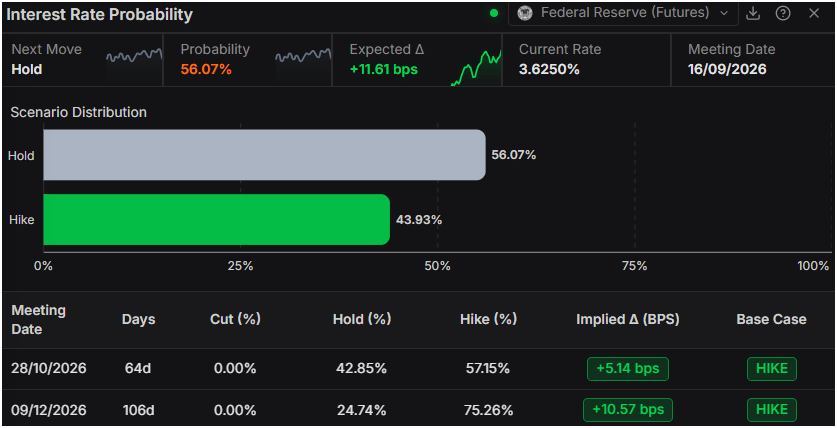
Source: Prime Terminal

Eyes turn to the release of the Federal Reserve’s favourite inflation gauge, the Core Personal Consumption Expenditures (PCE) Price Index, ahead of the speech by the new Fed Chair, Kevin Warsh, at the Jackson Hole Symposium.

The US economic schedule will also feature Durable Goods Orders, Gross Domestic Product (GDP) figures and Initial Jobless Claims data.

XAU/USD technical outlook: Gold struggles at $4,700

Gold is trading sideways for the second straight day with buyers unable to clear $4,700. This exacerbated a retracement below the $4,650, while the Relative Strength Index (RSI) is aiming lower above the 70 overbought level. If the RSI falls below the latter, the XAU/USD could dive further and challenge key support levels.

The first support would be the $4,600 mark, followed by the 200-day Simple Moving Average (SMA) at $4,519. Below sits the $4,500 mark, followed by the 100-day SMA at $4,379.

For a bullish resumption, XAU/USD must reclaim $4,700. If the breakout succeeds, a move to the May 7 swing high of $4,764 is on the cards, followed by a test of $4,800. The next area of interest would be $5,000.
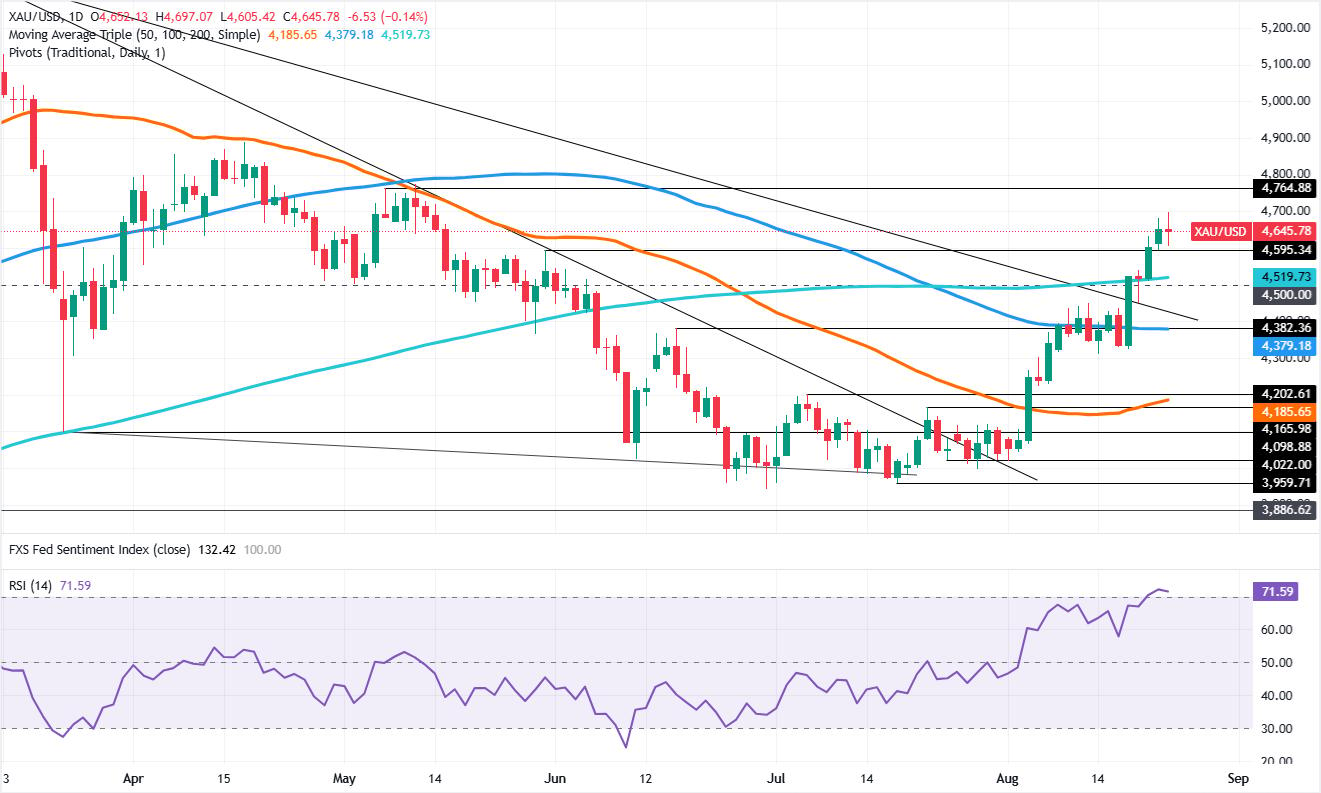
Gold daily chart

Gold FAQs

Gold has played a key role in human’s history as it has been widely used as a store of value and medium of exchange. Currently, apart from its shine and usage for jewelry, the precious metal is widely seen as a safe-haven asset, meaning that it is considered a good investment during turbulent times. Gold is also widely seen as a hedge against inflation and against depreciating currencies as it doesn’t rely on any specific issuer or government.

Central banks are the biggest Gold holders. In their aim to support their currencies in turbulent times, central banks tend to diversify their reserves and buy Gold to improve the perceived strength of the economy and the currency. High Gold reserves can be a source of trust for a country’s solvency. Central banks added 1,136 tonnes of Gold worth around $70 billion to their reserves in 2022, according to data from the World Gold Council. This is the highest yearly purchase since records began. Central banks from emerging economies such as China, India and Turkey are quickly increasing their Gold reserves.

Gold has an inverse correlation with the US Dollar and US Treasuries, which are both major reserve and safe-haven assets. When the Dollar depreciates, Gold tends to rise, enabling investors and central banks to diversify their assets in turbulent times. Gold is also inversely correlated with risk assets. A rally in the stock market tends to weaken Gold price, while sell-offs in riskier markets tend to favor the precious metal.

The price can move due to a wide range of factors. Geopolitical instability or fears of a deep recession can quickly make Gold price escalate due to its safe-haven status. As a yield-less asset, Gold tends to rise with lower interest rates, while higher cost of money usually weighs down on the yellow metal. Still, most moves depend on how the US Dollar (USD) behaves as the asset is priced in dollars (XAU/USD). A strong Dollar tends to keep the price of Gold controlled, whereas a weaker Dollar is likely to push Gold prices up.

Disclaimer: For information purposes only. Past performance is not indicative of future results.
placeholder
Pinduoduo Earnings Incoming: Morgan Stanley Sees Long-Term Profit Potential​Insights – On November 21, Chinese e-commerce giant Pinduoduo (PDD) will release its Q3 2024 earnings.
Author  Mitrade
Nov 20, 2024
​Insights – On November 21, Chinese e-commerce giant Pinduoduo (PDD) will release its Q3 2024 earnings.
placeholder
Bitcoin ETF Inflows For 2025 Now Outpace 2024, Data ShowsUS Bitcoin spot exchange-traded funds (ETFs) have seen more inflows this year so far compared to the same point in 2024, according to data.
Author  Bitcoinist
Jul 16, 2025
US Bitcoin spot exchange-traded funds (ETFs) have seen more inflows this year so far compared to the same point in 2024, according to data.
placeholder
Bitcoin briefly loses 2025 gains as crypto plunges over the weekend.Bitcoin experienced a sharp decline this weekend, briefly erasing its 2025 gains and dipping below its year-opening value of $93,507. The cryptocurrency fell to a low of $93,029 on Sunday, representing a 25% drop from its all-time high in October. Although it has rebounded slightly to around $94,209, the pressures on the market remain significant. The downturn occurred despite the reopening of the U.S. government on Thursday, which many had hoped would provide essential support for crypto markets. This year initially appeared promising for cryptocurrencies, particularly after the inauguration of President Donald Trump, who has established the most pro-crypto administration thus far. However, ongoing political tensions—including Trump's tariff strategies and the recent government shutdown, lasting a historic 43 days—have contributed to several rapid price pullbacks for Bitcoin throughout the year. Market dynamics are also being influenced by Bitcoin whales—investors holding large amounts of Bitcoin—who have been offloading portions of their assets, consequently stalling price rallies even as positive regulatory developments emerge. Despite these sell-offs, analysts from Glassnode argue that this behavior aligns with typical patterns seen among long-term investors during the concluding stages of bull markets, suggesting it is not indicative of a mass exodus. Notably, Bitcoin is not alone in its struggles, as Ethereum and Solana have also recorded declines of 7.95% and 28.3%, respectively, since the start of the year, while numerous altcoins have faced even steeper losses. Looking ahead, questions linger regarding the viability of the four-year cycle thesis, particularly given the increasing institutional support and regulatory frameworks now in place in the crypto landscape. Matt Hougan, chief investment officer at Bitwise, remains optimistic, suggesting a potential Bitcoin resurgence in 2026 driven by the “debasement trade” thesis and a broader trend toward increased adoption of stablecoins, tokenization, and decentralized finance. Hougan emphasized the soundness of the underlying fundamentals, pointing to a positive outlook for the sector in the longer term.
Author  Mitrade
Nov 17, 2025
Bitcoin experienced a sharp decline this weekend, briefly erasing its 2025 gains and dipping below its year-opening value of $93,507. The cryptocurrency fell to a low of $93,029 on Sunday, representing a 25% drop from its all-time high in October. Although it has rebounded slightly to around $94,209, the pressures on the market remain significant. The downturn occurred despite the reopening of the U.S. government on Thursday, which many had hoped would provide essential support for crypto markets. This year initially appeared promising for cryptocurrencies, particularly after the inauguration of President Donald Trump, who has established the most pro-crypto administration thus far. However, ongoing political tensions—including Trump's tariff strategies and the recent government shutdown, lasting a historic 43 days—have contributed to several rapid price pullbacks for Bitcoin throughout the year. Market dynamics are also being influenced by Bitcoin whales—investors holding large amounts of Bitcoin—who have been offloading portions of their assets, consequently stalling price rallies even as positive regulatory developments emerge. Despite these sell-offs, analysts from Glassnode argue that this behavior aligns with typical patterns seen among long-term investors during the concluding stages of bull markets, suggesting it is not indicative of a mass exodus. Notably, Bitcoin is not alone in its struggles, as Ethereum and Solana have also recorded declines of 7.95% and 28.3%, respectively, since the start of the year, while numerous altcoins have faced even steeper losses. Looking ahead, questions linger regarding the viability of the four-year cycle thesis, particularly given the increasing institutional support and regulatory frameworks now in place in the crypto landscape. Matt Hougan, chief investment officer at Bitwise, remains optimistic, suggesting a potential Bitcoin resurgence in 2026 driven by the “debasement trade” thesis and a broader trend toward increased adoption of stablecoins, tokenization, and decentralized finance. Hougan emphasized the soundness of the underlying fundamentals, pointing to a positive outlook for the sector in the longer term.
placeholder
Gold Price Forecast: US Treasury Yield Slump Pushes Gold Above $4,500, Will Gold Keep Rising?As of the Asian session on August 20, gold prices (XAUUSD) surged again today after breaking above $4,500 on Wednesday, reaching a nearly two-month high of $4,527.12 before pulling back i
Author  TradingKey
Aug 20, Thu
As of the Asian session on August 20, gold prices (XAUUSD) surged again today after breaking above $4,500 on Wednesday, reaching a nearly two-month high of $4,527.12 before pulling back i
placeholder
Ethereum Price Forecast: BitMine scoops 32K ETH, hints at further gainsEthereum (ETH) treasury company BitMine Immersion Technologies (BMNR) expanded its digital asset holdings last week with another round of acquisitions.
Author  FXStreet
Yesterday 01: 29
Ethereum (ETH) treasury company BitMine Immersion Technologies (BMNR) expanded its digital asset holdings last week with another round of acquisitions.
Related Instrument
goTop
quote