


Crude Oil is pricing a Hormuz deal, not a peace deal
- WTI trades more than 1.5% lower just above the $82.00 handle, giving back part of Wednesday's surge while holding an advance that has carried it roughly 20% off the early-July low.
- A drone strike on two gas vessels at Egypt's Damietta port opened a Mediterranean front, and both of the routes Saudi Arabia uses to bypass the Strait of Hormuz now sit inside the war.
- Negotiators in Muscat and Tehran are arguing over who controls and tolls the Strait rather than over ending the war, and the tape is treating the two as the same thing.
Crude Oil is lower on Thursday even as the war that sets its price reached a country it had spared for five months. WTI trades just above the $82.00 handle, down more than 1.5%, and Brent holds just above $86.50 with a near-identical loss after both gave back a chunk of Wednesday's rally. The tape is not reading the escalation at all. It is reading a shipping negotiation in Muscat.
The war found a fourth front
A drone struck two gas vessels at Egypt's Damietta port on Wednesday, setting a floating storage unit alight and spreading fire to a carrier alongside it. Cairo confirmed the cause on Thursday and no party has claimed responsibility. Egypt had been left alone since late February, which matters because the Suez Canal and the pipeline crossing Egyptian territory to the Mediterranean have been the safe northbound route for Saudi cargoes ever since Hormuz stopped working.
The southern bypass has been under attack for longer, with Yemen's Houthis claiming a strike this week on the East-West pipeline that carries the kingdom's barrels to the Red Sea port of Yanbu, days after they declared a maritime blockade of Saudi Arabia. Riyadh has since joined US forces hitting Tehran-linked militia sites in Iraq. Loadings at a Black Sea terminal handling Caspian volumes were suspended overnight after two associated tankers were attacked. Every route built to avoid the chokepoint is now a target, and Crude Oil is down on the day.
What Muscat is actually negotiating
The rally keeps getting sold on the same headline, which is progress in the Iran-Oman talks over the Strait. Those talks are not about ending the war. Tehran rejected Muscat's proposal for shared oversight of the waterway on Tuesday and countered with an arrangement handing Iran more control, while its deputy foreign minister warned that the Strait stays shut if Oman refuses and that toll-free transit is not coming back.
Iran's foreign ministry says there are no plans to negotiate with Washington at all, so the most bullish plausible outcome here is a waterway reopening under Iranian supervision with a fee attached. That is a permanent cost on every Gulf barrel, not the removal of a risk premium. Tanker trackers counted 14 transits on Wednesday against roughly 100 a day before the war, and the market bought that as normalization.
The barrels do not agree
Commercial Crude Oil inventories fell 7.2 million barrels in the week to 24 July, roughly six times the expected draw, leaving stocks at 404.5 million barrels and about 7% beneath the five-year average. Cushing, the delivery hub behind WTI, sits near 19.4 million barrels, the tank-bottom level where storage stops being useful. The Strategic Petroleum Reserve (SPR) is near 307.7 million barrels after an eighteenth consecutive weekly draw, its lowest in more than four decades.
Against that, Chinese buyers are sitting on ample stocks and staying out of the import market, which is the one honest bearish input on the board and no explanation for Thursday. The Dollar is down close to 1% and US equity indices are sharply higher, which is the exact backdrop that normally supports a Dollar-priced commodity. Crude Oil falling into that combination is not a demand signal. It is war premium leaving the price.
Sunday's meeting and Friday's data
Seven producers meet virtually on Sunday, having already agreed an August increase of 188K barrels a day, the fifth consecutive monthly addition and a rounding error against a chokepoint running at a fraction of its normal throughput. The Organization of the Petroleum Exporting Countries and its partners (OPEC+) carries a quieter deadline too, because Iran's 2027 production baseline will be measured from its August, September and October output. Tehran's quota for years ahead is being set during the months Washington is blockading its tankers.
Friday brings the Employment Cost Index (ECI) at 12:30 GMT and the Chicago Purchasing Managers Index (PMI) at 13:45 GMT, the demand-side check after a growth print that missed and a deflator that ran at 6.3% against a 3.6% consensus. The next inventory report lands 5 August, and on current trend it will show the same tightening the tape keeps declining to price.
WTI technical levels
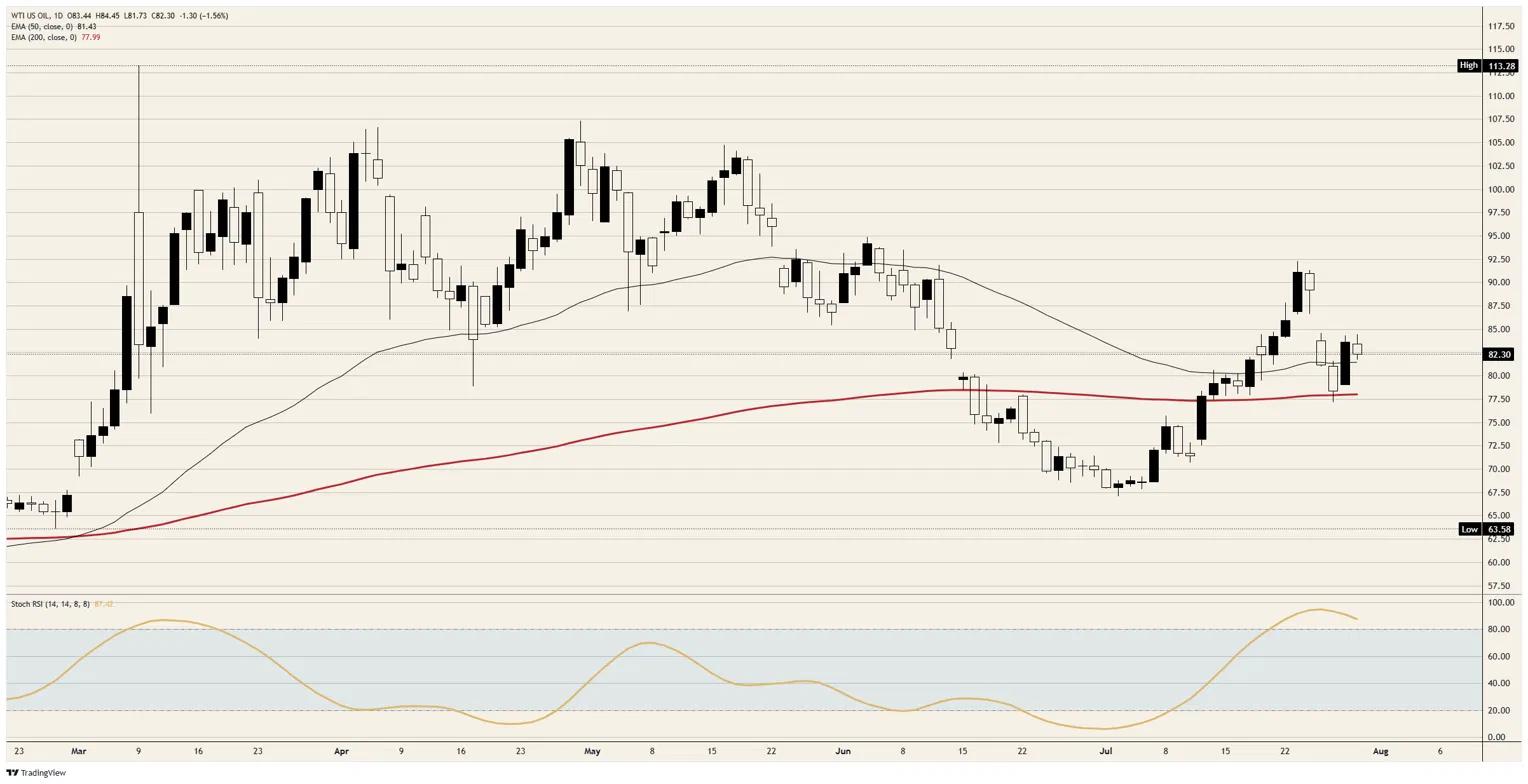
Resistance: Thursday's high short of $84.50 caps the first attempt higher, above which the $86.00 area and then last week's spike high near $92.00 come back into play.
Support: The 50-day Exponential Moving Average (EMA) near $81.50 held the session low, with the $80.00 handle beneath it and the 200-day EMA near $78.00 the level that would end the July advance outright.
Bias: Bullish while $81.50 holds. A daily Stochastic Relative Strength Index (Stoch RSI) near 87 argues the next few sessions belong to sellers, but the peace being discounted is a toll booth rather than an armistice, and dips into the 50-day are worth owning. A daily close beneath $81.50 invalidates and opens the $80.00 handle.
WTI daily chart
WTI Oil FAQs
WTI Oil is a type of Crude Oil sold on international markets. The WTI stands for West Texas Intermediate, one of three major types including Brent and Dubai Crude. WTI is also referred to as “light” and “sweet” because of its relatively low gravity and sulfur content respectively. It is considered a high quality Oil that is easily refined. It is sourced in the United States and distributed via the Cushing hub, which is considered “The Pipeline Crossroads of the World”. It is a benchmark for the Oil market and WTI price is frequently quoted in the media.
Like all assets, supply and demand are the key drivers of WTI Oil price. As such, global growth can be a driver of increased demand and vice versa for weak global growth. Political instability, wars, and sanctions can disrupt supply and impact prices. The decisions of OPEC, a group of major Oil-producing countries, is another key driver of price. The value of the US Dollar influences the price of WTI Crude Oil, since Oil is predominantly traded in US Dollars, thus a weaker US Dollar can make Oil more affordable and vice versa.
The weekly Oil inventory reports published by the American Petroleum Institute (API) and the Energy Information Agency (EIA) impact the price of WTI Oil. Changes in inventories reflect fluctuating supply and demand. If the data shows a drop in inventories it can indicate increased demand, pushing up Oil price. Higher inventories can reflect increased supply, pushing down prices. API’s report is published every Tuesday and EIA’s the day after. Their results are usually similar, falling within 1% of each other 75% of the time. The EIA data is considered more reliable, since it is a government agency.
OPEC (Organization of the Petroleum Exporting Countries) is a group of 12 Oil-producing nations who collectively decide production quotas for member countries at twice-yearly meetings. Their decisions often impact WTI Oil prices. When OPEC decides to lower quotas, it can tighten supply, pushing up Oil prices. When OPEC increases production, it has the opposite effect. OPEC+ refers to an expanded group that includes ten extra non-OPEC members, the most notable of which is Russia.
Recommended Articles


