


AMD Stock Has Surged 364% in 5 Years. History Suggests That It Will Become a Multibagger By 2030
Key Points
AMD has substantially increased its estimate of the total addressable market for server CPUs.
The company has been taking share away from Intel in this space.
AMD's revenue growth potential suggests that its market cap could jump considerably by 2030.
- 10 stocks we like better than Advanced Micro Devices ›
Shares of Advanced Micro Devices (NASDAQ: AMD) have shot up by a remarkable 364% over the past five years, outpacing the 68% jump in the tech-laden Nasdaq Composite index during the same period.
A big chunk of AMD's gains came over the past year and a half, once it became evident that the chip designer was poised to capitalize on the booming demand for AI chips in data centers and personal computers. The good news for AMD stock investors is that the catalysts driving its robust rally are getting stronger.
Where to invest $1,000 right now? Our analyst team just revealed what they believe are the 10 best stocks to buy right now, when you join Stock Advisor. See the stocks »
I will take a closer look at a couple of key trends that have supercharged this semiconductor stock over the past year and explain why they point toward terrific gains for investors through the end of the decade.

Image source: AMD.
AMD's tailwinds are getting stronger than before
At its Financial Analyst Day held in November 2025, AMD noted that the server central processing unit (CPU) market grew at a compound annual growth rate (CAGR) of just 4% between 2022 and 2024. The total addressable market (TAM) for server CPUs was $20 billion at the end of 2024, but it grew at a significantly faster pace of 30% in 2025 to $26 billion.
Agentic AI and inference applications drove this impressive uptick in the server CPU TAM last year. These workloads don't require the raw parallel processing power offered by graphics processing units (GPUs), an area where AMD failed to make a mark when the AI revolution kicked off in 2022.
However, CPUs play a central role in inference and agentic AI applications by managing GPUs and ensuring that other AI accelerator chips remain productive. As a result, AMD is now anticipating a significant bump in server CPU TAM over the long run. The company estimated that the server CPU market could clock an 18% CAGR between 2024 and 2030, reaching $60 billion in annual revenue by the end of the decade.
However, it significantly increased the TAM forecast at the recently held Advancing AI event. AMD now expects the server CPU market to hit an impressive $220 billion by the end of 2030. That's a 4x jump over AMD's prior estimate, and points toward a CAGR of 50%. Importantly, AMD now controls 46% revenue share of server CPUs, which is quite impressive considering that it reentered this market in 2017. Even better, AMD has consistently been taking market share from Intel in server CPUs.
Assuming it controls half of the server CPU market by the end of 2030, it could generate $110 billion in revenue from this segment. For comparison, AMD has generated $37.5 billion in revenue over the trailing twelve months, and the server CPU market alone could help it triple its top line in the next five years.
Moreover, AMD sees its overall data center accelerator TAM increasing by 7x over the next five years to $1.4 trillion in 2030. That translates into a 45% CAGR. The good news is that AMD seems well-positioned to capture a larger share of this lucrative opportunity. The company's data center GPUs are reportedly 30% to 50% cheaper than Nvidia, and that could help it significantly increase its data center GPU market share from current levels of around 5% to 7%.
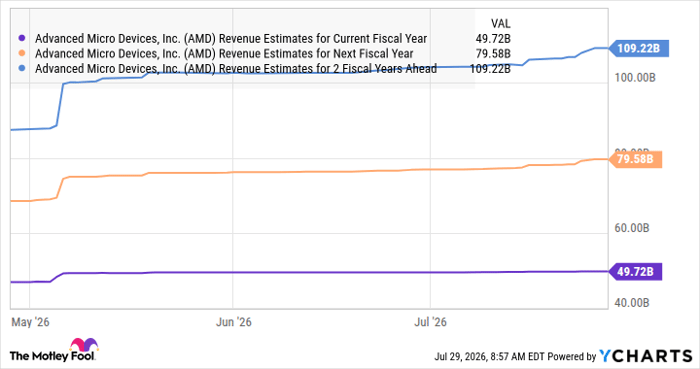
Analysts estimate that its share could reach 10% by the end of 2026, with further gains possible by the end of the decade. As such, AMD now seems primed for stronger growth over the next five years. The company's revenue increased by 34% in 2025, and analysts are expecting a much stronger increase of 43.5% in the current fiscal year to $49.7 billion.
The next couple of years point to major improvements in the company's top line, potentially setting it up for phenomenal upside through the end of the decade.
Data by YCharts
The stock still has multibagger potential
We have seen that this AI stock has been a multibagger over the past five years. Looking ahead, its tremendous earnings growth could help it replicate such a performance.
Consensus estimates project AMD's revenue to hit $109.2 billion in 2028, as seen in the previous chart. That's a three-year CAGR of 46%, using the company's 2025 revenue of $34.6 billion as the base. Assuming AMD's top line increases at a relatively conservative pace 30% in 2029 and 2030, its revenue could land at $184.5 billion by the end of the decade.
AMD currently has a price-to-sales ratio of 22, which is a premium to the U.S. tech sector's average sales multiple of 7.3. However, AMD's accelerating growth justifies its premium. But even if it trades at a discounted 15 times sales after five years, its market cap could increase to $2.77 trillion. That's 3.6x AMD's current market cap, indicating that investors can still buy and hold this semiconductor stock for the long run in anticipation of solid gains.
Should you buy stock in Advanced Micro Devices right now?
Before you buy stock in Advanced Micro Devices, consider this:
The Motley Fool Stock Advisor analyst team just identified what they believe are the 10 best stocks for investors to buy now… and Advanced Micro Devices wasn’t one of them. The 10 stocks that made the cut could produce monster returns in the coming years.
Consider when Netflix made this list on December 17, 2004... if you invested $1,000 at the time of our recommendation, you’d have $397,081!* Or when Nvidia made this list on April 15, 2005... if you invested $1,000 at the time of our recommendation, you’d have $1,166,221!*
Now, it’s worth noting Stock Advisor’s total average return is 889% — a market-crushing outperformance compared to 203% for the S&P 500. Don't miss the latest top 10 list, available with Stock Advisor, and join an investing community built by individual investors for individual investors.
See the 10 stocks »
*Stock Advisor returns as of July 30, 2026.
Harsh Chauhan has no position in any of the stocks mentioned. The Motley Fool has positions in and recommends Advanced Micro Devices and Intel. The Motley Fool has a disclosure policy.
Recommended Articles


