


Gold holds firm ahead of US NFP report as Middle East tensions remain in focus
- Gold holds firm on Friday as traders await the US Nonfarm Payrolls report for fresh clues on the Federal Reserve’s monetary policy path.
- Easing Oil prices and a weaker US Dollar support Gold, though Middle East tensions keep markets cautious.
- Technically, XAU/USD tests the 20-day SMA Bollinger mid-band while momentum remains moderate.
Gold (XAU/USD) holds firm on Friday but lacks upside momentum as traders refrain from placing aggressive directional bets ahead of the US Employment data while keeping a close eye on geopolitical developments in the Middle East. At the time of writing, XAU/USD is trading around $4,722, hovering below the two-week high of $4,764 touched on Thursday.
The metal remains on track for its first weekly advance in three weeks, drawing support from a weaker US Dollar (USD) and easing Oil prices amid cautious optimism that the US and Iran could reach a deal to end the war. However, tensions flared again on Thursday after both sides reportedly exchanged fire near the Strait of Hormuz.
Despite the renewed hostilities, US President Donald Trump downplayed the latest escalation. “The ceasefire is going. It’s in effect,” Trump told ABC News.
At the same time, Trump retaliated with fresh warnings toward Tehran as Washington awaits Iran’s response to the latest US proposal. “We’ll knock them out a lot harder, and a lot more violently, in the future, if they don’t get their Deal signed, FAST!” Trump wrote on his Truth Social platform.
While Oil prices have pulled back from recent highs, they remain elevated amid ongoing supply disruptions through the Strait of Hormuz, a key shipping route that carries nearly 20% of global Oil flows.
This continues to keep inflation risks in focus, limiting upside attempts in the non-yielding metal as markets increasingly expect major central banks, particularly the Federal Reserve (Fed), to keep interest rates higher for longer.
Attention now turns to the US Nonfarm Payrolls (NFP) report, which could play a key role in shaping expectations for the Fed’s next policy moves. Markets expect the US economy to have added 62K jobs in April, down from the 178K increase recorded in March, while the Unemployment Rate is seen holding steady at 4.3%.
A softer-than-expected reading could reinforce expectations for Fed rate cuts later this year, further weighing on the US Dollar and supporting the precious metal. On the other hand, a stronger labor market report could strengthen the case for the Fed to keep interest rates higher for longer, limiting the upside in Gold.
Technical analysis: XAU/USD trades within expanding Bollinger Bands as volatility builds
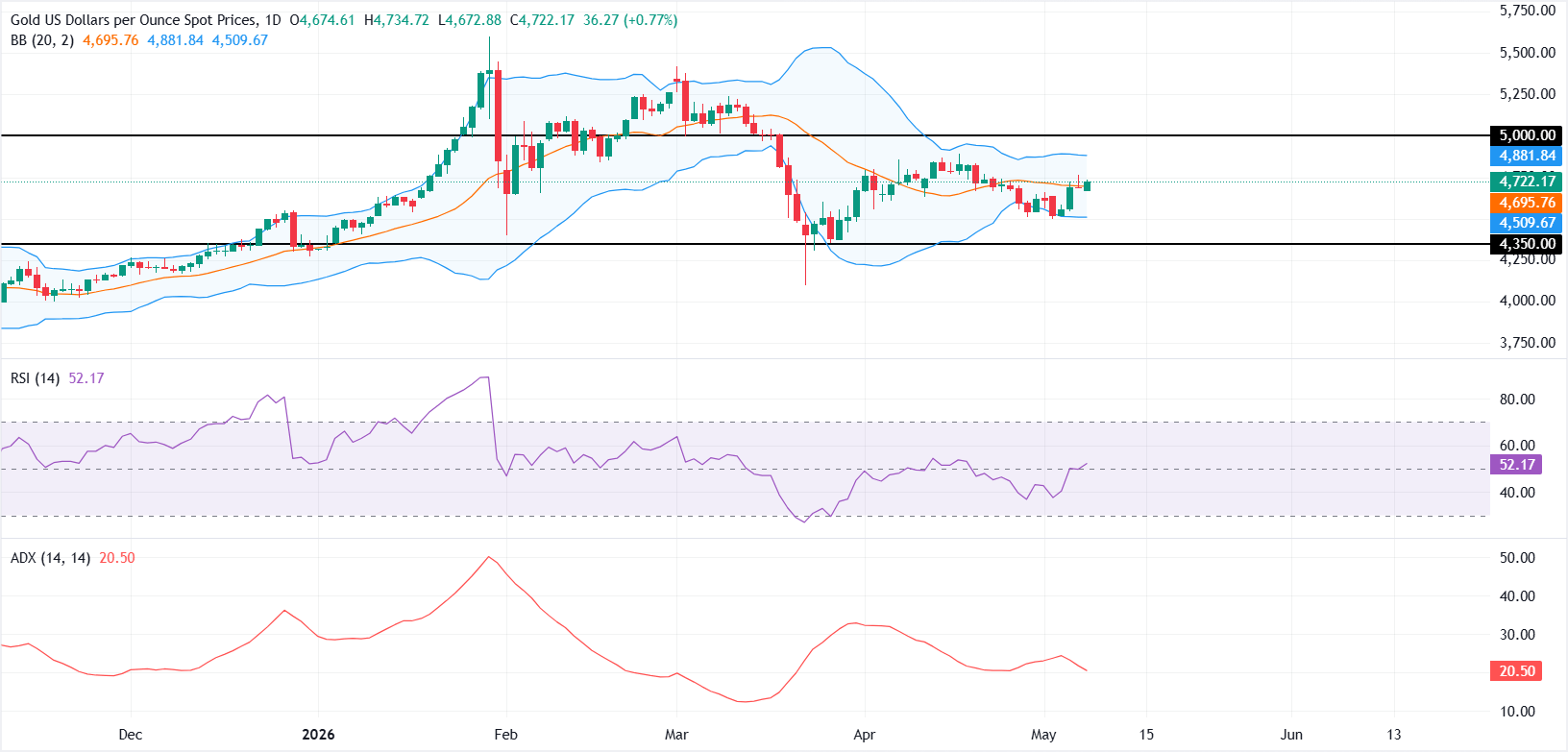
On the daily chart, XAU/USD tests the 20-day Simple Moving Average (the Bollinger middle band) around $4,695 while maintaining a constructive near-term bias, keeping the uptrend from recent lows intact as volatility bands continue to expand.
The Relative Strength Index near 52 suggests moderately positive momentum without overbought conditions, and a subdued Average Directional Index around 20 indicates a trend that is present but not strongly directional, leaving room for extended swings within the broader bullish structure.
On the topside, immediate resistance emerges at the upper Bollinger Band near $4,882, with a more strategic barrier at the psychological $5,000 mark, where sellers could attempt to reassert control.
On the downside, initial support is located at the mid-Bollinger band around $4,695, ahead of the lower band near $4,509; a deeper pullback eyeing the horizontal floor at $4,350 would be needed to seriously challenge the prevailing upward bias.
(The technical analysis of this story was written with the help of an AI tool.)
Fed FAQs
Monetary policy in the US is shaped by the Federal Reserve (Fed). The Fed has two mandates: to achieve price stability and foster full employment. Its primary tool to achieve these goals is by adjusting interest rates. When prices are rising too quickly and inflation is above the Fed’s 2% target, it raises interest rates, increasing borrowing costs throughout the economy. This results in a stronger US Dollar (USD) as it makes the US a more attractive place for international investors to park their money. When inflation falls below 2% or the Unemployment Rate is too high, the Fed may lower interest rates to encourage borrowing, which weighs on the Greenback.
The Federal Reserve (Fed) holds eight policy meetings a year, where the Federal Open Market Committee (FOMC) assesses economic conditions and makes monetary policy decisions. The FOMC is attended by twelve Fed officials – the seven members of the Board of Governors, the president of the Federal Reserve Bank of New York, and four of the remaining eleven regional Reserve Bank presidents, who serve one-year terms on a rotating basis.
In extreme situations, the Federal Reserve may resort to a policy named Quantitative Easing (QE). QE is the process by which the Fed substantially increases the flow of credit in a stuck financial system. It is a non-standard policy measure used during crises or when inflation is extremely low. It was the Fed’s weapon of choice during the Great Financial Crisis in 2008. It involves the Fed printing more Dollars and using them to buy high grade bonds from financial institutions. QE usually weakens the US Dollar.
Quantitative tightening (QT) is the reverse process of QE, whereby the Federal Reserve stops buying bonds from financial institutions and does not reinvest the principal from the bonds it holds maturing, to purchase new bonds. It is usually positive for the value of the US Dollar.
Recommended Articles


