


Breaking: Oil prices surge as Middle East chaos widens, WTI climbs above $85
Crude oil prices continue to surge on Friday as the crisis in the Middle East deepens.
At the time of press, the barrel of West Texas Intermediate (WTI) was trading at its highest level since April 24 at $85.05, gaining more than 8% on the day and up about 26% for the week. Similarly, the barrel of Brent rises 5.5% on a daily basis to trade at $87.80.
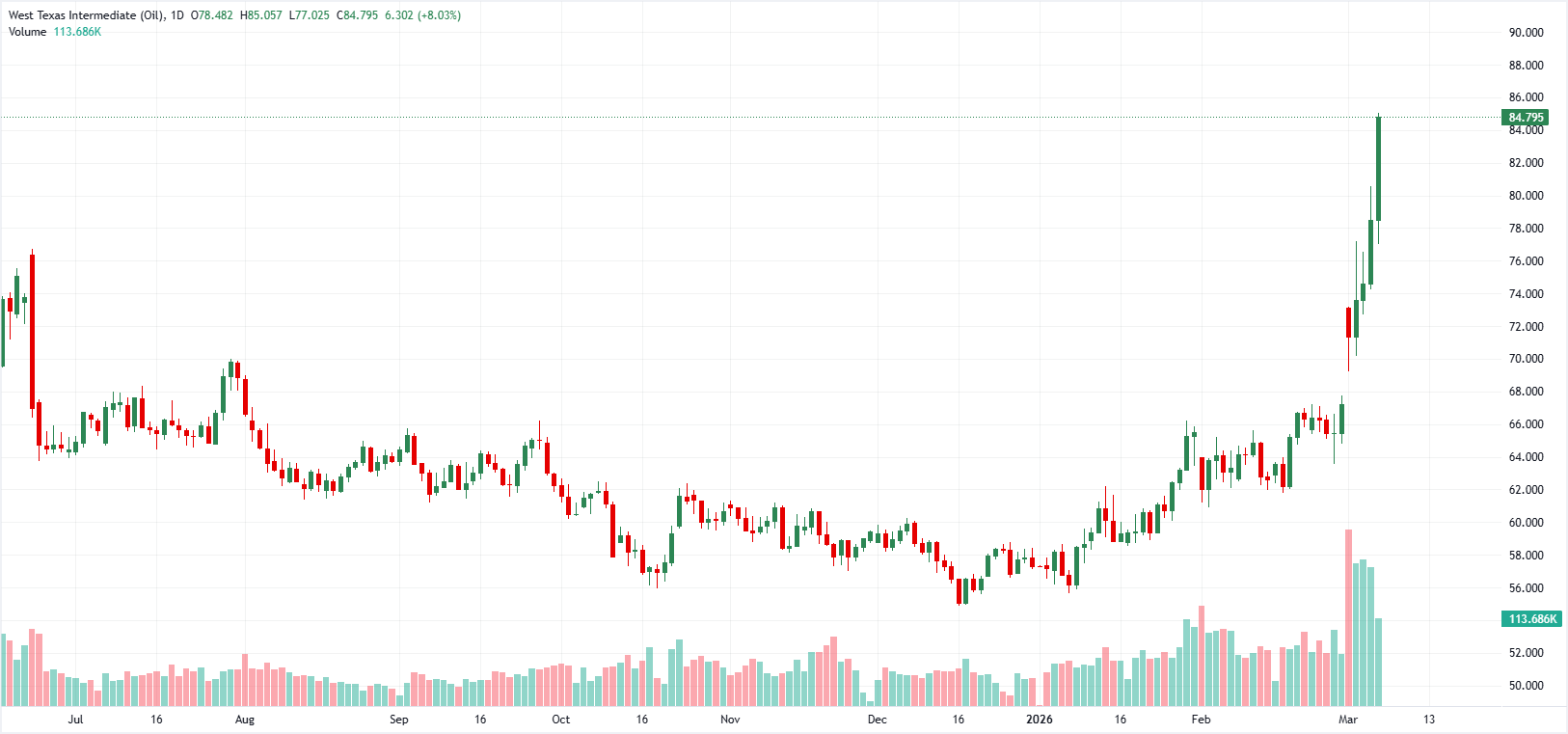
Earlier in the day, the Financial Times reported that Qatar’s Energy Minister Saad al-Kaabi warned that the ongoing war in the Middle East, which involves the United States (US), Israel, and Iran, could drive oil price to $150 a barrel.
Kaabi added that even if the war ended immediately it would take Qatar "weeks to months" to return to a normal cycle of deliveries.
Meanwhile, US Energy Secretary Chris Wright told Fox News that the US navy will escort ships as soon as reasonable and argued that they should see oil prices come down in weeks, rather than months. These comments, however, failed to trigger a correction in oil prices.
Commenting on rising oil prices, Federal Reserve (Fed) Governor Christopher Waller said that people will see a spike in gas prices but added that this situation is unlikely to cause sustained inflation. "If energy prices are unwound in a few weeks or a couple of months it will cause a problem for the Fed," Waller added and said it could have a broader impact if it were to last longer.
Following the Senate vote on Wednesday, the US House has rejected a measure to limit US President Donald Trump's ability to take further military action against Iran on Thursday. Meanwhile, US President Donald Trump said that Iranian officials reached out in an attempt to come to an agreement to end the war, but he insisted that it was too late. In response, Iranian Foreign Minister Abbas Araghchi told “NBC Nightly News” anchor Tom Llamas that Iran has not asked for a ceasefire and added that they have rejected negotiations with the US.
WTI Oil FAQs
WTI Oil is a type of Crude Oil sold on international markets. The WTI stands for West Texas Intermediate, one of three major types including Brent and Dubai Crude. WTI is also referred to as “light” and “sweet” because of its relatively low gravity and sulfur content respectively. It is considered a high quality Oil that is easily refined. It is sourced in the United States and distributed via the Cushing hub, which is considered “The Pipeline Crossroads of the World”. It is a benchmark for the Oil market and WTI price is frequently quoted in the media.
Like all assets, supply and demand are the key drivers of WTI Oil price. As such, global growth can be a driver of increased demand and vice versa for weak global growth. Political instability, wars, and sanctions can disrupt supply and impact prices. The decisions of OPEC, a group of major Oil-producing countries, is another key driver of price. The value of the US Dollar influences the price of WTI Crude Oil, since Oil is predominantly traded in US Dollars, thus a weaker US Dollar can make Oil more affordable and vice versa.
The weekly Oil inventory reports published by the American Petroleum Institute (API) and the Energy Information Agency (EIA) impact the price of WTI Oil. Changes in inventories reflect fluctuating supply and demand. If the data shows a drop in inventories it can indicate increased demand, pushing up Oil price. Higher inventories can reflect increased supply, pushing down prices. API’s report is published every Tuesday and EIA’s the day after. Their results are usually similar, falling within 1% of each other 75% of the time. The EIA data is considered more reliable, since it is a government agency.
OPEC (Organization of the Petroleum Exporting Countries) is a group of 12 Oil-producing nations who collectively decide production quotas for member countries at twice-yearly meetings. Their decisions often impact WTI Oil prices. When OPEC decides to lower quotas, it can tighten supply, pushing up Oil prices. When OPEC increases production, it has the opposite effect. OPEC+ refers to an expanded group that includes ten extra non-OPEC members, the most notable of which is Russia.
Recommended Articles


