


WTI trims gains after rally to one-year high as traders assess US-Iran conflict
- WTI pulls back after touching a one-year high near $77.20 on Tuesday.
- Supply disruptions in the Strait of Hormuz keep a geopolitical risk premium in Oil prices.
- Technically, WTI maintains a bullish structure as RSI nears overbought levels while MACD remains in positive territory.
West Texas Intermediate (WTI) Crude Oil trims part of its intraday gains on Wednesday as traders assess geopolitical developments surrounding the US-Iran conflict. At the time of writing, WTI trades near $74.32 after briefly reaching a one-year high of $77.20 on Tuesday.
The pullback comes after a New York Times report suggested that Iranian operatives had signalled openness to discussing terms to end the war. However, crude prices remain elevated, up nearly 10% this week, amid ongoing disruptions to Oil flows through the Strait of Hormuz.
US President Donald Trump tried to calm markets, saying the US “will begin escorting tankers through the Strait of Hormuz as soon as possible” if necessary. In a post on Truth Social on Tuesday, Trump added that Washington would provide political risk insurance for ships traveling through the Gulf to “ensure the FREE FLOW of ENERGY to the WORLD.”
Meanwhile, the Energy Information Administration (EIA) reported that US crude inventories rose by 3.475 million barrels last week, above expectations of 2.2 million barrels, though the increase was far smaller than the previous 15.989 million-barrel build. The report had little impact on prices as markets continued to focus on supply disruptions in the Middle East.
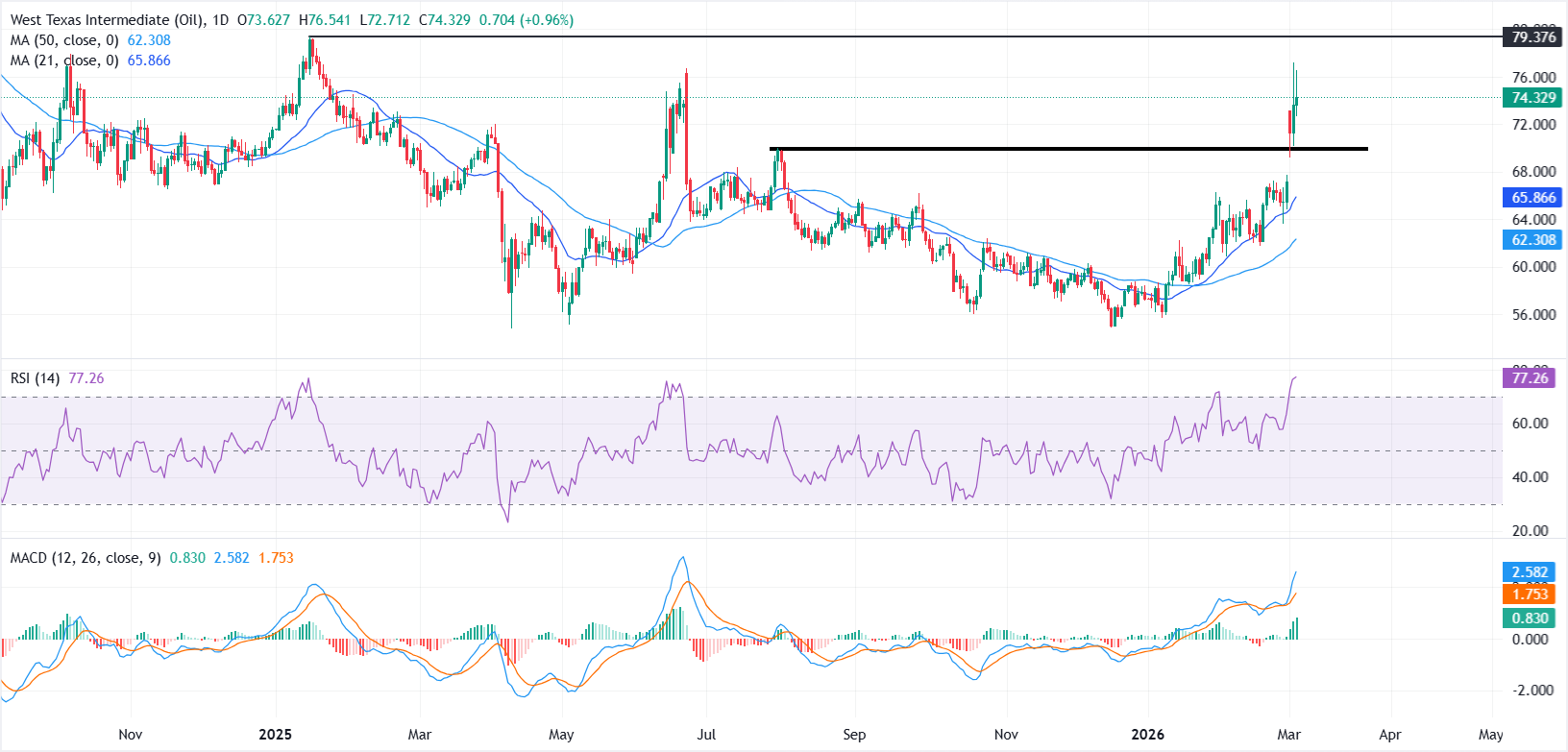
From a technical perspective, the daily chart shows WTI maintaining a steady uptrend, marked by a sequence of higher highs and higher lows since bottoming at $54.88 on December 16.
The Relative Strength Index (RSI) is hovering near 77, pointing to overbought conditions while still reflecting strong buying pressure. Meanwhile, the Moving Average Convergence Divergence (MACD) line remains above the signal line and firmly in positive territory, with the histogram continuing to expand.
On the upside, immediate resistance is seen at Tuesday’s peak near $77.20. A break above this level could bring the $79.00-$80.00 resistance zone, marked by the January 15, 2025 high near $79.37. A sustained move above this zone may open the door for a further extension toward the $85.00 handle.
On the downside, initial support emerges in the $69.00-$70.00 zone. A break below this area could expose the 21-day SMA near $65.86, followed by the 50-day SMA around $62.30.
WTI Oil FAQs
WTI Oil is a type of Crude Oil sold on international markets. The WTI stands for West Texas Intermediate, one of three major types including Brent and Dubai Crude. WTI is also referred to as “light” and “sweet” because of its relatively low gravity and sulfur content respectively. It is considered a high quality Oil that is easily refined. It is sourced in the United States and distributed via the Cushing hub, which is considered “The Pipeline Crossroads of the World”. It is a benchmark for the Oil market and WTI price is frequently quoted in the media.
Like all assets, supply and demand are the key drivers of WTI Oil price. As such, global growth can be a driver of increased demand and vice versa for weak global growth. Political instability, wars, and sanctions can disrupt supply and impact prices. The decisions of OPEC, a group of major Oil-producing countries, is another key driver of price. The value of the US Dollar influences the price of WTI Crude Oil, since Oil is predominantly traded in US Dollars, thus a weaker US Dollar can make Oil more affordable and vice versa.
The weekly Oil inventory reports published by the American Petroleum Institute (API) and the Energy Information Agency (EIA) impact the price of WTI Oil. Changes in inventories reflect fluctuating supply and demand. If the data shows a drop in inventories it can indicate increased demand, pushing up Oil price. Higher inventories can reflect increased supply, pushing down prices. API’s report is published every Tuesday and EIA’s the day after. Their results are usually similar, falling within 1% of each other 75% of the time. The EIA data is considered more reliable, since it is a government agency.
OPEC (Organization of the Petroleum Exporting Countries) is a group of 12 Oil-producing nations who collectively decide production quotas for member countries at twice-yearly meetings. Their decisions often impact WTI Oil prices. When OPEC decides to lower quotas, it can tighten supply, pushing up Oil prices. When OPEC increases production, it has the opposite effect. OPEC+ refers to an expanded group that includes ten extra non-OPEC members, the most notable of which is Russia.
Recommended Articles


