

Gold’s $5,000 Breaking Point: Why the Middle East Crisis Isn't Saving the Bulls

Source Tradingkey

TradingKey - US-Iran war continues to escalate, but gold prices suddenly plunge. Has it already peaked?

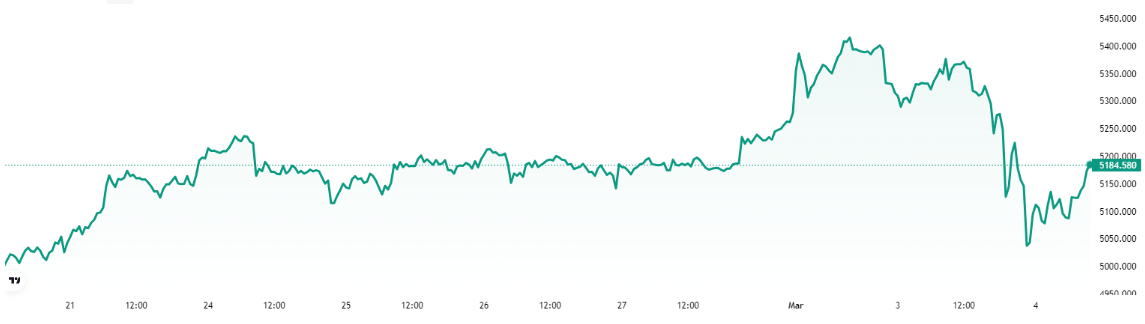
During early Asian trading on Wednesday (March 4), gold ( XAUUSD) reversed the previous day's decline, rebounding by more than 1% to break back above $5,100 per ounce, currently trading at $5,184.
xag-xau-usd-66e1893e460043ce97c7c2edabfc10a0Gold price chart, source: TradingView

Yesterday, spot gold prices saw a maximum drawdown of over 6%, dropping from a high of more than $5,300 to approach the $5,000 psychological level. With the situation in the Middle East continuing to deteriorate, why did gold prices fall instead of rise? This has left investors perplexed.

On the evening of March 3 local time, Iran's Islamic Revolutionary Guard Corps (IRGC) announced it had deployed a massive number of missiles and drones to attack targets within Israel, officially launching the 16th round of attacks under "Operation True Promise 4."

Despite Iranian retaliation, the United States has ignored calls from allies such as the UAE and Qatar to end the war as soon as possible. U.S. President Trump claimed that the U.S. military has sufficient ammunition and can sustain the conflict indefinitely. Furthermore, Trump stated, "I do not rule out sending ground troops to Iran; I don't care about the polls." Currently, instead of showing weakness or negotiating, both sides have launched even more aggressive attacks, entering a state that is nearly out of control.

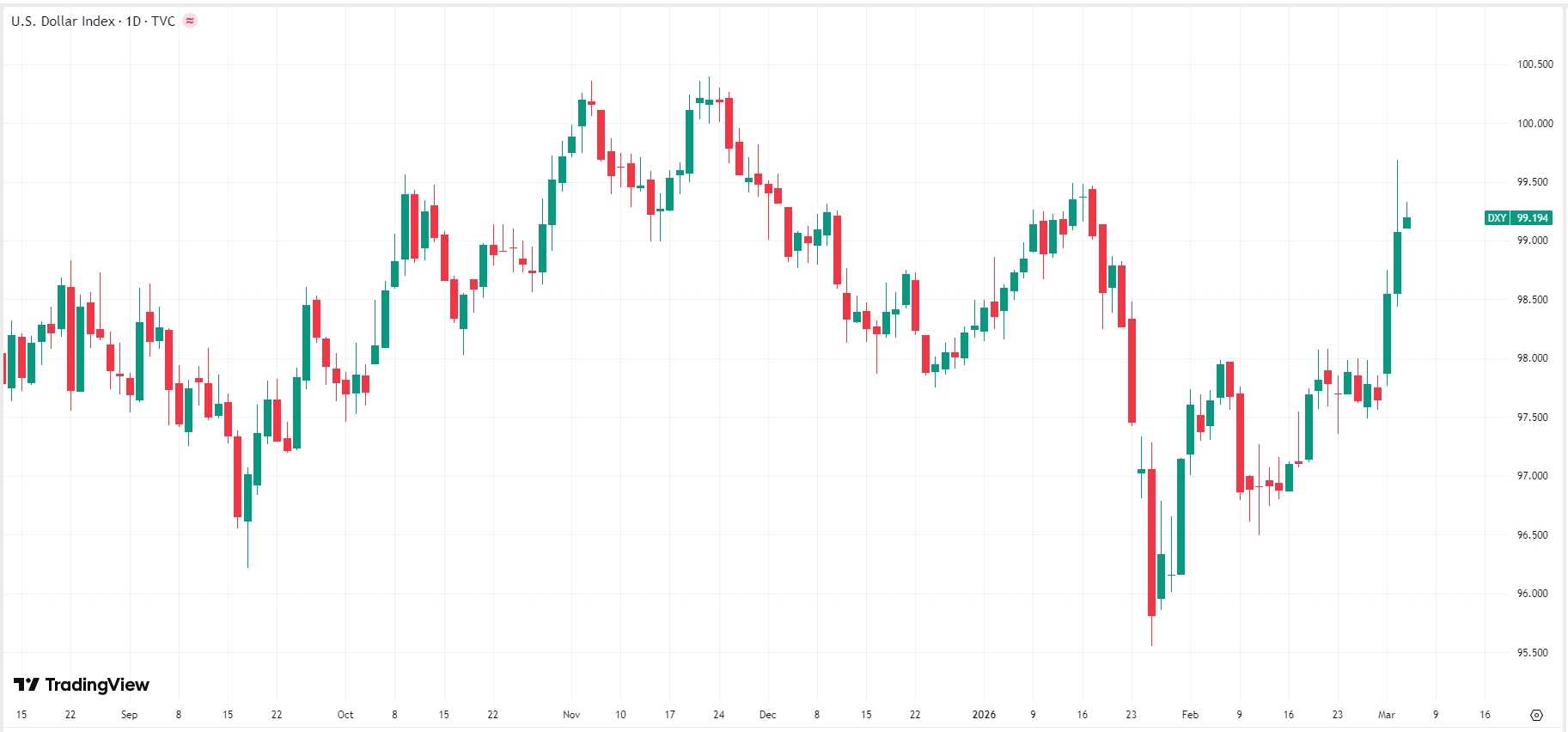
Although the war has boosted safe-haven demand and provided support for gold prices, a stronger U.S. dollar has become a burden on its upward momentum. Since the plunge on January 27, the U.S. Dollar Index (DXY) has continued to rebound, approaching the 100 mark with a cumulative gain of approximately 5%.
usd-dollar-27e77bbf9fde4b589b408da8ea5d308eU.S. Dollar Index (DXY) chart, source: TradingView

Furthermore, in the view of analyst Bob Haberkorn, the surge in demand for liquidity is also a major reason for the correction in gold prices. Bob Haberkorn stated, "The chase for liquidity—the demand to move into cash—seems to be causing the pullback in gold prices."

So, how low will gold prices fall? Bob Haberkorn believes this correction is temporary, and that geopolitical risks will continue to drive safe-haven capital into gold and silver, pushing their prices higher.

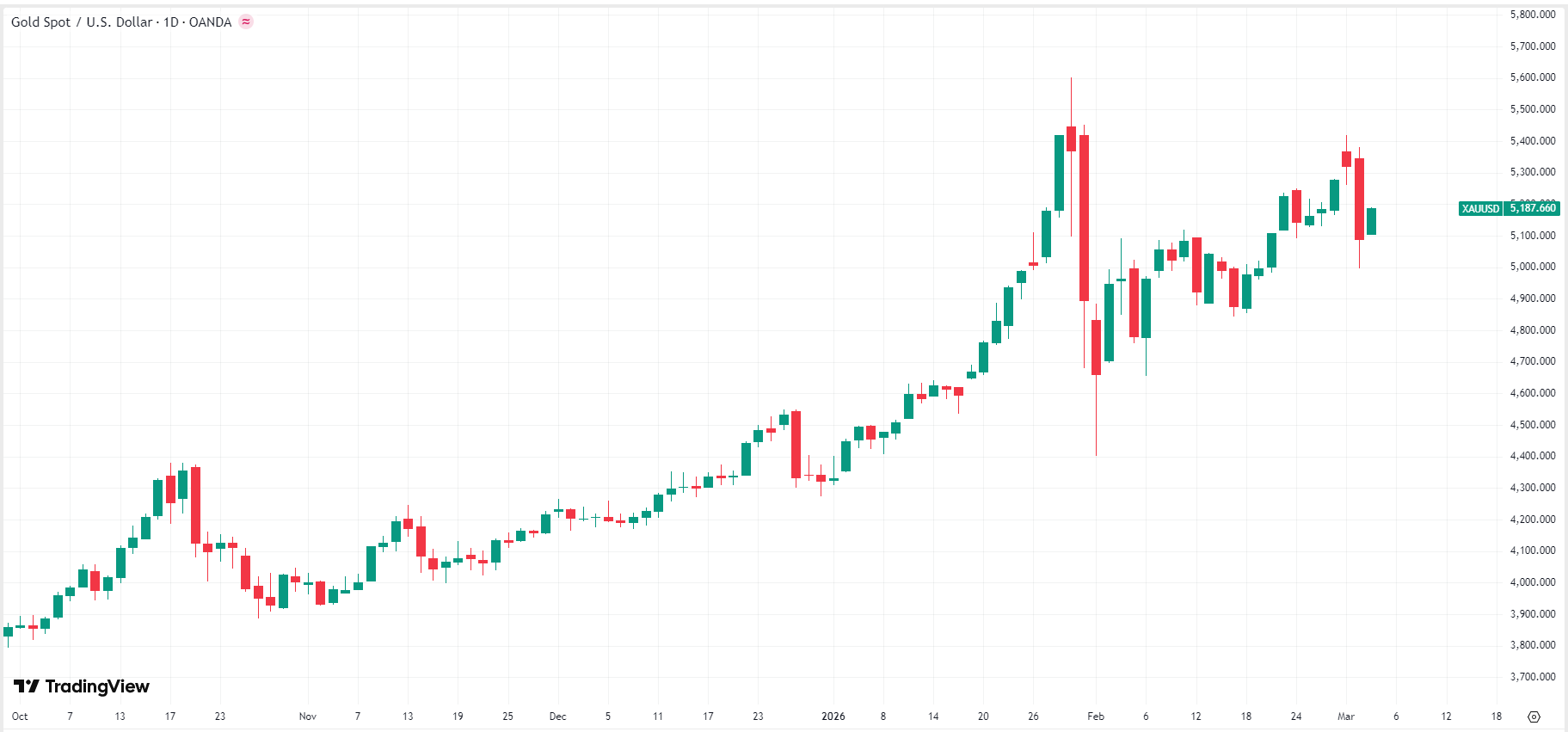
From a technical analysis perspective, the all-time high of $5,500 reached on January 29 is a key resistance level for gold, and the reversal after the March 2 rally indicates heavy selling pressure at that level. In this scenario, strong buying power is required to absorb profit-taking sell-offs; otherwise, prices will continue to retreat. In other words, without external catalysts or a de-escalation of the US-Iran war, gold prices will lose support.
usd-xag-gold-c9ec3ec0a5084a94b4af839fe4b7c9c6Gold price chart, source: TradingView

Disclaimer: For information purposes only. Past performance is not indicative of future results.
placeholder
Bitcoin CME gaps at $35,000, $27,000 and $21,000, which one gets filled first?Prioritize filling the $27,000 gap and even try higher.
Author  FXStreet
Aug 22, 2023
Prioritize filling the $27,000 gap and even try higher.
placeholder
Elon Musk’s xAI and Neuralink Launch New Funding Rounds​Billionaire Elon Musk recently raised funds for his two high-profile tech companies, xAI and Neuralink.
Author  Insights
Jun 03, 2025
​Billionaire Elon Musk recently raised funds for his two high-profile tech companies, xAI and Neuralink.
placeholder
The dollar weakened, equities dipped, and gold hit record highsThe dollar weakened, equities fell, and gold set new records on Wednesday as investors waited for a Fed rate cut later in the day.
Author  Cryptopolitan
Sep 17, 2025
The dollar weakened, equities fell, and gold set new records on Wednesday as investors waited for a Fed rate cut later in the day.
placeholder
Bitcoin briefly loses 2025 gains as crypto plunges over the weekend.Bitcoin experienced a sharp decline this weekend, briefly erasing its 2025 gains and dipping below its year-opening value of $93,507. The cryptocurrency fell to a low of $93,029 on Sunday, representing a 25% drop from its all-time high in October. Although it has rebounded slightly to around $94,209, the pressures on the market remain significant. The downturn occurred despite the reopening of the U.S. government on Thursday, which many had hoped would provide essential support for crypto markets. This year initially appeared promising for cryptocurrencies, particularly after the inauguration of President Donald Trump, who has established the most pro-crypto administration thus far. However, ongoing political tensions—including Trump's tariff strategies and the recent government shutdown, lasting a historic 43 days—have contributed to several rapid price pullbacks for Bitcoin throughout the year. Market dynamics are also being influenced by Bitcoin whales—investors holding large amounts of Bitcoin—who have been offloading portions of their assets, consequently stalling price rallies even as positive regulatory developments emerge. Despite these sell-offs, analysts from Glassnode argue that this behavior aligns with typical patterns seen among long-term investors during the concluding stages of bull markets, suggesting it is not indicative of a mass exodus. Notably, Bitcoin is not alone in its struggles, as Ethereum and Solana have also recorded declines of 7.95% and 28.3%, respectively, since the start of the year, while numerous altcoins have faced even steeper losses. Looking ahead, questions linger regarding the viability of the four-year cycle thesis, particularly given the increasing institutional support and regulatory frameworks now in place in the crypto landscape. Matt Hougan, chief investment officer at Bitwise, remains optimistic, suggesting a potential Bitcoin resurgence in 2026 driven by the “debasement trade” thesis and a broader trend toward increased adoption of stablecoins, tokenization, and decentralized finance. Hougan emphasized the soundness of the underlying fundamentals, pointing to a positive outlook for the sector in the longer term.
Author  Mitrade
Nov 17, 2025
Bitcoin experienced a sharp decline this weekend, briefly erasing its 2025 gains and dipping below its year-opening value of $93,507. The cryptocurrency fell to a low of $93,029 on Sunday, representing a 25% drop from its all-time high in October. Although it has rebounded slightly to around $94,209, the pressures on the market remain significant. The downturn occurred despite the reopening of the U.S. government on Thursday, which many had hoped would provide essential support for crypto markets. This year initially appeared promising for cryptocurrencies, particularly after the inauguration of President Donald Trump, who has established the most pro-crypto administration thus far. However, ongoing political tensions—including Trump's tariff strategies and the recent government shutdown, lasting a historic 43 days—have contributed to several rapid price pullbacks for Bitcoin throughout the year. Market dynamics are also being influenced by Bitcoin whales—investors holding large amounts of Bitcoin—who have been offloading portions of their assets, consequently stalling price rallies even as positive regulatory developments emerge. Despite these sell-offs, analysts from Glassnode argue that this behavior aligns with typical patterns seen among long-term investors during the concluding stages of bull markets, suggesting it is not indicative of a mass exodus. Notably, Bitcoin is not alone in its struggles, as Ethereum and Solana have also recorded declines of 7.95% and 28.3%, respectively, since the start of the year, while numerous altcoins have faced even steeper losses. Looking ahead, questions linger regarding the viability of the four-year cycle thesis, particularly given the increasing institutional support and regulatory frameworks now in place in the crypto landscape. Matt Hougan, chief investment officer at Bitwise, remains optimistic, suggesting a potential Bitcoin resurgence in 2026 driven by the “debasement trade” thesis and a broader trend toward increased adoption of stablecoins, tokenization, and decentralized finance. Hougan emphasized the soundness of the underlying fundamentals, pointing to a positive outlook for the sector in the longer term.
placeholder
Silver Price Forecast: XAG/USD falls to near $72.00 amid fading safe-haven demandSilver price (XAG/USD) continues to lose ground after registering tiny losses in the previous day, trading around $72.90 during the Asian hours on Thursday. The safe-haven demand for the precious metal fades amid rising optimism over Middle East peace.
Author  FXStreet
Apr 02, Thu
Silver price (XAG/USD) continues to lose ground after registering tiny losses in the previous day, trading around $72.90 during the Asian hours on Thursday. The safe-haven demand for the precious metal fades amid rising optimism over Middle East peace.
goTop
quote