

Gold and Silver February Summary: Safe-Haven and Speculation Resonance, Precious Metals See Double Boost From Sentiment and Speculative Funds

Source Tradingkey

TradingKey - In February 2026, the precious metals market strengthened significantly against a backdrop of rising geopolitical risks and fluctuating macro expectations. Gold (XAUUSD) and Silver (XAGUSD) not only continued the strong pattern established since the beginning of the year but also showed signs of accelerated upside momentum in the late-month period.
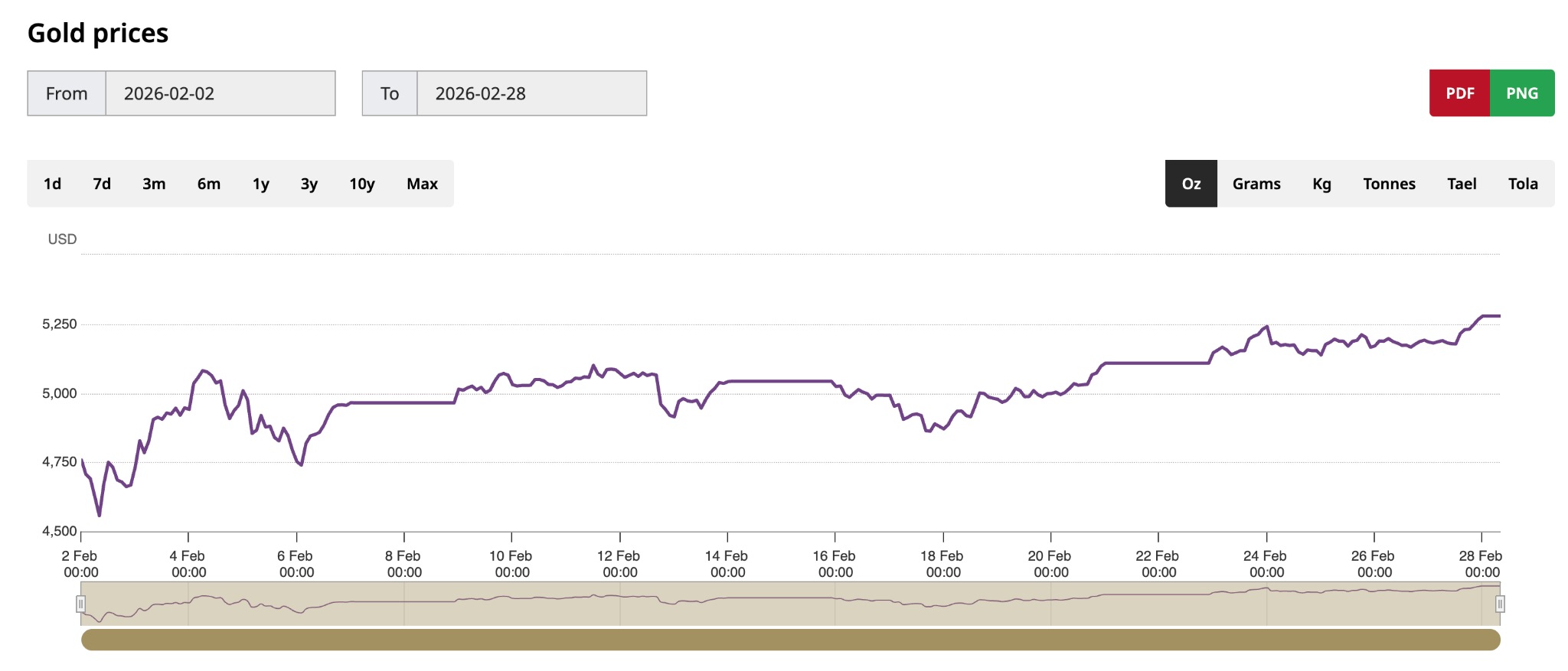
Gold-Price-Feb-a7352dabd16847aa8b13a46335b4dc4e

[Gold price performance in February, Source: World Gold Council]

Capital flows, U.S. dollar trends, changes in real interest rates, and geopolitical conflicts together constituted the core drivers of this month's market action.

From a price performance perspective, gold (XAUUSD) trended upward with volatility throughout February, approaching the $5,300 mark by month-end with significant cumulative gains. Silver (XAGUSD) exhibited more elastic growth, far outperforming gold for the month and achieving its tenth consecutive month of gains.

Silver prices approached $94, indicating that capital preference for high-beta assets is strengthening. In comparison, gold acted primarily as a safe-haven asset, while silver, which possesses both precious and industrial metal attributes, tended to amplify volatility as risk appetite improved and speculative sentiment rose.

The first primary theme for precious metals this month was geopolitical risk. Ongoing tensions in the Middle East led to market concerns that an escalation could impact energy supplies and global financial stability, rapidly driving up safe-haven demand. As a traditional safe-haven asset, gold received significant buying support during periods of concentrated risk events. Crude oil prices rose in tandem, reinforcing the logic of rebounding inflation expectations and further supporting precious metals. As of press time, Israel has announced strikes against Iran, a development in the Middle East that is bound to trigger a new major upward leg for precious metals.

The second theme was the expectation of a weakening U.S. dollar. During February, the U.S. Dollar Index was generally weak and volatile as market divisions grew regarding the future path of monetary policy. Some investors believe slowing U.S. economic momentum could limit the duration of high interest rates. A structural decline in the dollar naturally benefits dollar-denominated gold. Historical experience shows that the dollar and gold typically exhibit a negative correlation, a relationship that was reinforced once again this month.

The third theme this month was the repeated market positioning around rate-cut expectations. Although the Federal Reserve did not signal clear easing, some weakening economic data prompted investors to re-evaluate the interest rate path. Once rate-cut expectations heat up, the dollar comes under pressure and the attractiveness of non-yielding assets rises, providing support for gold.

Furthermore, on the capital front, ETF holdings remained relatively restrained, with no directional signal of sustained large-scale net inflows yet. This suggests that the current rally is driven more by futures and short-term capital rather than a broad return of long-term allocation funds.
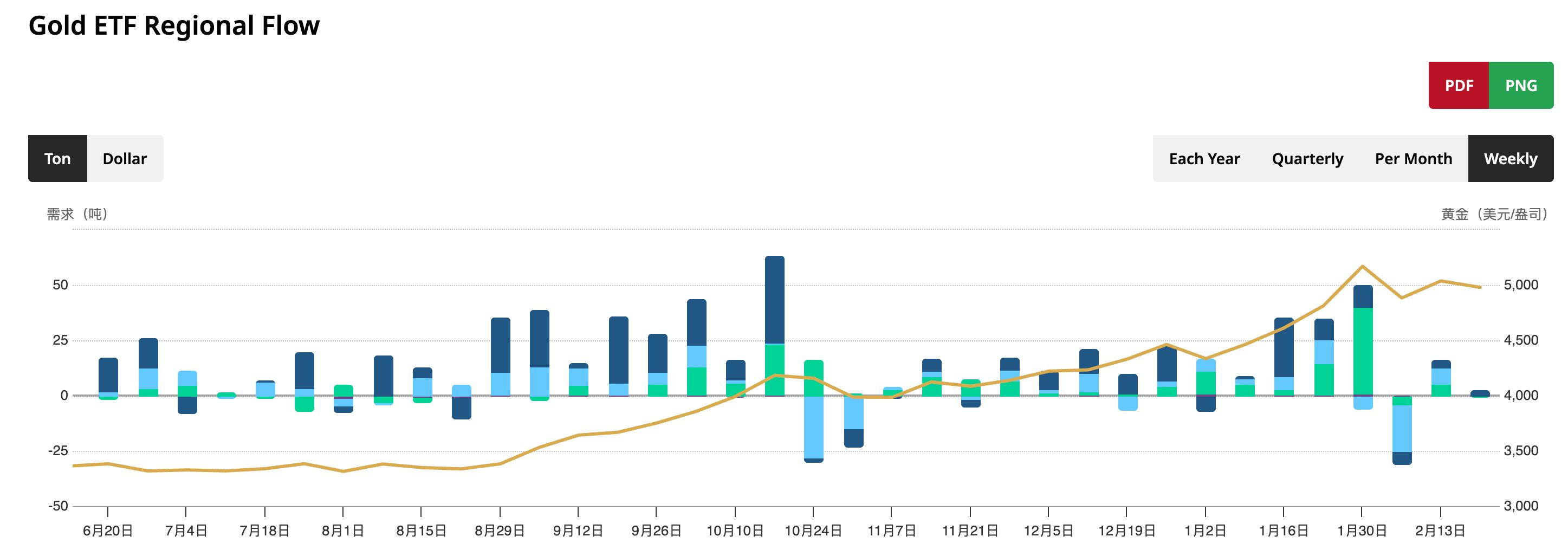
Gold-ETF-Weekly-0168cca577f24394942222b9263cde9a

[Gold ETF and central bank holdings by country, Source: World Gold Council]

Central bank gold purchases remain a long-term structural support, with emerging market central banks continuing to increase gold holdings to optimize reserve structures; however, this force is more long-term in nature and has limited impact on short-term price dynamics.

In contrast, silver's rise reflected improved risk appetite and a push from speculative capital. On one hand, expectations for an improving global manufacturing cycle benefited silver due to its significant industrial use. On the other hand, with gold continuously hitting new periodic highs, some capital shifted to silver—which had lagged in valuation—seeking catch-up opportunities. Silver's high-volatility nature often allows it to outperform gold during trending markets, though it also experiences sharper corrections.

From a technical perspective, $5,200 is merely a key psychological level that has only just been breached; it remains in a price-confirmation phase rather than having formed a stable consolidation zone. Only if prices can repeatedly test and hold above this range, forming a high-volume area, can it constitute new medium-term support. Otherwise, the risk of a sharp reversal after the breakout remains.

Overall, the precious metals rally in February was the result of multiple factors converging: geopolitics boosting safe-haven demand, a weak dollar reinforcing pricing logic, a marginal decline in real interest rates improving holding costs, and signs of recovery in capital flows. In this environment, gold demonstrated steady gains while silver amplified volatility.

Looking ahead to March, the market focus will center on two areas. First is whether the geopolitical situation escalates further; if conflict risks ease, the safe-haven premium may be given back. Second is the change in expectations for the dollar and interest rates, particularly the trajectory of real interest rates. If the dollar rebounds or real rates rise, precious metals may face short-term pressure. However, if macro uncertainty persists, gold still has medium-term support.

For investors, gold is better suited as a risk-hedging asset in a portfolio, while silver is more of a trend-trading tool. During periods of heightened volatility, controlling position size and timing is more critical than simply judging direction. February's market once again proved that when macro uncertainty rises, precious metals remain a key choice for capital seeking a margin of safety.

Disclaimer: For information purposes only. Past performance is not indicative of future results.
placeholder
Bitcoin CME gaps at $35,000, $27,000 and $21,000, which one gets filled first?Prioritize filling the $27,000 gap and even try higher.
Author  FXStreet
Aug 22, 2023
Prioritize filling the $27,000 gap and even try higher.
placeholder
Elon Musk’s xAI and Neuralink Launch New Funding Rounds​Billionaire Elon Musk recently raised funds for his two high-profile tech companies, xAI and Neuralink.
Author  Insights
Jun 03, 2025
​Billionaire Elon Musk recently raised funds for his two high-profile tech companies, xAI and Neuralink.
placeholder
The dollar weakened, equities dipped, and gold hit record highsThe dollar weakened, equities fell, and gold set new records on Wednesday as investors waited for a Fed rate cut later in the day.
Author  Cryptopolitan
Sep 17, 2025
The dollar weakened, equities fell, and gold set new records on Wednesday as investors waited for a Fed rate cut later in the day.
placeholder
Bitcoin briefly loses 2025 gains as crypto plunges over the weekend.Bitcoin experienced a sharp decline this weekend, briefly erasing its 2025 gains and dipping below its year-opening value of $93,507. The cryptocurrency fell to a low of $93,029 on Sunday, representing a 25% drop from its all-time high in October. Although it has rebounded slightly to around $94,209, the pressures on the market remain significant. The downturn occurred despite the reopening of the U.S. government on Thursday, which many had hoped would provide essential support for crypto markets. This year initially appeared promising for cryptocurrencies, particularly after the inauguration of President Donald Trump, who has established the most pro-crypto administration thus far. However, ongoing political tensions—including Trump's tariff strategies and the recent government shutdown, lasting a historic 43 days—have contributed to several rapid price pullbacks for Bitcoin throughout the year. Market dynamics are also being influenced by Bitcoin whales—investors holding large amounts of Bitcoin—who have been offloading portions of their assets, consequently stalling price rallies even as positive regulatory developments emerge. Despite these sell-offs, analysts from Glassnode argue that this behavior aligns with typical patterns seen among long-term investors during the concluding stages of bull markets, suggesting it is not indicative of a mass exodus. Notably, Bitcoin is not alone in its struggles, as Ethereum and Solana have also recorded declines of 7.95% and 28.3%, respectively, since the start of the year, while numerous altcoins have faced even steeper losses. Looking ahead, questions linger regarding the viability of the four-year cycle thesis, particularly given the increasing institutional support and regulatory frameworks now in place in the crypto landscape. Matt Hougan, chief investment officer at Bitwise, remains optimistic, suggesting a potential Bitcoin resurgence in 2026 driven by the “debasement trade” thesis and a broader trend toward increased adoption of stablecoins, tokenization, and decentralized finance. Hougan emphasized the soundness of the underlying fundamentals, pointing to a positive outlook for the sector in the longer term.
Author  Mitrade
Nov 17, 2025
Bitcoin experienced a sharp decline this weekend, briefly erasing its 2025 gains and dipping below its year-opening value of $93,507. The cryptocurrency fell to a low of $93,029 on Sunday, representing a 25% drop from its all-time high in October. Although it has rebounded slightly to around $94,209, the pressures on the market remain significant. The downturn occurred despite the reopening of the U.S. government on Thursday, which many had hoped would provide essential support for crypto markets. This year initially appeared promising for cryptocurrencies, particularly after the inauguration of President Donald Trump, who has established the most pro-crypto administration thus far. However, ongoing political tensions—including Trump's tariff strategies and the recent government shutdown, lasting a historic 43 days—have contributed to several rapid price pullbacks for Bitcoin throughout the year. Market dynamics are also being influenced by Bitcoin whales—investors holding large amounts of Bitcoin—who have been offloading portions of their assets, consequently stalling price rallies even as positive regulatory developments emerge. Despite these sell-offs, analysts from Glassnode argue that this behavior aligns with typical patterns seen among long-term investors during the concluding stages of bull markets, suggesting it is not indicative of a mass exodus. Notably, Bitcoin is not alone in its struggles, as Ethereum and Solana have also recorded declines of 7.95% and 28.3%, respectively, since the start of the year, while numerous altcoins have faced even steeper losses. Looking ahead, questions linger regarding the viability of the four-year cycle thesis, particularly given the increasing institutional support and regulatory frameworks now in place in the crypto landscape. Matt Hougan, chief investment officer at Bitwise, remains optimistic, suggesting a potential Bitcoin resurgence in 2026 driven by the “debasement trade” thesis and a broader trend toward increased adoption of stablecoins, tokenization, and decentralized finance. Hougan emphasized the soundness of the underlying fundamentals, pointing to a positive outlook for the sector in the longer term.
placeholder
Silver Price Forecast: XAG/USD falls to near $72.00 amid fading safe-haven demandSilver price (XAG/USD) continues to lose ground after registering tiny losses in the previous day, trading around $72.90 during the Asian hours on Thursday. The safe-haven demand for the precious metal fades amid rising optimism over Middle East peace.
Author  FXStreet
Apr 02, Thu
Silver price (XAG/USD) continues to lose ground after registering tiny losses in the previous day, trading around $72.90 during the Asian hours on Thursday. The safe-haven demand for the precious metal fades amid rising optimism over Middle East peace.
goTop
quote