




Gold Conquers $5,000, Silver Surges 100 Points, Who Is Behind the 'Buying Spree'?
TradingKey - Spot gold broke the historic $5,000 per ounce mark in early Monday trading, achieving this feat just over three months after gold prices first topped $4,000 on October 8, 2025. During the same period, spot silver also rose strongly, hitting a new high above $109 per ounce.
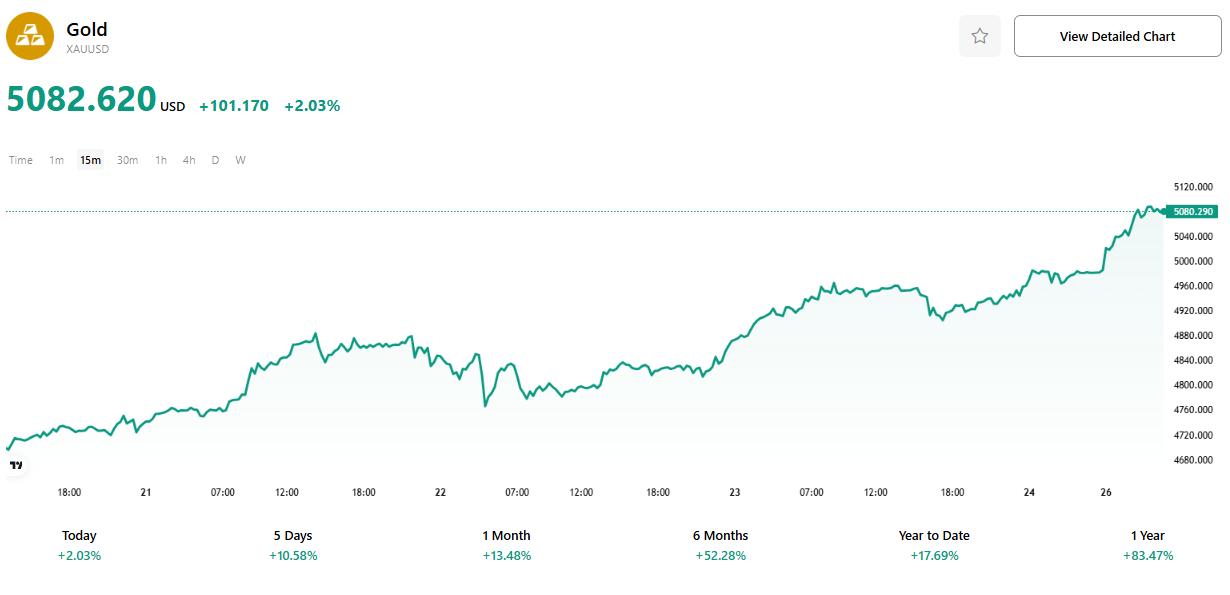
According to a gold market survey released by Kitco News, the overall sentiment among Wall Street institutional strategists remains optimistic, while retail investors have shown a degree of caution. However, most professional analysts agree that this round of gold gains is not a "rootless bubble" but is built on solid fundamentals.
Rich Checkan, President and COO of Asset Strategies International, stated bluntly: "At some point in the future, we may see gold prices fluctuate or correct, but I don't think that will happen this week. The current geopolitical situation is more complex than ever, and doubts about the Federal Reserve's political independence persist. High stock valuations and the upward momentum of some commodities also suggest that gold prices still have room to move higher. The trend is an investor's best friend."
Regarding the silver market, Paul Williams, Managing Director at Solomon Global, expressed optimism about its future trajectory. He noted that the rise in silver prices is driven not only by sustained industrial demand growth but also by retail investor enthusiasm, safe-haven appeal, and the worsening long-term supply shortage. "The threshold for gold prices is too high for some investors; silver provides a more accessible way to participate in the precious metals market. It is expected that by 2026, the potential target for silver prices could reach $120."
He added that ongoing geopolitical tensions continue to drive silver's safe-haven status, while demand for silver in future technology sectors such as new energy and artificial intelligence is growing rapidly, with no substantial improvement on the supply side. "We believe the supply shortage will persist for some time, which also supports the medium-term bullish logic for silver."
Analysis indicates that continuous gold purchases by global central banks, frequent geopolitical conflicts, and concerns over the credibility of the fiat currency system are working together to reshape investors' long-term value judgments for gold and silver, becoming the three core drivers of this upward wave.
Central banks continue to ramp up gold purchases
Currently, global central banks are entering a new wave of gold reserve expansion. A recent report by the World Gold Council shows that in November 2025, global central banks maintained a net buying stance, with a net purchase of 45 tonnes for the month. Although this was down from October, it remained at a relatively high level for the year.
As of November 2025, total gold purchases by global central banks for the year reached 297 tonnes, reflecting a sustained preference at the national level for gold as a traditional safe-haven asset. Within this trend, buying from emerging market central banks has been particularly significant, with Poland, Kazakhstan, Brazil, Turkey, and China emerging as the primary buyers.
Among them, the Polish central bank announced last week that it has approved plans to add up to 150 tonnes of gold reserves. If fully executed, its total national gold reserves will increase to 700 tonnes.
On the China front, according to official foreign exchange reserve data released by the People's Bank of China, China's gold reserves stood at 74.15 million ounces as of the end of December 2025, an increase of 30,000 ounces from the previous month. This also means that since November 2024, the Chinese central bank has increased its gold holdings for 14 consecutive months, injecting stable expectations and long-term confidence into the global gold market.
Escalating geopolitical instability
Currently, global geopolitical risks are escalating, becoming a key factor driving investors to re-evaluate their allocation to safe-haven assets.
Contradictions between the US and Europe over the Greenland issue have become increasingly prominent. Although US President Trump publicly stated he would not use force to seize this strategic Arctic location from Denmark, his intention to control Greenland has not diminished. He continues to exert diplomatic and policy pressure on the EU, attempting to force compromises on related issues.
Meanwhile, Trump continues to take a hardline stance on trade policy. Recently, he again threatened that if Canada chooses to sign a trade agreement with China, the US would consider imposing tariffs as high as 100% on its goods. This increasingly evident unilateralist tendency has caused global markets to have deeper concerns about the stability of the international trade system.
Market uncertainty resulting from geopolitical tensions is significantly increasing the demand for safe-haven allocations in precious metal assets. Against the backdrop of the ongoing war in Ukraine, the deteriorating situation in Gaza, and the US crackdown on top Venezuelan officials, gold and silver prices have continued to strengthen.
"Holding gold, it isn't linked to someone else's debt like a bond or a stock, and it's not subject to corporate performance like a stock," said Nicholas Frappell, Global Head of Institutional Markets at ABC Refinery.
"In today's uncertain world, gold is an excellent risk diversification tool," he added.
Shaking confidence in the US dollar
Colin Cieszynski, Chief Market Strategist at SIA Wealth Management, said he maintains a neutral view on gold prices for the coming week, but from a medium-to-long-term perspective, the fundamental drivers pushing gold higher remain strong.
He noted that recent geopolitical events like the Greenland situation may only be "temporary catalysts," and that "sustained weakness in the US dollar is the most core supporting force."
Last week, driven by safe-haven buying, the Bloomberg Dollar Spot Index fell 1.6%, its largest weekly decline since last May. This trend makes gold priced in other currencies "cheaper," thereby driving international buying and further strengthening gold's role as a hedge against exchange rate fluctuations and inflation risks.
"People are clearly moving away from the US dollar, which is very beneficial for gold prices," said Nikos Kavlis of research consultancy Metals Focus.
However, a deeper impact stems from the structural pressures facing the US dollar system itself.
In recent years, the US has continuously tightened its global governance commitments, pursuing a more pronounced inward-looking strategy. Actions such as cutting public investment, strengthening trade barriers, and implementing "long-arm jurisdiction" on overseas US dollar assets are gradually eroding the foundations of trust in it as an international reserve currency.
Looking back at the US-led rules-based international order formed after World War II, the US has provided "public goods" such as security and aid to the world while enjoying the dividends of low financing costs and high capital returns through the "seigniorage" effect of the dollar as a reserve currency. However, this structural exchange of "global governance for financial privilege" is now being questioned by more and more countries.
Chris Vecchio, Head of Futures Strategy and Forex at Tastylive.com, said there is already a strong demand in the market for "non-fiat system" assets. "The US dollar no longer carries the foundation of global trust as it did in the past; therefore, investors are looking toward more real, tangible assets."
What happens next?
After a period of aggressive gains, the market is beginning to focus on the subsequent performance of precious metals: Have gold and silver prices "overextended" themselves? Is there still room for further upside?
Innes, a partner at SPI Asset Management, pointed out that the rally in gold is driven not just by geopolitical conflicts, but by a deeper logic related to global public finance issues.
"In a context where fiscal deficits continue to expand, policy credibility is being constantly tested, and central bank reputations are gradually giving way to the influence of sovereign balance sheets, investors are more concerned with stability than leverage," he emphasized. Even if certain geopolitical risks subside in the short term, this macro structure will not fundamentally change.
Innes added that there are indeed signs of "crowding" in gold trades, and it faces questions of being overvalued. However, if prices maintain a structural consolidation pattern—"consolidating rather than collapsing"—gold's strong trend is still likely to continue.
By contrast, the silver market is more volatile.
Andrew Thrasher, Senior Portfolio Manager at Financial Enhancement Group, said current silver prices are "unbelievable" as they are more than 100% above the 200-day moving average, indicating a short-term overbought market. "Technically, the rubber band has been stretched very tight." He believes investors and traders are currently scaling back positions, and while there is room for further price increases, the trend has become extremely sensitive and overly optimistic.
Despite prices being at historic highs, mainstream Wall Street institutions remain optimistic about the medium-to-long-term trend for gold, with many raising their target prices.
Investment bank Jefferies ( JEF) issued the most aggressive forecast, predicting that gold prices could potentially reach $6,600 per ounce within the year.
Bank of America ( BAC) has set a short-term target price of $6,000 per ounce. Its analyst Michael Hartnett noted in a report that looking back at past gold bull market cycles, gold prices have risen an average of 300% within 43 months. By analogy with the current trend, gold prices reaching $6,000 by the spring of 2026 is foreseeable.
Independent analyst Ross Norman expects gold prices could peak at $6,400 this year, with an average price of around $5,375 for the full year. He emphasized that macro-level support remains solid—government leverage continues to expand, debt sustainability faces challenges, and central bank demand for gold remains robust, with the market still willing to use gold as a key asset for diversified reserves.
At the same time, Goldman Sachs ( GS) also raised its late-2026 gold price forecast last week, from an estimated $4,900 to $5,400. The bank noted that private capital continues to pour into the gold market, competing with central banks for limited resources, a structural change that is reshaping the market ecosystem.
Ole Hansen, Head of Commodity Strategy at Saxo Bank, also stated that while "Fear Of Missing Out" (FOMO) is one of the drivers behind the current gold rally, this movement should not be simply dismissed as market hype. "Macro fundamentals remain solid," he said.
Most analysts say the resilient performance of gold and silver is gradually validating the long-term hypothesis of "hard currency believers"—that when the credibility of global fiat currencies is under fire, gold and silver will once again become true safe havens.
Recommended Articles


