


Pound Sterling's rate advantage buys it no say this week
- GBP/USD holds just under 1.3550 after a 42-pip Monday, up 0.17%.
- One of Tuesday's four MPC witnesses voted to hike in July.
- Markets price a 59% Fed hike on September 16 and 16% from the BoE.
GBP/USD holds just under 1.3550 after a Monday that covered 42 pips with American desks shut for Labor Day. The week that follows is not that. Pound Sterling carries the higher policy rate of the two, the larger tightening path over twelve months, and almost none of the event risk that decides where the pair sits by Friday.
A holiday is not a verdict
The last thing to move this pair was Friday's US Nonfarm Payrolls (NFP), which printed 162K against a 53K consensus. GBP/USD fell 57 pips inside minutes to just beneath 1.3500 on the 12:30 GMT release and had recovered about two thirds of it by the European afternoon.
The mechanism matters more than the move. A strong American labour market raises the odds the Federal Reserve tightens again, a tighter Fed means a stronger Dollar, and a stronger Dollar means a lower GBP/USD. Sterling spent Friday being punished for somebody else's good news, and Friday next runs the same experiment on the price data.
Sterling already won the rate argument
Bank Rate is 3.75%. The Federal Reserve's target band is 3.50% to 3.75%, a midpoint of 3.625%, with the effective rate at 3.63%. The Dollar's rate advantage over the Pound, the thing that set the terms of this pair for most of four years, has gone.
The forward path reads the same way. Markets price 71.9 basis points of Bank of England tightening over twelve months against 59.5 from the Federal Reserve, and a terminal rate of 4.47% in London against 4.22% in Washington by the middle of 2027.
The inflation data does not obviously support that ordering. UK CPI inflation was 2.6% in June and the Bank's July report expected it to rise from there as energy costs pass through rather than to have peaked. The American annual rate is seen at 3.4% on Friday. London has the lower inflation, the higher policy rate and the larger path priced against it, and GBP/USD sits roughly 330 pips beneath its January high all the same.
Tuesday is the only British thing that counts
Monetary Policy Report hearings begin at 13:15 GMT on Tuesday. Four Monetary Policy Committee (MPC) members appear before the Treasury Committee: the Governor, the Deputy Governor for Markets and Banking, and two external members. The session covers July's report and the decision to hold Bank Rate.
One of those four voted to raise Bank Rate by a quarter point in July. That vote was 6-3 to hold, after 7-2 in June, so the hawkish minority has been growing a member at a time while the headline decision has not moved. The July report framed the problem as an energy shock the Committee cannot influence but has to set policy around.
None of which touches September. The Bank of England meets on September 17 with a hike priced at 16%, and the first move the market genuinely expects is November, at 56%, with December at 54% behind it and 1.25 hikes priced into Bank Rate by mid-December. Tuesday cannot change next week. It can change November, which is more than anything else on the British calendar can claim.
The rest of the week belongs to the Dollar
British Retail Consortium (BRC) sales land at 23:01 GMT on Monday, seen at 1.2% YoY after 1%. The US Producer Price Index (PPI) follows on Thursday at 12:30 GMT, seen at 0.4% on the month after a flat July and 5.3% YoY after 4.7%, with the core measure at 4.6% YoY after 4.2%.
Friday opens with UK growth at 06:00 GMT, where July output is seen flat after 0.3% and industrial and manufacturing production are both seen at 0.1%. UK consumer inflation expectations follow at 08:30 GMT, last at 4% against a CPI rate well beneath it. The US Consumer Price Index (CPI) arrives at 12:30 GMT, seen at 0.4% on the month after 0.1%, with the annual rate steady at 3.4% and the core measure easing to 2.4%. A stalled British quarter and a hot American print land six and a half hours apart, and only one of them moves a policy rate.
Levels and bias
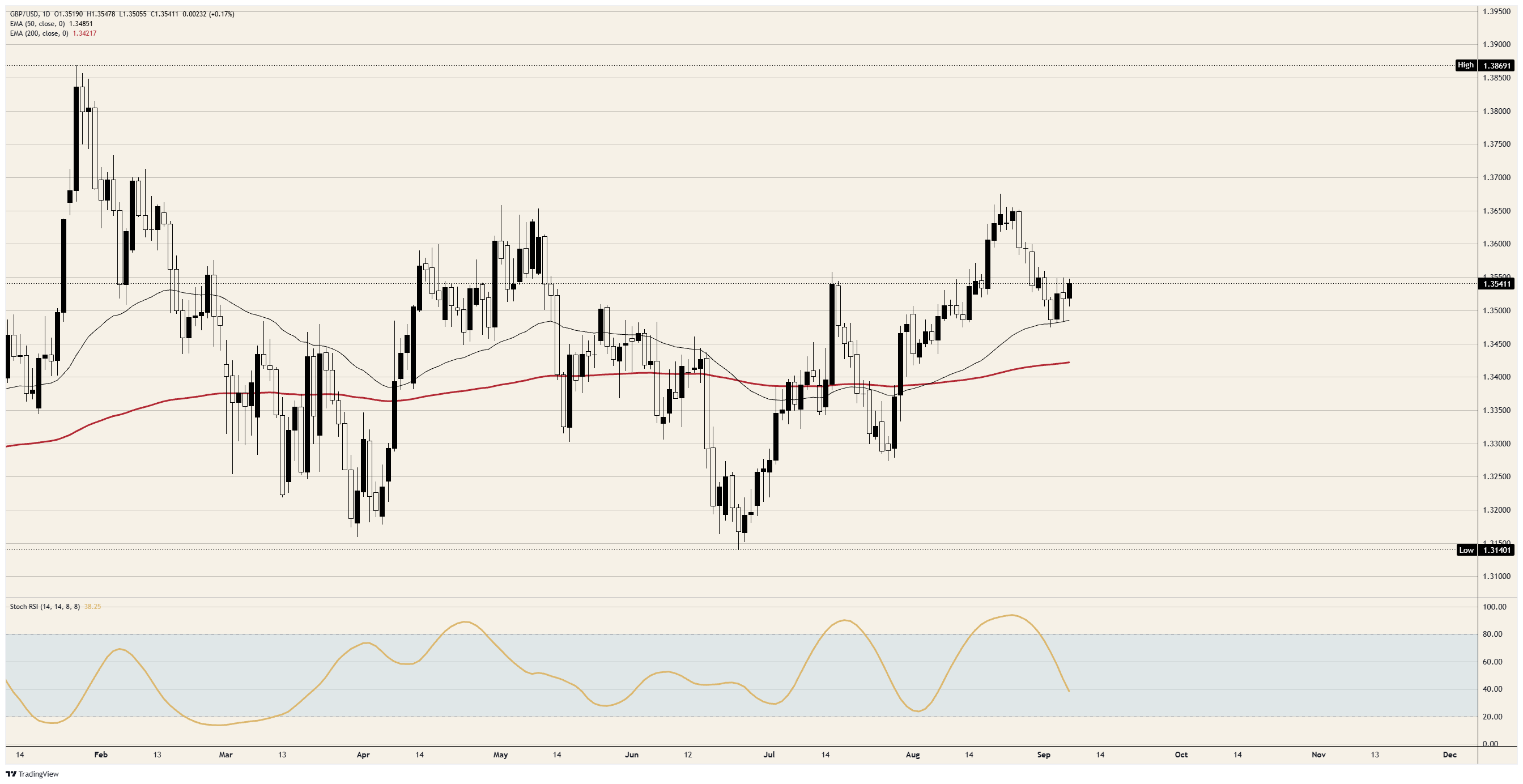
Resistance: The 1.3550 area caps the pair and Monday's high stopped short of it, in the same place Friday's high stopped. Above it, 1.3600 is the first round figure and the late-August peak in the 1.3650 area is what defines the range. The January high just under 1.3900 is not this week's business.
Support: The 1.3500 handle is doing all the work. Monday's low sat just above it and Friday's NFP low just beneath, with the 50-day Exponential Moving Average (EMA) between the two: the spike undercut that average by less than three pips before the pair took it back. Beneath there, 1.3450 is the next figure and the 200-day EMA sits just above 1.3400.
Bias: Bearish while 1.3550 caps, with 1.3500 and the 50-day EMA beneath it the objective. The daily Stochastic Relative Strength Index (Stoch RSI) has fallen from above 90 in late August to 38 while price held its range, so momentum has left without price following, though the intraday reading near 67 was still rising into the European evening. The scheduled risk points the same way, because Friday's American inflation consensus is hot enough to firm a Fed hike already priced at 59% while nothing British this week can move a September call priced at 16%. A daily close above 1.3550 invalidates the call, and a hearing on Tuesday that lifts November pricing does it faster.
GBP/USD daily chart
Pound Sterling FAQs
The Pound Sterling (GBP) is the oldest currency in the world (886 AD) and the official currency of the United Kingdom. It is the fourth most traded unit for foreign exchange (FX) in the world, accounting for 12% of all transactions, averaging $630 billion a day, according to 2022 data. Its key trading pairs are GBP/USD, also known as ‘Cable’, which accounts for 11% of FX, GBP/JPY, or the ‘Dragon’ as it is known by traders (3%), and EUR/GBP (2%). The Pound Sterling is issued by the Bank of England (BoE).
The single most important factor influencing the value of the Pound Sterling is monetary policy decided by the Bank of England. The BoE bases its decisions on whether it has achieved its primary goal of “price stability” – a steady inflation rate of around 2%. Its primary tool for achieving this is the adjustment of interest rates. When inflation is too high, the BoE will try to rein it in by raising interest rates, making it more expensive for people and businesses to access credit. This is generally positive for GBP, as higher interest rates make the UK a more attractive place for global investors to park their money. When inflation falls too low it is a sign economic growth is slowing. In this scenario, the BoE will consider lowering interest rates to cheapen credit so businesses will borrow more to invest in growth-generating projects.
Data releases gauge the health of the economy and can impact the value of the Pound Sterling. Indicators such as GDP, Manufacturing and Services PMIs, and employment can all influence the direction of the GBP. A strong economy is good for Sterling. Not only does it attract more foreign investment but it may encourage the BoE to put up interest rates, which will directly strengthen GBP. Otherwise, if economic data is weak, the Pound Sterling is likely to fall.
Another significant data release for the Pound Sterling is the Trade Balance. This indicator measures the difference between what a country earns from its exports and what it spends on imports over a given period. If a country produces highly sought-after exports, its currency will benefit purely from the extra demand created from foreign buyers seeking to purchase these goods. Therefore, a positive net Trade Balance strengthens a currency and vice versa for a negative balance.
Recommended Articles


