


Swiss Franc edges lower as US Dollar rebounds, FOMC minutes in focus
- Swiss Franc ticks lower against the US Dollar as the latter rebounds.
- Higher oil prices could force traders to raise hawkish Fed bets again.
- Investors await FOMC Minutes of the July policy meeting.
The Swiss Franc (CHF) trades marginally lower against the US Dollar (USD) in the early European trading session on Tuesday, with the USD/CHF pair edging up to near 0.8116. The Swiss Franc pair rises as the US Dollar bounces back amid fears that surging oil prices could re-ignite hawkish Federal Reserve (Fed) interest rate expectations.
At press time, the US Dollar Index (DXY), which gauges the Greenback’s value against six major currencies, trades slightly higher to near 99.65. The USD Index recovered on Monday after posting a fresh two-month low at 99.29.
The WTI Oil price has hit a fresh two-week high near $84.50 as United States (US) President Donald Trump confirmed no renewal of the US-Iran ceasefire.
In the last few weeks, traders have pared Fed interest rate hike expectations due to soft US economic data for July.
Fed hike bets fade as HSBC sees September hold risk rising
Analysts at HSBC Asset Management highlight that "market pricing for a September Federal Reserve rate hike has fallen to its lowest level since mid-June," as investors reassess the policy outlook. They note that expectations have been squeezed lower, "wedged between Warsh’s comments and the benign CPI print," while "a softer labour report has also weighed on rate expectations." HSBC adds that "if August inflation and employment data show more of the same, the Fed is likely to stay on hold in September," underscoring the importance of upcoming US data in shaping the near-term rate path.
Going forward, investors will focus on the US Federal Open Market Committee (FOMC) minutes of the July policy meeting, which will be released on Wednesday.
Meanwhile, the price action in the Swiss Franc is expected to be driven by geopolitical headlines, as the Switzerland economic calendar has nothing much to offer this week.
Technical Analysis
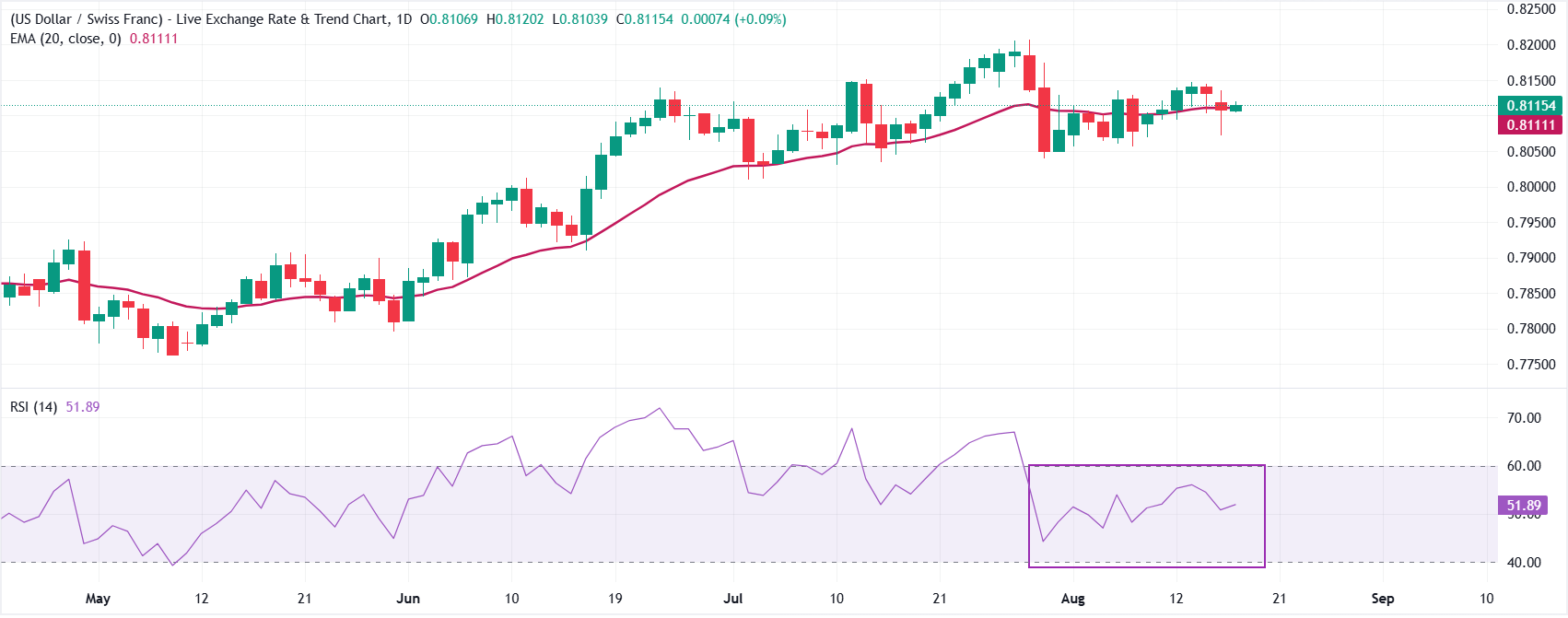
In the daily chart, USD/CHF trades at 0.8115, holding marginally above the 20-day exponential moving average (EMA) at 0.8111, which lends a mild bullish bias in the near term. The Relative Strength Index (RSI) at 51.89 sits just above the neutral 50 line, suggesting steady but unspectacular upside momentum as the pair consolidates after its recent recovery from the 0.8050 area.
On the downside, immediate support is located at the 20-day EMA at 0.8111, and a close below this level would hint at fading bullish pressure and a deeper pullback toward recent lows. As long as the pair holds above this moving average, dip-buying interest is likely to persist, keeping the short-term structure constructive while traders watch for a stronger momentum pickup to extend gains.
(The technical analysis of this story was written with the help of an AI tool. Know more.)
US Dollar FAQs
The US Dollar (USD) is the official currency of the United States of America, and the ‘de facto’ currency of a significant number of other countries where it is found in circulation alongside local notes. It is the most heavily traded currency in the world, accounting for over 88% of all global foreign exchange turnover, or an average of $6.6 trillion in transactions per day, according to data from 2022. Following the second world war, the USD took over from the British Pound as the world’s reserve currency. For most of its history, the US Dollar was backed by Gold, until the Bretton Woods Agreement in 1971 when the Gold Standard went away.
The most important single factor impacting on the value of the US Dollar is monetary policy, which is shaped by the Federal Reserve (Fed). The Fed has two mandates: to achieve price stability (control inflation) and foster full employment. Its primary tool to achieve these two goals is by adjusting interest rates. When prices are rising too quickly and inflation is above the Fed’s 2% target, the Fed will raise rates, which helps the USD value. When inflation falls below 2% or the Unemployment Rate is too high, the Fed may lower interest rates, which weighs on the Greenback.
In extreme situations, the Federal Reserve can also print more Dollars and enact quantitative easing (QE). QE is the process by which the Fed substantially increases the flow of credit in a stuck financial system. It is a non-standard policy measure used when credit has dried up because banks will not lend to each other (out of the fear of counterparty default). It is a last resort when simply lowering interest rates is unlikely to achieve the necessary result. It was the Fed’s weapon of choice to combat the credit crunch that occurred during the Great Financial Crisis in 2008. It involves the Fed printing more Dollars and using them to buy US government bonds predominantly from financial institutions. QE usually leads to a weaker US Dollar.
Quantitative tightening (QT) is the reverse process whereby the Federal Reserve stops buying bonds from financial institutions and does not reinvest the principal from the bonds it holds maturing in new purchases. It is usually positive for the US Dollar.
Recommended Articles


