


USD/JPY Forecast: Rare US Intervention Sends Pair to 155; Will It Fall Further?
TradingKey - As of the European session on August 3, the US dollar against the Japanese yen ( USD/JPY) was trading near 156.70, having briefly plummeted to 155.20 intraday before paring some of its losses. Last week, USD/JPY neared 164.00, hitting a roughly 40-year high, but the exchange rate has fallen for four consecutive trading sessions as Japan and the US successively bought yen.
Why the Dollar Is Falling Against the Yen?
The direct cause of the current decline in USD/JPY is the joint foreign exchange intervention by the US and Japan. Japan's Ministry of Finance confirmed that after Japan bought yen in the New York market last week, the US Treasury Department also participated in buying yen through the New York Fed to curb the currency's recent excessive volatility and disorderly depreciation. This is the first joint intervention by the US and Japan since 1998, releasing a policy signal far stronger than unilateral intervention by Japan.
Japanese Finance Minister Satsuki Katayama stated that if the yen experiences sharp volatility again, Japan and the US will not hesitate to take further joint action. US Treasury Secretary Bessent also indicated that Washington is prepared to repeat intervention if necessary. Because the market cannot accurately predict the timing and scale of the authorities' next entry, some investors who previously bet on the continuous depreciation of the yen began to unwind their positions, driving USD/JPY down rapidly from above 163 to near 155.
The direct participation of the US in this intervention has also changed the market's assessment of the yen. In the past, unilateral yen purchases by Japan usually only triggered a short-term rally because the wide US-Japan interest rate gap meant investors still preferred to borrow low-yield yen to buy dollar assets. However, the US's participation implies that the yen's depreciation is no longer merely a domestic issue for Japan, but is instead seen as a risk that could affect global financial stability and the US Treasury market.
Japan holds a massive amount of US Treasuries. If Japan were to sell off US Treasuries in a concentrated manner to raise intervention funds, it could push up US Treasury yields and increase borrowing costs for the US government. Direct yen purchases by the US Treasury, or utilizing the New York Fed to provide dollar liquidity, can reduce Japan's need to conduct large-scale sales of US Treasuries, which is likely one of the key reasons why the US is willing to participate in the intervention.
The Bank of Japan's policy stance has also begun to provide support for the yen. While the BOJ kept its policy rate unchanged at 1% at its July meeting, it stated in its economic outlook that it will continue to raise rates in the future as underlying inflation gradually approaches 2%. BOJ Governor Kazuo Ueda also noted that if upside risks to inflation expand, the central bank will discuss whether faster action is needed. The combination of the joint intervention and the BOJ keeping the door open to rate hikes has further weakened the upward momentum of USD/JPY.
Can the Yen Continue to Appreciate?
Whether the yen can sustain its appreciation remains uncertain. U.S. interest rates are still significantly higher than Japan's, and with low yen financing costs, the foundation for the carry trade has not fully disappeared. Meanwhile, Japan's expansionary fiscal policy could increase government debt and inflationary pressures, which would also limit the yen's long-term appreciation potential.
ING believes that if expectations for Fed rate hikes do not cool significantly and the Bank of Japan does not tighten policy further, USD/JPY could still climb back above 160.
USD/JPY Technical Analysis
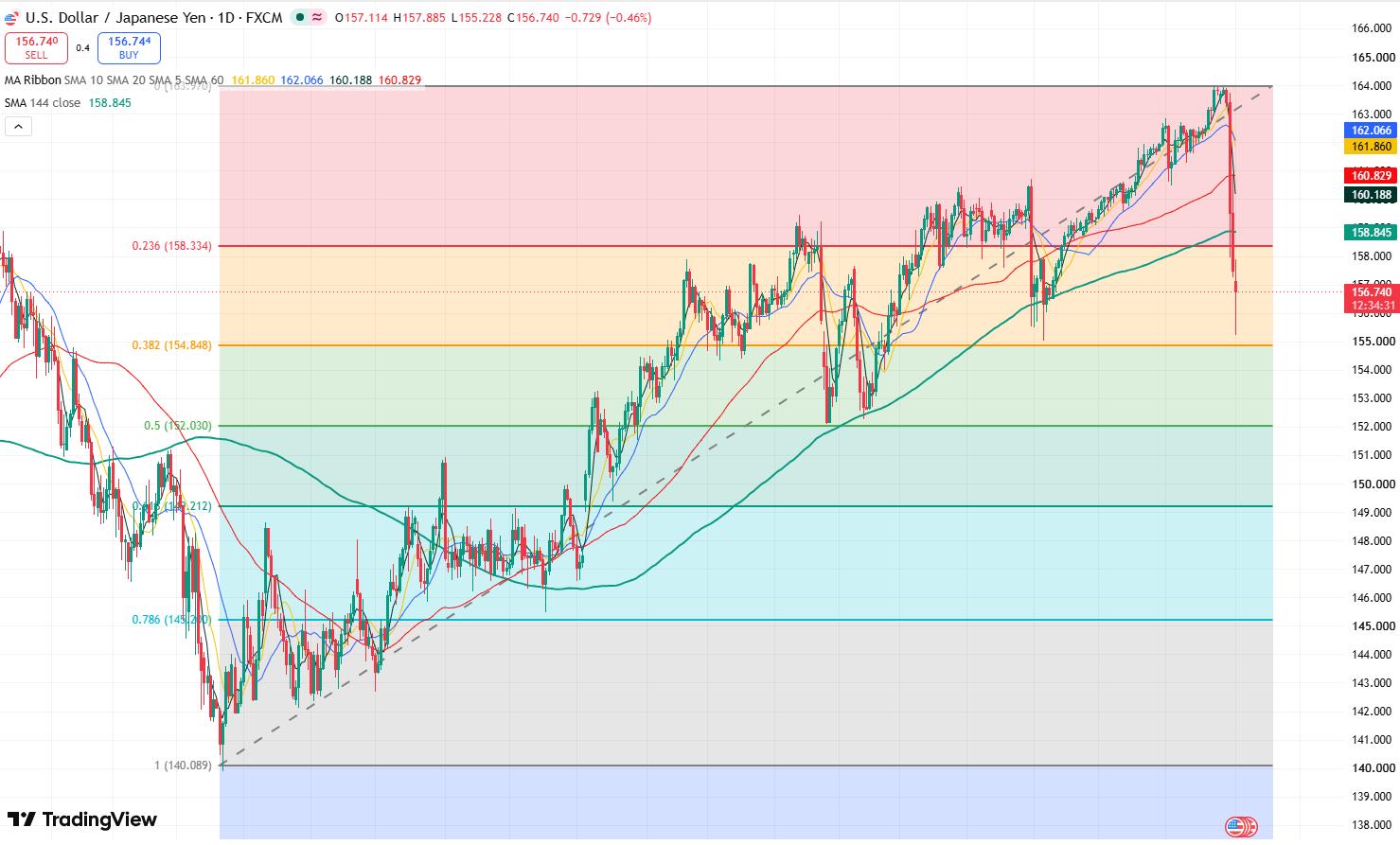
USD/JPY Daily Chart, Source: TradingView
According to the USD/JPY daily chart, the pair previously approached the 164.00 level before falling rapidly, breaking below two key levels of 160.00 and 158.00 in quick succession, indicating that short-term market sentiment has shifted to the bearish side. Following joint intervention by the U.S. and Japan, bearish momentum has significantly strengthened. However, the exchange rate quickly rebounded from near 155.20 to around 157.00, suggesting some support remains near the 155.00 level.
On the downside, initial support for the pair is located near the 155.00 level. A break below this level could lead to further declines toward 152.00, with a potential test of the key 150.00 level.
On the upside, immediate resistance sits near the 158.00 level. If the pair breaks and holds above this point, further room for a rebound would open up, potentially testing the 160.00 level. However, with both the U.S. and Japan clearly indicating that further interventions remain on the table, levels above 160 will face stronger policy pressure. Only a decisive break and consolidation above 160 would allow USD/JPY to challenge the 162 to 164 range once again.
Recommended Articles


