


Indian Rupee fails to extend winning streak as oil prices bounce back
- The Indian Rupee corrects against the US Dollar after rising for three straight trading days.
- Oil prices bounce back strongly on revival of geopolitical risks.
- Investors await the Fed’s policy announcement, which is scheduled at 18:00 GMT.
The Indian Rupee (INR) opens marginally lower against the US Dollar (USD) on Wednesday after a three-day winning streak. The USD/INR pair rebounds to near 95.85 as oil prices have rebounded strongly due to revived geopolitical risks.
In the opening trade, the MCX Crude Oil contract expiring on August 19 is up 4.3% at around Rs. 7,930, snapping a three-day losing streak.
A sharp recovery in oil prices bodes poorly for the Indian currency, given that India covers 85% of its energy needs from imports. Higher oil prices increase foreign outflows from reserves.
US-Saudi forces retaliate against Iran
Late Tuesday, the United States (US) Central Command (CENTCOM) and Saudi Arabia, in a joint operation, reported carrying out precision strikes in Iraq targeting Iran-backed groups for planning attacks on US forces and Saudi oil facilities in the Eastern Province and Riyadh regions, AlJazeera reported.
The exchange of attacks in the Middle East has renewed fears of a prolonged closure of the Strait of Hormuz, which is a vital passage for almost 20% of global energy supply.
Meanwhile, the announcement from the Iranian Islamic Revolutionary Guard Corps (IRGC) that three oil tankers were 'struck and stopped' a few hours ago after ignoring warnings in the Hormuz indicates that energy transport from the passage remains shut, a scenario that will keep global oil supply squeezed.
Key event is Fed’s monetary policy decision
The major event of the week will be the Federal Reserve’s (Fed) monetary policy decision, which will be announced at 18:00 GMT. The CME FedWatch tool shows that traders see a 69.5% chance that the Fed will leave interest rates unchanged in the range of 3.50%-3.75%. This will be the fifth straight policy meeting when the Fed will maintain the status quo.
Financial markets should not expect monetary policy guidance from the Fed, as Chairman Kevin Warsh explicitly said in the previous meeting that “so-called forward guidance is not well-suited in the current policy juncture”.
Ahead of the Fed’s policy announcement, the US Dollar Index (DXY), which gauges the Greenback’s value against six major currencies, trades 0.13% lower to near 101.25.
Bloodbath in KOSPI – Boon for Indian markets
Plummeting KOSPI stock markets due to nosediving shares of memory-chip manufacturer giant SK Hynix could turn out to be a boon for Indian equity markets in the near term. The Indian stock market underperformed in the last year as global investors diverted their funds to equity markets in South Korea and Taiwan to play the Artificial Intelligence (AI) and semiconductors theme.
The significant plunge in South Korean markets is expected to force global investors to return to the Indian stock market, a scenario that will boost foreign inflows, and hence strengthen the Indian currency.
Technical Analysis: USD/INR struggles to return above 20-day EMA
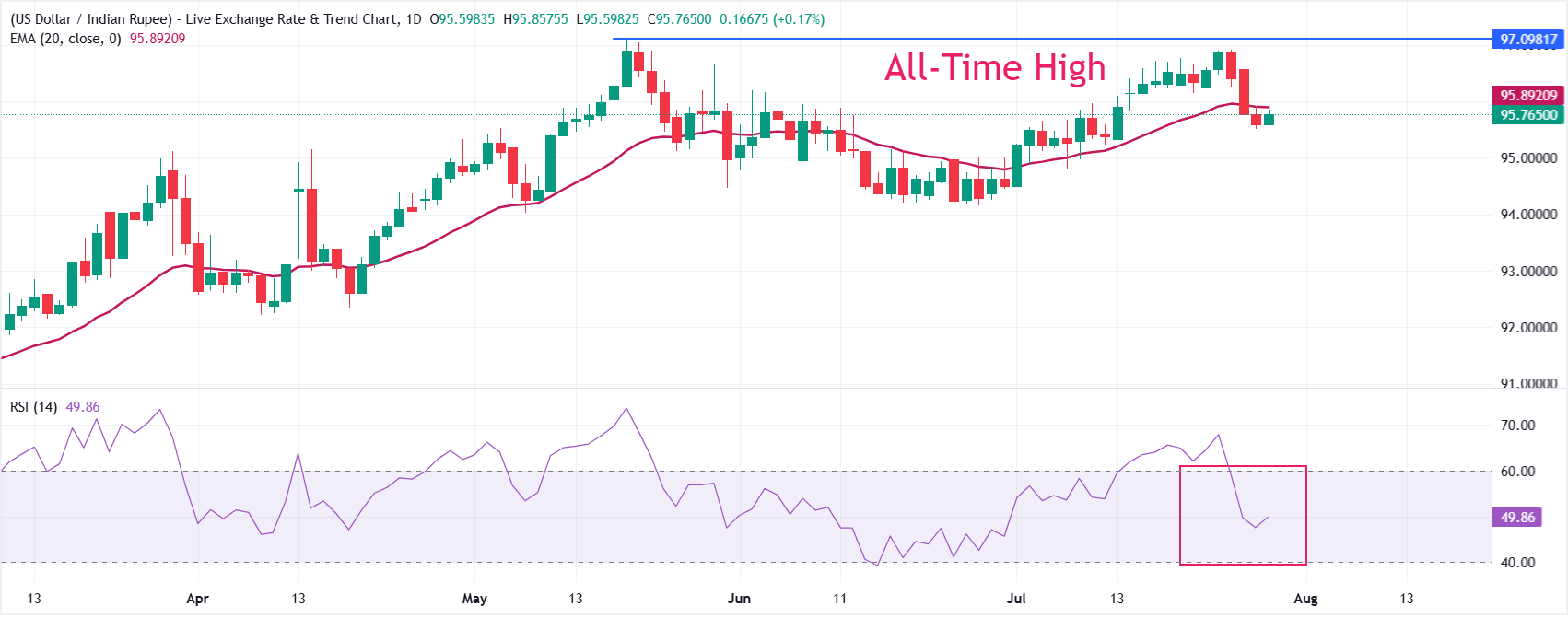
USD/INR trades higher at around 95.85 at press time, but is keeping a mild bearish near-term bias as it holds just under the 20-day Exponential Moving Average (EMA) at 95.8921.
The pair has slipped back below this short-term average after recent gains, suggesting rallies are being capped by nearby overhead supply, while the Relative Strength Index (14) near 50 hints at fading momentum rather than a decisive directional push.
On the topside, immediate resistance is aligned with the 20-day EMA around 95.89, and a sustained break above this barrier would be needed to resume the journey toward the all-time high at 97.10. Looking down, Tuesday's low at 95.51 is the key support zone, followed by 95.00.
(The technical analysis of this story was written with the help of an AI tool. Know more.)
Indian Rupee FAQs
The Indian Rupee (INR) is one of the most sensitive currencies to external factors. The price of Crude Oil (the country is highly dependent on imported Oil), the value of the US Dollar – most trade is conducted in USD – and the level of foreign investment, are all influential. Direct intervention by the Reserve Bank of India (RBI) in FX markets to keep the exchange rate stable, as well as the level of interest rates set by the RBI, are further major influencing factors on the Rupee.
The Reserve Bank of India (RBI) actively intervenes in forex markets to maintain a stable exchange rate, to help facilitate trade. In addition, the RBI tries to maintain the inflation rate at its 4% target by adjusting interest rates. Higher interest rates usually strengthen the Rupee. This is due to the role of the ‘carry trade’ in which investors borrow in countries with lower interest rates so as to place their money in countries’ offering relatively higher interest rates and profit from the difference.
Macroeconomic factors that influence the value of the Rupee include inflation, interest rates, the economic growth rate (GDP), the balance of trade, and inflows from foreign investment. A higher growth rate can lead to more overseas investment, pushing up demand for the Rupee. A less negative balance of trade will eventually lead to a stronger Rupee. Higher interest rates, especially real rates (interest rates less inflation) are also positive for the Rupee. A risk-on environment can lead to greater inflows of Foreign Direct and Indirect Investment (FDI and FII), which also benefit the Rupee.
Higher inflation, particularly, if it is comparatively higher than India’s peers, is generally negative for the currency as it reflects devaluation through oversupply. Inflation also increases the cost of exports, leading to more Rupees being sold to purchase foreign imports, which is Rupee-negative. At the same time, higher inflation usually leads to the Reserve Bank of India (RBI) raising interest rates and this can be positive for the Rupee, due to increased demand from international investors. The opposite effect is true of lower inflation.
Recommended Articles


