


Indian Rupee struggles as Oil prices advance on supply disruptions
- Indian Rupee declines as volatile oil prices and weak domestic equities weighed on market sentiment.
- Oil rises as fears of a prolonged Iran conflict overshadow coordinated reserve releases by major economies.
- USD/INR rises as a firm US Dollar and surging energy prices dampen expectations of Federal Reserve rate cuts.
USD/INR continues its winning streak for the third successive session on Thursday. The Indian Rupee (INR) remained under pressure as volatile oil prices and weak domestic equities weighed on sentiment, though intermittent US Dollar (USD) sales by state-run banks helped limit losses, traders told Reuters.
Oil prices rise due to shipping disruptions through the strategic Strait of Hormuz. Crude extended gains as the risk of a prolonged Iran conflict overshadowed a coordinated release of oil reserves by major economies. Markets also viewed the emergency supply measures as insufficient even after the International Energy Agency (IEA) agreed to its largest-ever release of 400 million barrels.
Meanwhile, the USD/INR pair strengthened as the US Dollar remained firm. Surging energy prices have heightened forward-looking inflation risks, reducing expectations that the Federal Reserve (Fed) will cut interest rates soon.
Meanwhile, recent inflation data suggested price pressures remain relatively contained, reinforcing expectations that the Fed may keep policy steady in the near term. Analysts also noted that the latest inflation figures do not yet fully capture the recent surge in oil prices driven by geopolitical tensions.
The February US Consumer Price Index (CPI) released on Wednesday showed inflation rising 0.3% month-over-month (MoM) and 2.4% year-over-year (YoY), largely in line with market expectations. Core CPI, which excludes food and energy, increased 0.2% MoM and 2.5% YoY. Traders will now focus on the upcoming US Personal Consumption Expenditures (PCE) data due Friday for further policy clues.
Technical Analysis: USD/INR eyes record high of 92.81 near ascending channel upper boundary
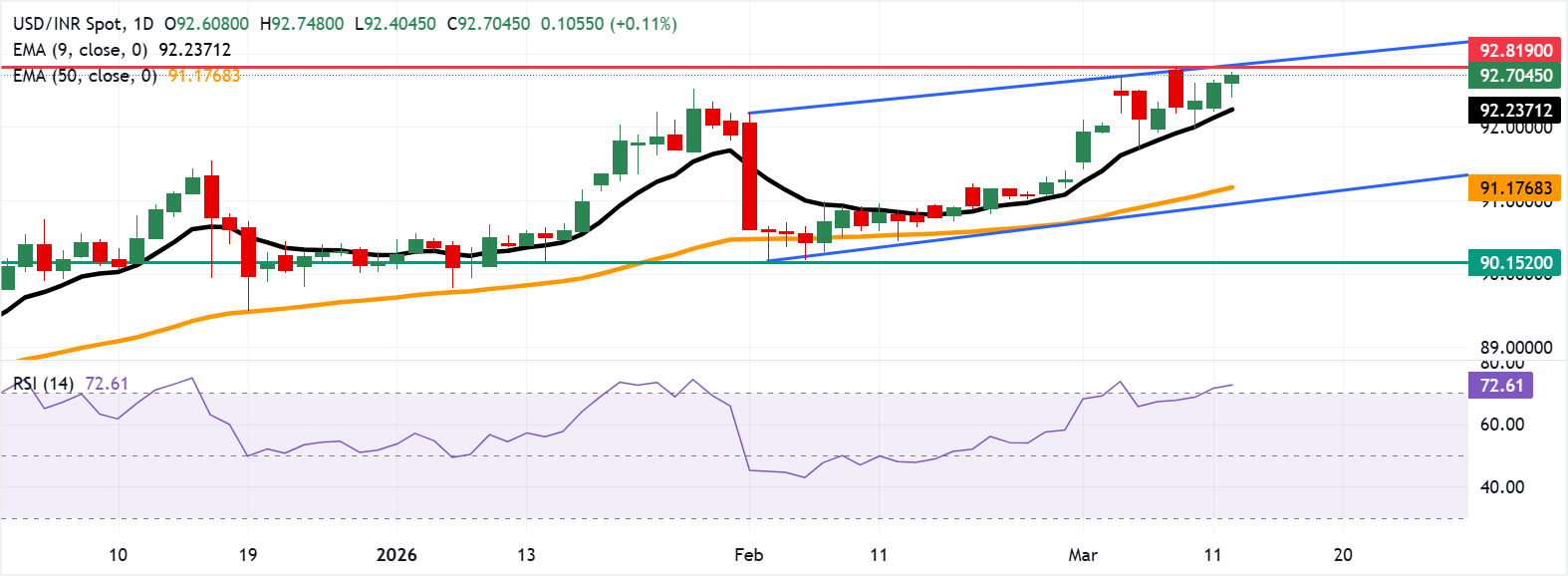
USD/INR trades around 92.70 on Thursday. The technical analysis of the daily chart indicates a persistent bullish bias as the pair rises within the ascending channel pattern.
The near-term bias is bullish as the USD/INR pair holds above both the rising 50- and nine-day Exponential Moving Averages (EMAs), keeping the recent breakout sequence intact after rebounding from the 91.00–91.25 area. Momentum remains positive with the 14-day Relative Strength Index (RSI) near 72 and pushing deeper into overbought territory, signaling firm upside pressure even as the rally becomes stretched.
The USD/INR pair targets the all-time high of 92.81, reached on March 9, followed by the ascending channel’s upper boundary at 92.90. On the downside, primary support lies at the nine-day EMA at 92.23. A break below this level would weaken the short-term momentum and expose the 50-day EMA at 91.17, followed by the channel’s lower boundary near 90.90.
(The technical analysis of this story was written with the help of an AI tool.)
Indian Rupee FAQs
The Indian Rupee (INR) is one of the most sensitive currencies to external factors. The price of Crude Oil (the country is highly dependent on imported Oil), the value of the US Dollar – most trade is conducted in USD – and the level of foreign investment, are all influential. Direct intervention by the Reserve Bank of India (RBI) in FX markets to keep the exchange rate stable, as well as the level of interest rates set by the RBI, are further major influencing factors on the Rupee.
The Reserve Bank of India (RBI) actively intervenes in forex markets to maintain a stable exchange rate, to help facilitate trade. In addition, the RBI tries to maintain the inflation rate at its 4% target by adjusting interest rates. Higher interest rates usually strengthen the Rupee. This is due to the role of the ‘carry trade’ in which investors borrow in countries with lower interest rates so as to place their money in countries’ offering relatively higher interest rates and profit from the difference.
Macroeconomic factors that influence the value of the Rupee include inflation, interest rates, the economic growth rate (GDP), the balance of trade, and inflows from foreign investment. A higher growth rate can lead to more overseas investment, pushing up demand for the Rupee. A less negative balance of trade will eventually lead to a stronger Rupee. Higher interest rates, especially real rates (interest rates less inflation) are also positive for the Rupee. A risk-on environment can lead to greater inflows of Foreign Direct and Indirect Investment (FDI and FII), which also benefit the Rupee.
Higher inflation, particularly, if it is comparatively higher than India’s peers, is generally negative for the currency as it reflects devaluation through oversupply. Inflation also increases the cost of exports, leading to more Rupees being sold to purchase foreign imports, which is Rupee-negative. At the same time, higher inflation usually leads to the Reserve Bank of India (RBI) raising interest rates and this can be positive for the Rupee, due to increased demand from international investors. The opposite effect is true of lower inflation.
Recommended Articles


