


Here's Why Oil Prices Are Surging and What a Strait of Hormuz Disruption Could Mean for Global Supply
Key Points
Iran's attacks on ships have effectively closed the Strait of Hormuz.
The waterway is vital to global energy and food supplies.
The longer it remains closed, the higher prices will go and the more damage it will do to the global economy.
- These 10 stocks could mint the next wave of millionaires ›
Crude prices have gone hyperbolic this year. WTI, the U.S. oil price benchmark, has nearly doubled this year and recently closed above $112 a barrel. Meanwhile, Brent, the global benchmark, is up almost 80% in 2026, trading recently above $109 per barrel. The catalyst is the near closure of the Strait of Hormuz, a narrow waterway between the Persian Gulf and the Gulf of Oman.
Here's a look at what the disruption of oil flowing through the Strait of Hormuz means for global supply.
Will AI create the world's first trillionaire? Our team just released a report on the one little-known company, called an "Indispensable Monopoly" providing the critical technology Nvidia and Intel both need. Continue »
Image source: Getty Images.
A crucial global floating highway
The Strait of Hormuz is a crucial waterway. Before the war with Iran, 20% of global crude oil and liquified natural gas (LNG) supply traversed this waterway each day. In addition to being crucial to the energy market, the Strait is also vital to global food supplies as the Gulf is a major fertilizer exporter and imports a significant amount of food.
Iran has choked off the free flow of energy and other supplies through the Strait by attacking ships trying to exit the Persian Gulf. That has made it nearly impossible for ships to get insurance coverage to pass through the Strait. As a result, ship traffic is at a standstill.
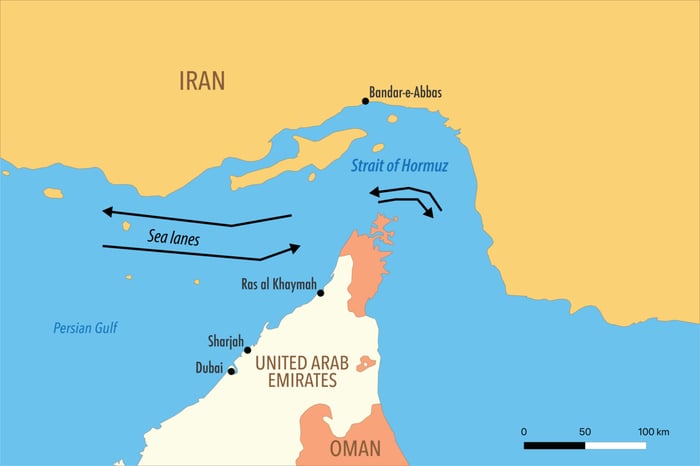
Image source: Getty Images.
Working on workarounds
Reopening the Strait of Hormuz doesn't appear to be a major priority for the U.S. military. In a nationally televised address this week, President Trump said the Strait would "open up naturally" once the U.S. completes its military operations over the next few weeks. He also called on other countries to "take care" of it by reopening it themselves. About 40 countries met by video conference after his address to discuss a strategy to reopen the Strait.
The world has been relying on emergency stockpiles and alternative shipping routes to keep the oil flowing in the global economy. The International Energy Agency (IEA) coordinated a record release of 400 million barrels of oil from emergency stockpiles, enough to cover about 20 days of supply from the Strait. IEA members held over 1.2 billion barrels before the war and controlled another 600 million barrels, giving them additional stockpiles to release if needed.
Additionally, Saudi Arabia has begun moving more oil via the East-West Pipeline to Red Sea export terminals. That pipeline reached its capacity of 7 million barrels per day (BPD), up from 1.7 million BPD before the war. Meanwhile, the UAE's Abu Dhabi Crude Oil Pipeline can bypass the Strait and transport up to 1.8 million BPD to a terminal in the Gulf of Oman.
The coming global supply crunch and economic impact
At issue is that the emergency stockpiles won't last forever, and the bypass pipelines can't offset the entire disruption caused by the Strait of Hormuz closure. Further, they don't address the LNG and food supply issues caused by its closure. At some point, these supply issues will start to have a meaningful impact on the global economy.
The longer the Strait remains closed, the higher prices will likely rise. Further, even after the Strait reopens to shipping traffic, it will take a long time for the supply chain to return to normal. As a result, the world could experience supply shortages and economic contraction in the coming quarters. According to a recent study by the Federal Reserve Bank of Dallas, a 90-day closer of the Strait of Hormuz (one economic quarter) would likely cause a 2.9% quarterly decline in GDP. Meanwhile, if it remains closed for two quarters, it would like cause negative economic growth for the rest of the year.
The Strait needs to reopen soon to prevent economic damage
The longer the Strait of Hormuz remains closed, the higher oil prices will likely go. While emergency stockpiles and bypass pipelines are helping prevent a major supply shock, they can't fill the entire gap for months on end. The longer the Strait remains closed, the greater the impact on the global economy, a risk investors need to monitor closely.
Where to invest $1,000 right now
When our analyst team has a stock tip, it can pay to listen. After all, Stock Advisor’s total average return is 926%* — a market-crushing outperformance compared to 185% for the S&P 500.
They just revealed what they believe are the 10 best stocks for investors to buy right now, available when you join Stock Advisor.
See the stocks »
*Stock Advisor returns as of April 4, 2026.
The Motley Fool has a disclosure policy.
Recommended Articles


