


AUD/JPY extends losses after weaker Aussie data
- The Australian Dollar loses ground after the release of the weaker AiG Industry Index on Wednesday.
- The Australian Industry Index indicated prevailing contractionary conditions for the past twenty-four months.
- Traders will monitor for any potential Japanese intervention, following recent reports suggesting Tokyo's involvement in the currency market.
AUD/JPY extends its losing streak for the third consecutive session. The Australian Dollar (AUD) faced pressure following the release of the AiG Industry Index on Wednesday, a leading indicator measuring private business activity in Australia, which continued its decline in March.
The softer Aussie Retail Sales released on Tuesday could potentially impact the Reserve Bank of Australia's (RBA) hawkish stance on interest rate trajectory. However, higher-than-expected domestic inflation data released last week raised expectations that the RBA may delay interest rate cuts. The central bank is scheduled to meet next week, and it is widely anticipated to maintain interest rates at the current level of 4.35%
In Japan, market participants are closely monitoring for potential intervention following reports of Tokyo's involvement in the currency market on Monday, which boosted the Japanese Yen (JPY), according to Reuters. Additionally, expectations for a sustained significant interest rate differential between Japan and other nations suggest that the trajectory of the JPY is biased toward further depreciation.
The Bank of Japan (BoJ) is set to release its Monetary Policy Meeting Minutes on Thursday. These minutes provide insight into economic developments in Japan following the actual meeting. Changes in this report can influence JPY volatility.
Daily Digest Market Movers: AUD/JPY edges lower after weaker Aussie data
- In April, the AiG Australian Industry Index declined by 3.6 points to reach -8.9 points, indicating prevailing contractionary conditions for the past twenty-four months. The previous reading was -5.3 in March.
- The benchmark ASX 200 opened lower on Wednesday, with all 11 sectors in the red. This decline followed hot US labor data that unsettled Wall Street, sparking concerns that persistent inflation may prompt the US Federal Reserve (Fed) to maintain higher interest rates for an extended period.
- As reported by the Financial Review, ANZ anticipates that the RBA will commence cutting interest rates in November, following last week’s stronger-than-expected inflation data. In a similar vein, Australia's largest mortgage lender, Commonwealth Bank, has adjusted its forecast for the timing of the first interest rate cut by the RBA. They are now projecting only one cut in November.
- The seasonally adjusted Australian Retail Sales released on Tuesday, showed a drop in March, compared to the expected increase and the previous growth.
- Japan’s Retail Trade increased by 1.2% year-over-year in March, which was lower than the expected increase of 2.5% and the previous increase of 4.7%. The seasonally adjusted Retail Trade (MoM) decreased by 1.2%, against the expected rise of 0.6%.
- Masato Kanda, Japan's senior currency diplomat, made pointed comments regarding the currency's impact on import prices, emphasizing its significant influence. He highlighted the readiness of authorities to take action around the clock to address currency-related matters, as per a Reuters report.
- BoJ Governor Kazuo Ueda provided insights into the central bank's decision to maintain the status quo during the post-policy meeting press conference on Friday. Ueda outlined that the BoJ will adjust the degree of monetary easing if the underlying inflation rate rises.
Technical Analysis: AUD/JPY hovers around the psychological level of 102.00
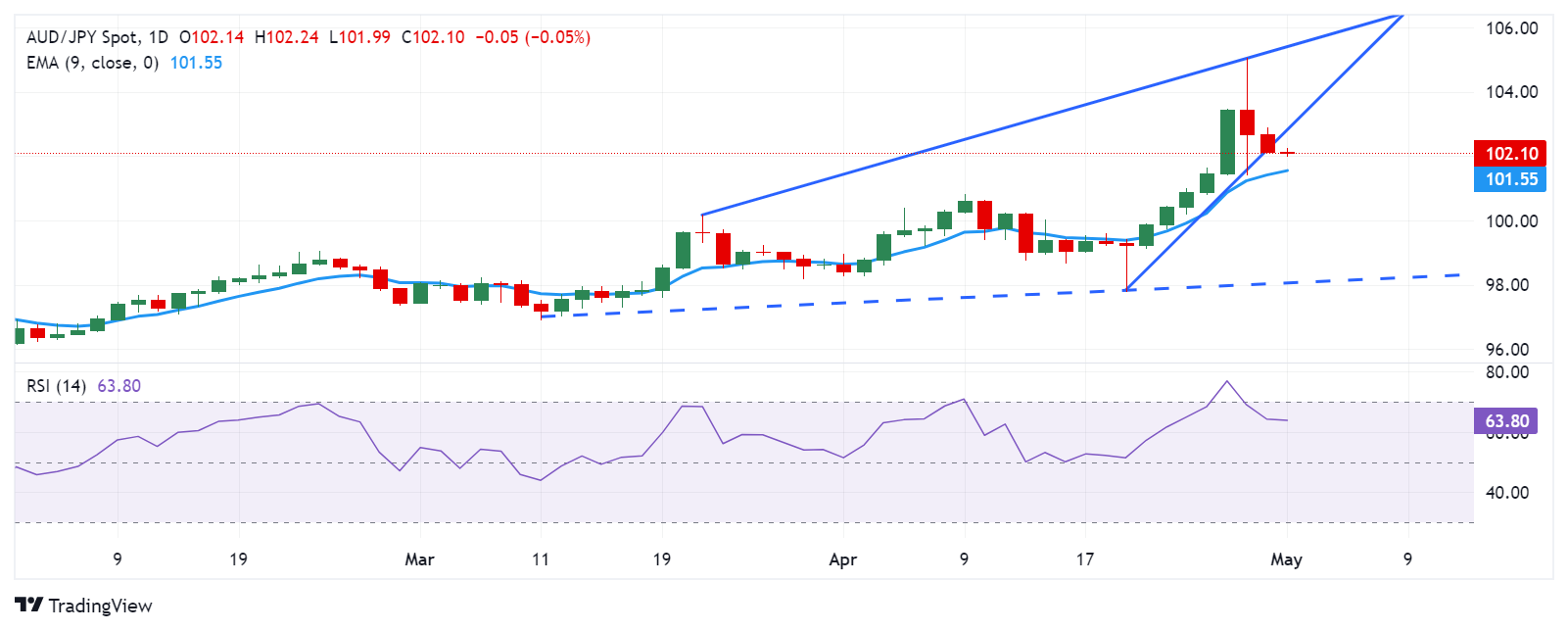
The AUD/JPY trades around 102.10 on Wednesday, breaking below the lower boundary of a rising wedge pattern on the daily chart, which typically indicates a bearish reversal. This decline could weaken bullish sentiment; however, traders may await confirmation from the 14-day Relative Strength Index (RSI), which is still above the 50-level.
Immediate resistance is observed at the lower boundary of the wedge around the psychological level of 103.00. A rebound back into the ascending wedge could potentially improve the bullish sentiment and push the AUD/JPY pair toward the psychological level of 105.00, coinciding with the upper boundary of the wedge.
On the downside, immediate support for the AUD/JPY pair is seen at the psychological level of 102.00, followed by the nine-day Exponential Moving Average (EMA) at 101.56.
AUD/JPY: Daily Chart
Australian Dollar price today
The table below shows the percentage change of the Australian Dollar (AUD) against listed major currencies today. The Australian Dollar was the weakest against the New Zealand Dollar.
| USD | EUR | GBP | CAD | AUD | JPY | NZD | CHF | |
| USD | 0.08% | 0.09% | 0.02% | 0.11% | 0.06% | -0.12% | 0.08% | |
| EUR | -0.07% | 0.00% | -0.06% | 0.04% | -0.01% | -0.20% | 0.00% | |
| GBP | -0.09% | 0.00% | -0.06% | 0.04% | -0.01% | -0.20% | 0.00% | |
| CAD | -0.02% | 0.06% | 0.07% | 0.10% | 0.05% | -0.14% | 0.06% | |
| AUD | -0.12% | -0.04% | -0.04% | -0.10% | -0.07% | -0.24% | -0.04% | |
| JPY | -0.05% | 0.00% | 0.00% | -0.06% | 0.06% | -0.20% | 0.04% | |
| NZD | 0.12% | 0.20% | 0.20% | 0.14% | 0.24% | 0.19% | 0.20% | |
| CHF | -0.09% | 0.00% | 0.00% | -0.06% | 0.04% | -0.06% | -0.20% |
The heat map shows percentage changes of major currencies against each other. The base currency is picked from the left column, while the quote currency is picked from the top row. For example, if you pick the Euro from the left column and move along the horizontal line to the Japanese Yen, the percentage change displayed in the box will represent EUR (base)/JPY (quote).
Australian Dollar FAQs
One of the most significant factors for the Australian Dollar (AUD) is the level of interest rates set by the Reserve Bank of Australia (RBA). Because Australia is a resource-rich country another key driver is the price of its biggest export, Iron Ore. The health of the Chinese economy, its largest trading partner, is a factor, as well as inflation in Australia, its growth rate, and Trade Balance. Market sentiment – whether investors are taking on more risky assets (risk-on) or seeking safe havens (risk-off) – is also a factor, with risk-on positive for AUD.
The Reserve Bank of Australia (RBA) influences the Australian Dollar (AUD) by setting the level of interest rates that Australian banks can lend to each other. This influences the level of interest rates in the economy as a whole. The main goal of the RBA is to maintain a stable inflation rate of 2-3% by adjusting interest rates up or down. Relatively high interest rates compared to other major central banks support the AUD, and the opposite for relatively low. The RBA can also use quantitative easing and tightening to influence credit conditions, with the former AUD-negative and the latter AUD-positive.
China is Australia’s largest trading partner so the health of the Chinese economy is a major influence on the value of the Australian Dollar (AUD). When the Chinese economy is doing well it purchases more raw materials, goods and services from Australia, lifting demand for the AUD, and pushing up its value. The opposite is the case when the Chinese economy is not growing as fast as expected. Positive or negative surprises in Chinese growth data, therefore, often have a direct impact on the Australian Dollar and its pairs.
Iron Ore is Australia’s largest export, accounting for $118 billion a year according to data from 2021, with China as its primary destination. The price of Iron Ore, therefore, can be a driver of the Australian Dollar. Generally, if the price of Iron Ore rises, AUD also goes up, as aggregate demand for the currency increases. The opposite is the case if the price of Iron Ore falls. Higher Iron Ore prices also tend to result in a greater likelihood of a positive Trade Balance for Australia, which is also positive of the AUD.
The Trade Balance, which is the difference between what a country earns from its exports versus what it pays for its imports, is another factor that can influence the value of the Australian Dollar. If Australia produces highly sought after exports, then its currency will gain in value purely from the surplus demand created from foreign buyers seeking to purchase its exports versus what it spends to purchase imports. Therefore, a positive net Trade Balance strengthens the AUD, with the opposite effect if the Trade Balance is negative.
Recommended Articles


