




EUR/USD stays low in risk-off markets with a busy week ahead
- EUR/USD consolidates losses around 1.1850 after dropping by over 1% on Friday.
- The US Dollar remains supported by the nomination of Kevin Warsh as the next Fed Chair.
- Investors are focusing on the Eurozone and US Manufacturing PMIs on Monday
The Euro (EUR) is trading practically flat against the US Dollar (USD) on Monday, moving near 1.1850 at the time of writing and consolidating losses after dropping by over 1% on Friday. The nomination of Kevin Warsh as the next Federal Reserve (Fed) Chair has provided some support to the US Dollar, while a risk-averse market sentiment is weighing on the Euro ahead of a plethora of economic events this week
Investors showed some relief after US President Donald Trump confirmed on Friday that Kevin Warsh will replace Jerome Powell as Fed Chairman when his term expires in May. Warsh is partidary of a smaller balance sheet and has advocated for lower borrowing costs in recent times, although he is expected to take a cautious approach to inflation.
Market sentiment has been sour in Asia and is expected to remain weak during the European session. News reporting that Chinese investors are struggling to liquidate popular Silver positions has triggered a spillover into Stock markets, likely affecting risk-sensitive currencies such as the EUR.
Investors will also be cautious ahead of a busy economic calendar this week. Earlier on Monday, the stronger-than-expected German Retail Sales in December have provided marginal support to the Euro, although the focus remains on the Eurozone and the US Manufacturing Purchasing Managers' Indexes (PMI) due later today. The weekly calendar also features the Eurozone Central Bank's (ECB) monetary policy decision on Thursday and the key US Nonfarm Payrolls (NFP) report on Friday.
Euro Price Today
The table below shows the percentage change of Euro (EUR) against listed major currencies today. Euro was the strongest against the Australian Dollar.
| USD | EUR | GBP | JPY | CAD | AUD | NZD | CHF | |
|---|---|---|---|---|---|---|---|---|
| USD | -0.07% | -0.01% | 0.00% | 0.27% | 0.43% | 0.28% | -0.05% | |
| EUR | 0.07% | 0.06% | 0.06% | 0.34% | 0.49% | 0.35% | 0.02% | |
| GBP | 0.01% | -0.06% | -0.02% | 0.28% | 0.44% | 0.29% | -0.03% | |
| JPY | 0.00% | -0.06% | 0.02% | 0.26% | 0.42% | 0.27% | -0.06% | |
| CAD | -0.27% | -0.34% | -0.28% | -0.26% | 0.16% | 0.00% | -0.32% | |
| AUD | -0.43% | -0.49% | -0.44% | -0.42% | -0.16% | -0.15% | -0.48% | |
| NZD | -0.28% | -0.35% | -0.29% | -0.27% | -0.01% | 0.15% | -0.32% | |
| CHF | 0.05% | -0.02% | 0.03% | 0.06% | 0.32% | 0.48% | 0.32% |
The heat map shows percentage changes of major currencies against each other. The base currency is picked from the left column, while the quote currency is picked from the top row. For example, if you pick the Euro from the left column and move along the horizontal line to the US Dollar, the percentage change displayed in the box will represent EUR (base)/USD (quote).
Daily Digest market Movers: The Dollar remains supported by Warsh's nomination
- The market has reacted positively to the nomination of Kevin Warsh as the next Fed Chief. The market is forecasting at least two rate cuts in 2026, according to data from the CME Group's Fed Watch Tool, but Warsh has already served as a Fed Governor, and he was sensitive to inflation risks during his tenure.
- German Retail Sales have shown a 0.1% growth in December, following a 0.5% decline in November and beating the market consensus that had anticipated a 0.2% drop. Year-on-year, German retail consumption accelerated by 1.5%, from 1.3% in the previous month. The impact of the data on the Euro has been minor.
- In the Eurozone calendar on Monday, the main focus will be on the final HCOB Manufacturing PMI. Preliminary data revealed that the sector's activity improved to 49.4 in January, from 48.8 in December, but still at numbers consistent with a moderate contraction.
- In the US, January's ISM Manufacturing PMI is expected to show a moderate improvement to 48.3 from 47.9 in December, with prices paid accelerating to a four-month high of 60.5.
- Later on, Atlanta Fed President Raphael Bostic will take the stage. Bostic has been reluctant to cut interest rates and recently affirmed that the balance sheet is "about right" last week, which brings to light the divergences within the central bank's committee.
Technical Analysis: EUR/USD hovers above 1.1835 with bears in control
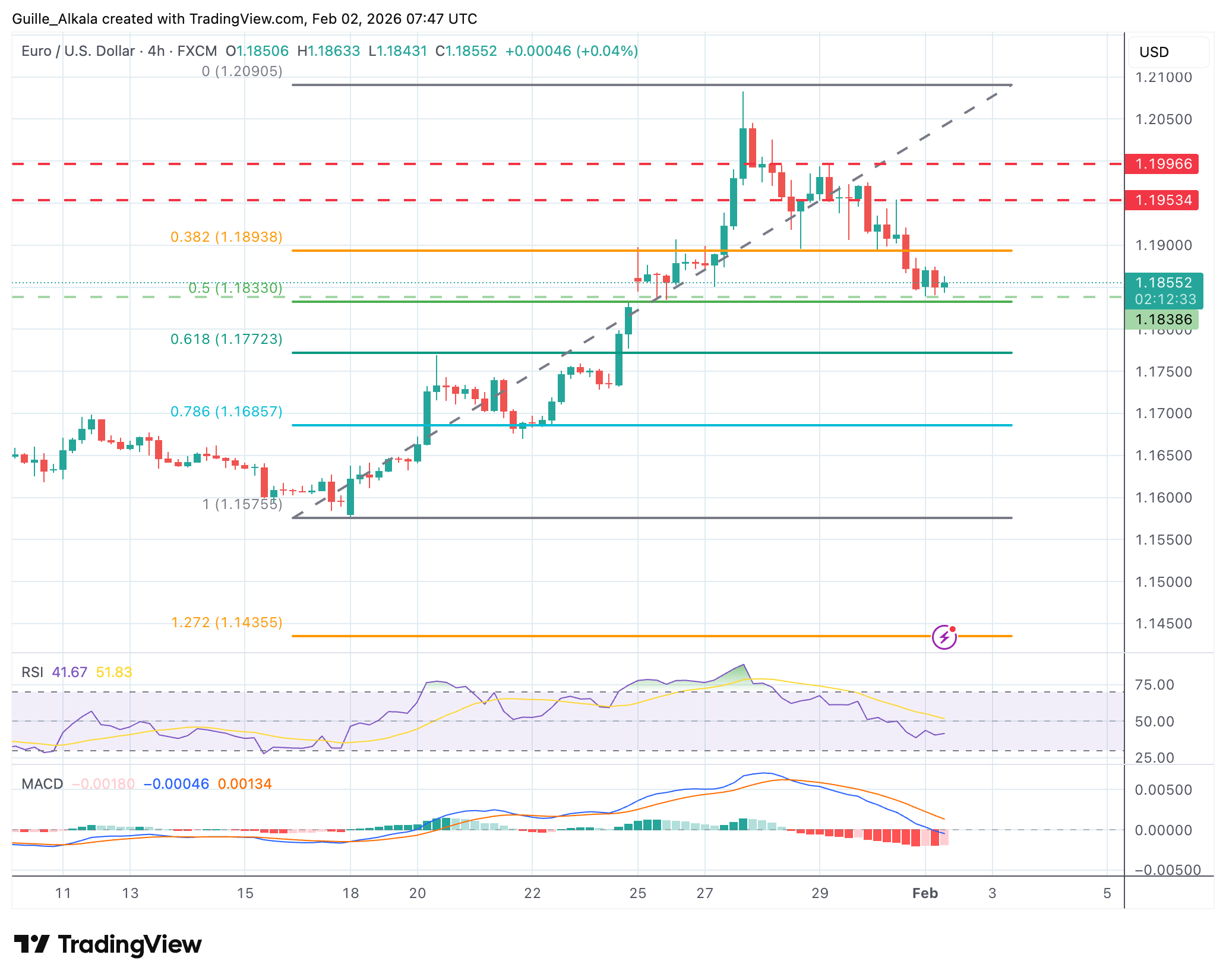
The EUR/USD is on a bearish correction, hovering at 1.1850 after pulling back from four-year highs near 1.2100. Technical indicators are pointing lower on the 4-hour chart. The Relative Strength Index (RSI) has dropped below the key 50 level, and the Moving Average Convergence Divergence (MACD) histogram shows expanding negative bars.
The pair has found some footing above the January 26 low, at the 1.1835 area, and the 50% Fibonacci retracement of the late-January rally, at 1.1830. Further down, the target is the 61.8% Fibonnaci retracement of the mentioned cycle, at the 1.1770 area.
Upside attempts are likely to be challenged at Friday's high, near 1.1955, ahead of the round 1.2000 level.
Risk sentiment FAQs
In the world of financial jargon the two widely used terms “risk-on” and “risk off'' refer to the level of risk that investors are willing to stomach during the period referenced. In a “risk-on” market, investors are optimistic about the future and more willing to buy risky assets. In a “risk-off” market investors start to ‘play it safe’ because they are worried about the future, and therefore buy less risky assets that are more certain of bringing a return, even if it is relatively modest.
Typically, during periods of “risk-on”, stock markets will rise, most commodities – except Gold – will also gain in value, since they benefit from a positive growth outlook. The currencies of nations that are heavy commodity exporters strengthen because of increased demand, and Cryptocurrencies rise. In a “risk-off” market, Bonds go up – especially major government Bonds – Gold shines, and safe-haven currencies such as the Japanese Yen, Swiss Franc and US Dollar all benefit.
The Australian Dollar (AUD), the Canadian Dollar (CAD), the New Zealand Dollar (NZD) and minor FX like the Ruble (RUB) and the South African Rand (ZAR), all tend to rise in markets that are “risk-on”. This is because the economies of these currencies are heavily reliant on commodity exports for growth, and commodities tend to rise in price during risk-on periods. This is because investors foresee greater demand for raw materials in the future due to heightened economic activity.
The major currencies that tend to rise during periods of “risk-off” are the US Dollar (USD), the Japanese Yen (JPY) and the Swiss Franc (CHF). The US Dollar, because it is the world’s reserve currency, and because in times of crisis investors buy US government debt, which is seen as safe because the largest economy in the world is unlikely to default. The Yen, from increased demand for Japanese government bonds, because a high proportion are held by domestic investors who are unlikely to dump them – even in a crisis. The Swiss Franc, because strict Swiss banking laws offer investors enhanced capital protection.
Recommended Articles


