




Pound Sterling ticks down as easing US-EU disputes improve US Dollar appeal
- The Pound Sterling trades subduedly against the US Dollar amid easing US-EU disputes.
- Trump drops the plan of US military action on Greenland and tariff threats on EU nations.
- Investors await US PCE inflation, flash US-UK S&P Global PMIs, and the UK Retail Sales data.
The Pound Sterling (GBP) trades with caution against its major currency peers, consolidating around 1.3430 against the US Dollar (USD) during the European trading session on Thursday. The British currency is slightly under pressure against the US Dollar as the appeal of the latter has improved amid receding geopolitical and trade tensions between the United States (US) and the European Union (EU).
Tensions between two of the world’s largest economies eased after US President Donald Trump took back his decision of imposing 10% tariffs on several EU members and the United Kingdom (UK), and dropped his plans of US military action on Greenland after a meeting with the Secretary General of the North Atlantic Treaty Organization (NATO), Mark Rutte.
US President Trump also announced that both Washington and NATO have reached a framework of a “future deal with respect to Greenland, and in fact, the entire Arctic Region”.
Disputes between the US and the EU over Greenland’s entitlement had propelled risk-off market sentiment, weighed on the US Dollar and US assets, as investors became worried about long-term relations between two of the world’s largest economies. The event also led to an improvement in the appeal of European assets.
Daily Digest Market Movers: Higher UK inflation data fails to weigh on BoE dovish bets
- The Pound Sterling struggles to attract bids against its peers, even as the UK Consumer Price Index (CPI) rose more than expected in December. The data released on Wednesday showed that the headline inflation accelerated to 3.4% year-on-year (YoY) compared to estimates of 3.3% and the November reading of 3.2%.
- However, the impact of higher UK inflation appears to be insignificant on the Pound Sterling as the pace of price increases is expected to slow sharply in the coming months, with last year’s rises in utility costs and other government-controlled tariffs falling out of the annual comparison, Reuters reported.
- Economists at the National Institute of Economic and Social Research (NIESR) think tank have stated that the Bank of England (BoE) “will not be worried by these numbers”, and they predict “one interest rate cut in the first half of this year”.
- Going forward, investors will focus on the UK Retail Sales data for December and the preliminary S&P Global Purchasing Managers’ Index (PMI) for January, which will be released on Friday.
- The data is expected to show that Retail Sales, a key measure of consumer spending, contracted steadily by 0.1% month-on-month (MoM). This would be the third straight decline in the consumer spending measure.
- In the US, investors will focus on the US Personal Consumption Expenditure Price Index (PCE) data for October and November, which will be published at 15:00 GMT. The data will slightly influence market expectations for the Federal Reserve’s (Fed) monetary policy outlook. Currently, traders are confident that the Fed will keep interest rates steady in the range of 3.50%-3.75% in the policy meeting later this month, according to the CME FedWatch tool.
Technical Analysis: GBP/USD wobbles near 20-day EMA
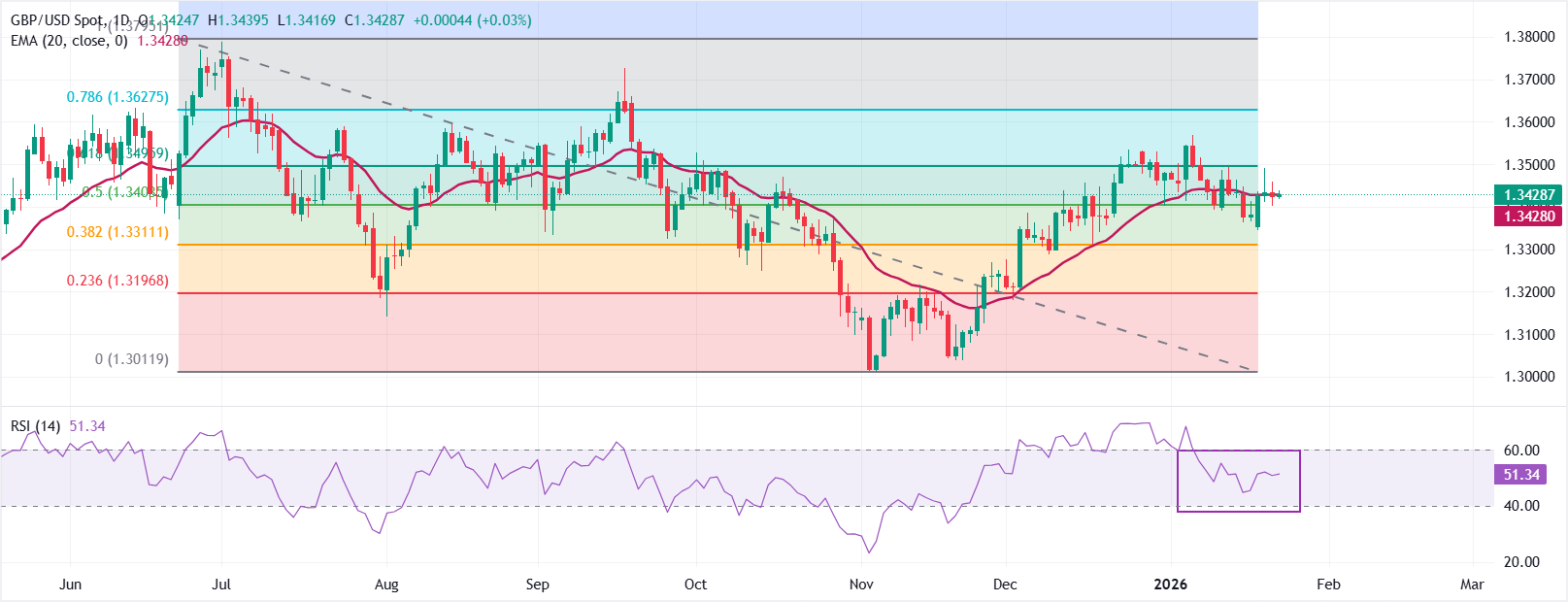
GBP/USD trades flat near 1.3430 at the time of writing. The 20-day Exponential Moving Average (EMA) has flattened after a steady climb, signaling consolidation around the short-term mean.
The 14-day Relative Strength Index (RSI) at 51 (neutral) hints at indecision among traders, with no clear direction in the price action as the pair consolidates.
Measured from the 1.3795 high to the 1.3012 low, the 50% Fibonacci retracement at 1.3404 acts as immediate support, while the 61.8% Fibonacci retracement at 1.3496 caps rebounds. A break above 1.3496 would indicate that the pair is regaining strength.
(The technical analysis of this story was written with the help of an AI tool.)
Pound Sterling FAQs
The Pound Sterling (GBP) is the oldest currency in the world (886 AD) and the official currency of the United Kingdom. It is the fourth most traded unit for foreign exchange (FX) in the world, accounting for 12% of all transactions, averaging $630 billion a day, according to 2022 data. Its key trading pairs are GBP/USD, also known as ‘Cable’, which accounts for 11% of FX, GBP/JPY, or the ‘Dragon’ as it is known by traders (3%), and EUR/GBP (2%). The Pound Sterling is issued by the Bank of England (BoE).
The single most important factor influencing the value of the Pound Sterling is monetary policy decided by the Bank of England. The BoE bases its decisions on whether it has achieved its primary goal of “price stability” – a steady inflation rate of around 2%. Its primary tool for achieving this is the adjustment of interest rates. When inflation is too high, the BoE will try to rein it in by raising interest rates, making it more expensive for people and businesses to access credit. This is generally positive for GBP, as higher interest rates make the UK a more attractive place for global investors to park their money. When inflation falls too low it is a sign economic growth is slowing. In this scenario, the BoE will consider lowering interest rates to cheapen credit so businesses will borrow more to invest in growth-generating projects.
Data releases gauge the health of the economy and can impact the value of the Pound Sterling. Indicators such as GDP, Manufacturing and Services PMIs, and employment can all influence the direction of the GBP. A strong economy is good for Sterling. Not only does it attract more foreign investment but it may encourage the BoE to put up interest rates, which will directly strengthen GBP. Otherwise, if economic data is weak, the Pound Sterling is likely to fall.
Another significant data release for the Pound Sterling is the Trade Balance. This indicator measures the difference between what a country earns from its exports and what it spends on imports over a given period. If a country produces highly sought-after exports, its currency will benefit purely from the extra demand created from foreign buyers seeking to purchase these goods. Therefore, a positive net Trade Balance strengthens a currency and vice versa for a negative balance.
more than expected
Recommended Articles


