


Anheuser-Busch Inbev SA Stock (BUD) Moved Down by 3.72% on Jul 23: Drivers Behind the Movement
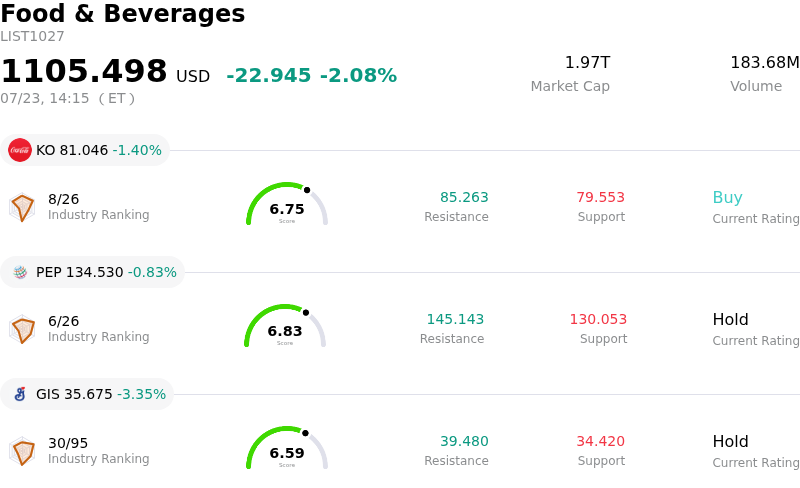
Anheuser-Busch Inbev SA (BUD) moved down by 3.72%. The Food & Beverages sector is down by 2.08%. The company underperformed the industry. Top 3 stocks by turnover in the sector: Coca-Cola Co (KO) down 1.40%; PepsiCo Inc (PEP) down 0.83%; General Mills Inc (GIS) down 3.35%.
What is driving Anheuser-Busch Inbev SA (BUD)’s stock price down today?
The downward movement in Anheuser-Busch InBev shares follows the release of second-quarter financial results that revealed a challenging landscape for the global brewer. While revenue growth remained positive in select emerging markets, the company faced significant headwinds in its North American segment. Persistent shifts in consumer preferences and a cautious spending environment among core demographics led to lower-than-anticipated volume sales. More importantly, management's updated earnings guidance for the remainder of the fiscal year suggests that margin expansion may be more constrained than previously projected, triggering a reassessment of the stock's short-term valuation.
Macroeconomic factors are also playing a critical role in the current price action. Rising input costs, particularly for packaging materials and logistical operations, continue to weigh on the company’s bottom line despite aggressive hedging strategies. In addition to cost inflation, the broader consumer staples sector is grappling with heightened volatility as market participants react to recent labor market data and its implications for central bank policy. For a multinational entity like BUD, currency fluctuations—specifically the strengthening of the U.S. dollar against key Latin American and European currencies—have introduced significant translation risks that diminish reported earnings from high-growth international regions.
Institutional sentiment has shifted following a series of analyst adjustments that cited concerns over the company's long-term deleveraging trajectory. While the firm has made strides in reducing its debt load, the pace of progress is being scrutinized against the backdrop of stagnating growth in mature markets. High-frequency retail data also reflects a cooling of enthusiasm for the brand portfolio in the face of increasing competition from craft alternatives and the rapid growth of the non-alcoholic beverage category. As institutional investors and large-scale funds rebalance their portfolios in response to these fundamental shifts, the resulting technical pressure has contributed to the notable intraday volatility.
Furthermore, regulatory developments in key markets have added a layer of uncertainty for investors. Reports of potential tax adjustments on alcoholic beverages in major European territories and stricter marketing regulations in developing regions have raised concerns about future volume growth and operational costs. These external pressures, combined with the earnings miss, have led to a broader de-risking move among market participants, placing the stock under significant selling pressure as the market digests the implications for the company's mid-term growth profile.
Technical Analysis of Anheuser-Busch Inbev SA (BUD)
Technically, Anheuser-Busch Inbev SA (BUD) shows a MACD (12,26,9) value of 0.378, indicating a neutral signal. The RSI at 59.623 suggests neutral condition and the Williams %R at 16.396 suggests overbought condition. Please monitor closely.
Fundamental Analysis of Anheuser-Busch Inbev SA (BUD)
Anheuser-Busch Inbev SA (BUD) is in the Food & Beverages industry. Its latest annual revenue is $59.32B, ranking 2 in the industry. The net profit is $6.84B, ranking 3 in the industry. Company Profile
Over the past month, multiple analysts have rated the company as Buy, with an average price target of $93.39, a high of $105.00, and a low of $84.50.
More details about Anheuser-Busch Inbev SA (BUD)
Company Specific Risks:
- North American Volume Stagnation: Recent retail data for the period leading into the Memorial Day weekend indicates that flagship brands have failed to reclaim lost market share, with consumer sentiment remaining fractured following previous brand controversies and rising competition from Mexican imports.
- Interest Rate Sensitivity and Debt Burden: Given the company's significant net debt position, recent hawkish signals from the Federal Reserve regarding "higher-for-longer" interest rates have increased concerns over the long-term cost of refinancing and the pace of the company's deleveraging strategy.
- Emerging Market Currency Volatility: Renewed weakness in the Brazilian Real and other Latin American currencies over the last 72 hours has heightened translation risks, as a significant portion of the company's organic growth is generated in regions where local currency devaluation erodes reported USD earnings.
- Margin Compression from Input Costs: Institutional analysts have raised concerns regarding the sustainability of pricing power in a cooling consumer environment, suggesting that the company may struggle to pass on ongoing volatility in aluminum and energy costs without further impacting sales volumes.
Recommended Articles


