

Brent (UKOIL) Drops on Jul 9: Key Factors to Watch

Source Tradingkey

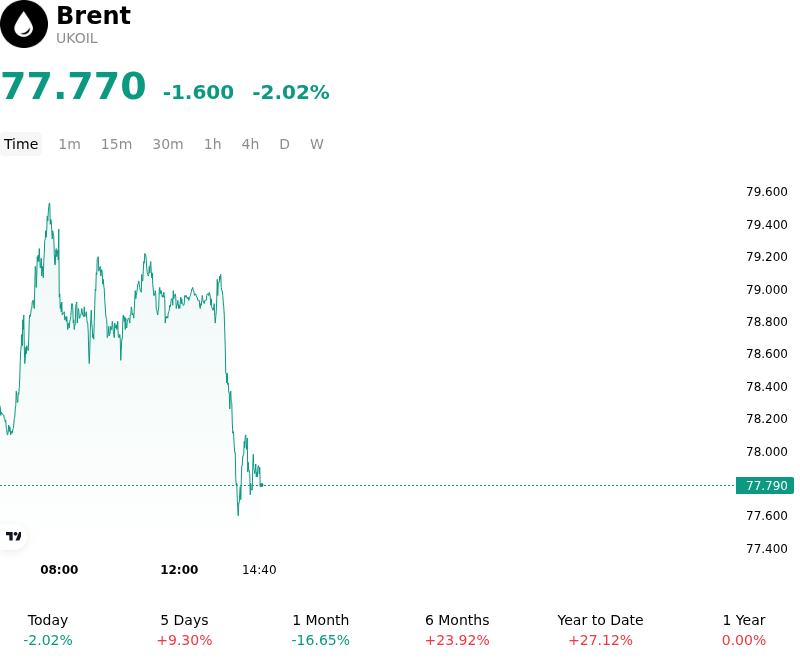
Brent (UKOIL) is down 2.02% at Jul 9 02:45(ET), now at $77.77, with a 7-day up of 8.62%.
SummaryOverview

What is driving Brent (UKOIL)’s stock price down today?

The downward movement in UKOIL on July 9, 2026, primarily reflects a standard technical consolidation and profit-taking by market participants following an exceptionally volatile, news-driven surge earlier in the week. In the preceding sessions, global crude benchmarks spiked sharply in response to escalating geopolitical hostilities between the United States and Iran. The United States launched military strikes on Iranian targets for two consecutive days and revoked a temporary sanctions waiver on Iranian oil sales, raising immediate fears of a total breakdown in diplomatic relations and major shipping disruptions through the critical Strait of Hormuz waterway.

This geopolitical escalation initially injected a substantial risk premium back into the energy complex, pushing Brent crude briefly above the $80-per-barrel threshold. However, the subsequent intraday decline indicates that the market quickly digested the immediate shock of the military strikes. Traders began locking in gains as the initial panic subsided, particularly as rhetoric from the White House suggested that the U.S. expected the latest military flare-up to resolve quickly, leaving the door open to future diplomatic talks and avoiding a full-scale regional war.

Beyond short-term profit-taking, the pull-back was reinforced by broader structural factors and macroeconomic headwinds. While the heightened risk of shipping bottlenecks in the Middle East has kept prices volatile, the underlying global supply-demand balance remains comfortably supplied. Upward revisions in non-OPEC global production capacity and expectations of softer demand growth continue to cap sustained upward momentum for energy prices. Additionally, the sharp rise in oil prices earlier in the week immediately reignited concerns over persistent global inflation. This prompted financial markets to pull forward expectations for central bank interest rate hikes, which in turn strengthened the U.S. dollar and created a natural headwind for dollar-denominated commodities.

Ultimately, the intraday retreat in Brent crude represents a transition from high-conviction geopolitical repricing to a state of technical consolidation. Investors remain highly sensitive to further headlines out of the Persian Gulf, but the lack of immediate, physical disruptions to seaborne oil flows has allowed the market to temper its initial war-risk premium.

Technical Analysis of Brent (UKOIL)

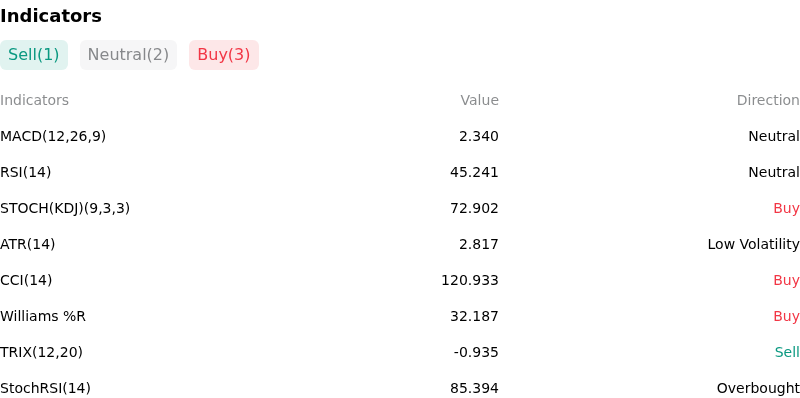
Technically, Brent (UKOIL) shows a MACD (12,26,9) value of 2.340, indicating a neutral signal. The RSI at 45.241 suggests neutral condition and the Williams %R at 32.187 suggests buy condition. Please monitor closely.
IndicatorAnalysis

More details about Brent (UKOIL)

Recent Events and Risks:

  • OPEC+ Output Target Increases: The OPEC+ alliance formalized a decision to raise their collective production targets by an additional 188,000 barrels per day effective August 2026. This represents the fifth consecutive month of expanding quotas, signaling a major push by core producers to reclaim market share and threatening to create structural oversupply as the market enters the second half of the year.
  • Slowing Global Demand and Rising Stockpiles: In its latest forecasts, the EIA lowered its global oil consumption outlook, projecting a demand contraction of 1.1 million barrels per day for 2026. This demand destruction—particularly in Asia, where China has sharply pulled back on Gulf crude purchases—has led major financial institutions like Citi to forecast a potential slide in Brent crude toward $60–$65 per barrel.
  • First Weekly U.S. Crude Inventory Build Since April: The EIA’s latest weekly petroleum report showed a surprise build of 3.0 million barrels in U.S. commercial crude inventories, reversing ten consecutive weeks of draws and defying analyst expectations of a 1.1 to 1.6 million-barrel decline. This build was driven by a rise in raw imports alongside a decline in domestic refinery capacity utilization.
  • Bearish Futures Curve Shift: The front end of the Brent forward curve has slipped into a mild contango structure. September futures trading above the spot price signals that prompt-month physical crude supplies are temporarily outstripping immediate refining demand, which historically exerts downward pressure on spot prices.
Disclaimer: For information purposes only. Past performance is not indicative of future results.
placeholder
Bitcoin CME gaps at $35,000, $27,000 and $21,000, which one gets filled first?Prioritize filling the $27,000 gap and even try higher.
Author  FXStreet
Aug 22, 2023
Prioritize filling the $27,000 gap and even try higher.
placeholder
Pinduoduo Earnings Incoming: Morgan Stanley Sees Long-Term Profit Potential​Insights – On November 21, Chinese e-commerce giant Pinduoduo (PDD) will release its Q3 2024 earnings.
Author  Mitrade
Nov 20, 2024
​Insights – On November 21, Chinese e-commerce giant Pinduoduo (PDD) will release its Q3 2024 earnings.
placeholder
Elon Musk’s xAI and Neuralink Launch New Funding Rounds​Billionaire Elon Musk recently raised funds for his two high-profile tech companies, xAI and Neuralink.
Author  Insights
Jun 03, 2025
​Billionaire Elon Musk recently raised funds for his two high-profile tech companies, xAI and Neuralink.
placeholder
Bitcoin briefly loses 2025 gains as crypto plunges over the weekend.Bitcoin experienced a sharp decline this weekend, briefly erasing its 2025 gains and dipping below its year-opening value of $93,507. The cryptocurrency fell to a low of $93,029 on Sunday, representing a 25% drop from its all-time high in October. Although it has rebounded slightly to around $94,209, the pressures on the market remain significant. The downturn occurred despite the reopening of the U.S. government on Thursday, which many had hoped would provide essential support for crypto markets. This year initially appeared promising for cryptocurrencies, particularly after the inauguration of President Donald Trump, who has established the most pro-crypto administration thus far. However, ongoing political tensions—including Trump's tariff strategies and the recent government shutdown, lasting a historic 43 days—have contributed to several rapid price pullbacks for Bitcoin throughout the year. Market dynamics are also being influenced by Bitcoin whales—investors holding large amounts of Bitcoin—who have been offloading portions of their assets, consequently stalling price rallies even as positive regulatory developments emerge. Despite these sell-offs, analysts from Glassnode argue that this behavior aligns with typical patterns seen among long-term investors during the concluding stages of bull markets, suggesting it is not indicative of a mass exodus. Notably, Bitcoin is not alone in its struggles, as Ethereum and Solana have also recorded declines of 7.95% and 28.3%, respectively, since the start of the year, while numerous altcoins have faced even steeper losses. Looking ahead, questions linger regarding the viability of the four-year cycle thesis, particularly given the increasing institutional support and regulatory frameworks now in place in the crypto landscape. Matt Hougan, chief investment officer at Bitwise, remains optimistic, suggesting a potential Bitcoin resurgence in 2026 driven by the “debasement trade” thesis and a broader trend toward increased adoption of stablecoins, tokenization, and decentralized finance. Hougan emphasized the soundness of the underlying fundamentals, pointing to a positive outlook for the sector in the longer term.
Author  Mitrade
Nov 17, 2025
Bitcoin experienced a sharp decline this weekend, briefly erasing its 2025 gains and dipping below its year-opening value of $93,507. The cryptocurrency fell to a low of $93,029 on Sunday, representing a 25% drop from its all-time high in October. Although it has rebounded slightly to around $94,209, the pressures on the market remain significant. The downturn occurred despite the reopening of the U.S. government on Thursday, which many had hoped would provide essential support for crypto markets. This year initially appeared promising for cryptocurrencies, particularly after the inauguration of President Donald Trump, who has established the most pro-crypto administration thus far. However, ongoing political tensions—including Trump's tariff strategies and the recent government shutdown, lasting a historic 43 days—have contributed to several rapid price pullbacks for Bitcoin throughout the year. Market dynamics are also being influenced by Bitcoin whales—investors holding large amounts of Bitcoin—who have been offloading portions of their assets, consequently stalling price rallies even as positive regulatory developments emerge. Despite these sell-offs, analysts from Glassnode argue that this behavior aligns with typical patterns seen among long-term investors during the concluding stages of bull markets, suggesting it is not indicative of a mass exodus. Notably, Bitcoin is not alone in its struggles, as Ethereum and Solana have also recorded declines of 7.95% and 28.3%, respectively, since the start of the year, while numerous altcoins have faced even steeper losses. Looking ahead, questions linger regarding the viability of the four-year cycle thesis, particularly given the increasing institutional support and regulatory frameworks now in place in the crypto landscape. Matt Hougan, chief investment officer at Bitwise, remains optimistic, suggesting a potential Bitcoin resurgence in 2026 driven by the “debasement trade” thesis and a broader trend toward increased adoption of stablecoins, tokenization, and decentralized finance. Hougan emphasized the soundness of the underlying fundamentals, pointing to a positive outlook for the sector in the longer term.
placeholder
Gold declines as Trump scraps Iran memorandum, markets await Fed minutesGold (XAU/USD) trades around $4,050 on Wednesday, down 1.40% on the day at the time of writing, as investors favor the US Dollar (USD) following a fresh deterioration in tensions between the United States (US) and Iran.
Author  FXStreet
21 hours ago
Gold (XAU/USD) trades around $4,050 on Wednesday, down 1.40% on the day at the time of writing, as investors favor the US Dollar (USD) following a fresh deterioration in tensions between the United States (US) and Iran.
goTop
quote