


Micro Silver (XAGUSD-M) Is up 2.20% on Jul 3: What You Need to Watch
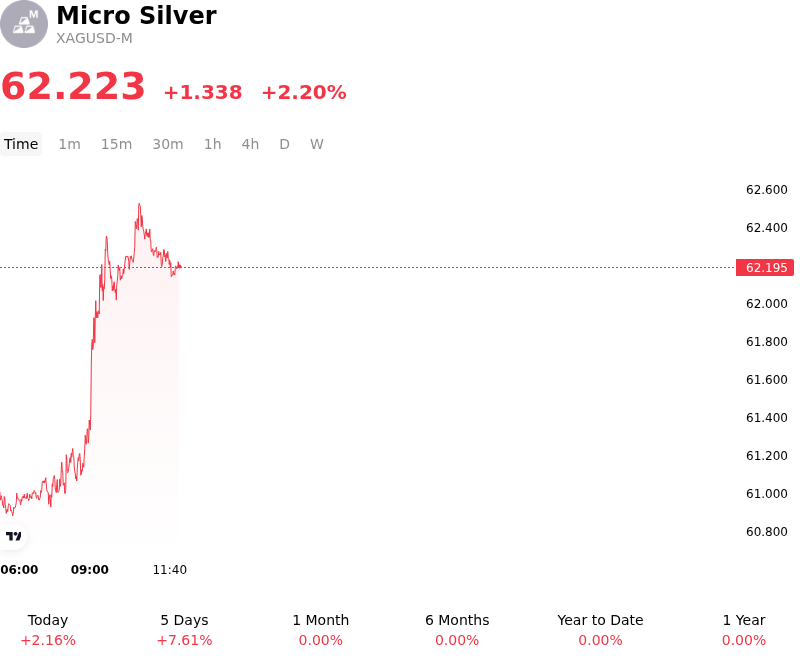
Micro Silver (XAGUSD-M) is up 2.20% at Jul 3 00:00(ET), now at $62.223, with a 7-day up of 5.34%.
What is driving Micro Silver (XAGUSD-M)’s stock price up today?
Silver spot prices climbed to reclaim key psychological thresholds, extending a robust rebound driven by a sudden shift in macroeconomic data and central bank policy expectations. The primary catalyst was a significantly weaker-than-expected US labor market report, which revealed that nonfarm payrolls grew by only 57,000 in June, far below market forecasts. Coming on the heels of a downbeat ISM Manufacturing PMI and a downward revision to previous months' employment figures, the data prompted institutional participants to sharply scale back bets on aggressive near-term interest-rate hikes by the Federal Reserve. This dovish repricing was further cemented by Federal Reserve Chair Kevin Warsh’s comments at the ECB Forum on Central Banking in Sintra, where he noted subsiding underlying inflation risks. As a result, US Treasury yields dropped significantly, and the US dollar retreated from recent multi-month highs, lowering the opportunity cost of holding non-yielding precious metals and triggering a strong capital inflow into silver.
While the shift in the interest rate outlook provided a broad macro tailwind, silver’s significant outperformance compared to gold highlights its unique dual-role fundamentals. Unlike gold, silver prices are heavily influenced by industrial demand, which has reached successive record highs due to secular growth in solar photovoltaics, electric vehicle infrastructure, and artificial intelligence hardware. The Silver Institute projections continue to point toward a persistent annual supply deficit for 2026, marking the sixth consecutive year of structural undersupply in the global physical market. Given that new mine supply is inelastic and requires years to develop, this long-term deficit narrative underpins a tight physical market. When macro-driven short-covering is initiated, this lack of available warehouse inventory often amplifies upward price moves.
Technical and liquidity-driven factors also played a critical role in the intraday strength. Because the rally occurred around the US July 4 holiday weekend, market participation was characterized by thin holiday liquidity, which naturally exacerbated price volatility. The break above the key sixty-dollar level triggered algorithmic buy-stops and prompted a rapid covering of short positions established during the second-quarter correction. Although risks of economic slowdowns and renewed Fed hawkishness remain on the horizon, institutional sentiment has turned increasingly constructive, with several major investment banks forecasting elevated average prices for the remainder of the year based on the combination of easing monetary headwinds and irreplaceable industrial demand.
More details about Micro Silver (XAGUSD-M)
Recent Events and Risks:
- Technical Breakdown and Speculative Liquidation: Spot silver (XAGUSD) has suffered a severe technical breakdown, breaking below its critical multi-month weekly support floor of $64.50 and its 50-week EMA. This structural breakdown has triggered cascading stop-loss orders among highly leveraged participants, exposing the metal to aggressive trend-following short positions and a potential washout toward the psychological $50.00 floor or the 200-week moving average at $42.00.
- Unwinding of Geopolitical Safe-Haven Bids: Progress in diplomatic US-Iran peace talks and the steady recovery of commercial shipping lanes through the Strait of Hormuz have led to a rapid unwinding of the geopolitical risk premium, removing a key pillar of support and prompting a heavy flush-out of long positions.
- Softening Industrial Demand and Thrifting: Industrial silver demand is exhibiting growing weakness, with solar-related silver consumption projected to drop 19% year-on-year in 2026 as green energy manufacturers actively thrift silver usage or transition to cheaper alternative metals. Additionally, global commercial demand for jewelry and silverware is expected to decline by 16% and 20% respectively.
- Monetary Policy and Real Yield Headwinds: Despite recent soft labor market data, the persistent threat of at least one Federal Reserve interest rate hike in late 2026 continues to support U.S. dollar strength and elevated real Treasury yields, significantly raising the opportunity cost of holding non-yielding assets like silver.
Recommended Articles


