




BEST STOCK TRADING PLATFORMS IN AUSTRALIA: PROS AND CONS

Choosing a reputable Australian stock trading platform can sometimes be likened to wading through a financial minefield. On the surface, every platform promises seamless execution and "zero" fees, but beneath the marketing lies a dense thicket of technical jargon, shifting fee structures, and varying security protocols.
In today's article, we'll be getting down to the nitty-gritty and breaking down the eight best trading platforms in Australia, peeling away the layers of hype to expose their true strengths and weaknesses.
Critical Considerations for Platform Selection
The Legal Framework: CHESS vs Custodial Models
The Functional Difference: Physical Shares vs CFDs
Foreign Exchange (FX) and Hidden Costs
Tax Reporting and Compliance
Educational and Analytical Support
1. Mitrade
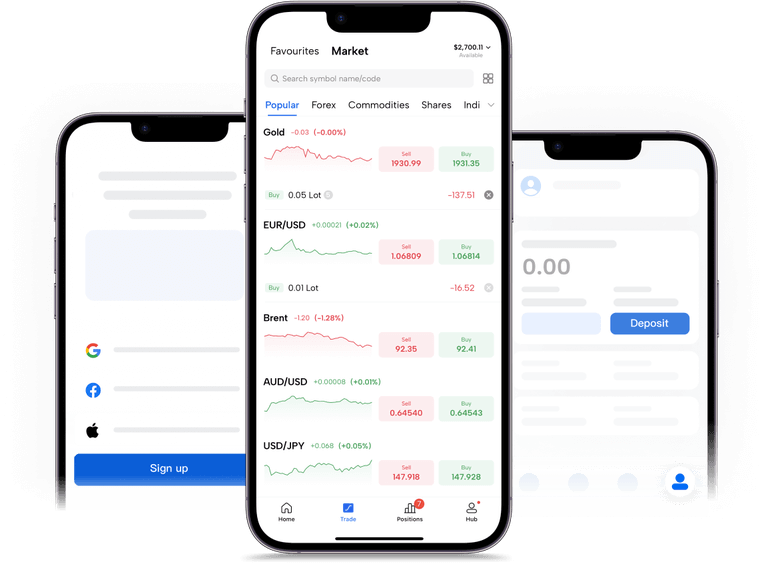
Mitrade is an ASIC-registered stock trading broker specialising in Contracts for Differences (CFDs). It targets traders who need flexibility and advanced execution techniques rather than asset ownership. Unlike other brokers, Mitrade allows traders to speculate on price changes without buying the underlying assets.
Pros
Free Trading: The broker charges no flat commissions. Instead, it generates revenue from its buy-sell spreads.
Fast Order Execution: More than 97 per cent of orders are processed within 50 milliseconds.
Leverage Usage: Traders can leverage their capital up to 1:200 to gain greater market exposure.
Negative Balance Insurance: A crucial safety feature for retail traders that prevents losses exceeding their total deposit amount.
Market Diversity: Mitrade offers access to over 800 financial products from a single platform, right from international stocks, major and minor forex pairs, precious metals such as gold& silver, and popular cryptocurrencies.
Sophisticated Analytical Tools: Professional charting tools, live market sentiment data, and an economic calendar are accessible through the proprietary trading platform.
User-Friendly Platform: The platform has been designed to be compatible with both desktop and mobile devices, making it convenient for traders who trade 24/7.
Cons
No MetaTrader Support: Mitrade only offers its own proprietary platform. It does not support MetaTrader 4 (MT4) or MetaTrader 5 (MT5), which are the industry standards for advanced charting and automated trading.

 Enjoy simple and fast tradingFlexible leverage options available Follow real-time trading strategies

2. CMC Invest
The reason CMC Invest retains its leading position in the market is the balance between the low cost of using the service and the high-end features offered specifically to ASX investors.
Pros
Zero Cost Daily Brokerage: One of the most interesting aspects is that users can receive zero commission on their first daily trading order for ASX securities valued at less than $1,000.
Ownership via CHESS: Each Australian transaction is assigned a Holder Identification Number, indicating that the owner has direct ownership of the assets through the Clearing House Electronic Subregister System.
Access to Global Markets:CMC Invest not only provides access to the Australian Securities Exchange but also connects investors to more than 15 exchanges around the world, like NYSE, NASDAQ, LSE, and Tokyo Stock Exchange, offering free broker commissions on many international buy transactions.
Professional Charts: This platform supports more than 80 indicators and 12 charts, useful for investors who use technical analysis as a basis to inform their trading decisions.
Cons
One Thousand Dollars Minimum Speed Bump: You want to buy one single share of the American technology company? Nope. The minimum trade size on the platform is $1,000. It's definitely not the most "loose change-friendly" trading solution.
Too Many Buttons: The platform is overly complex, with too many buttons and functions. For someone who wants a simple interface with just "Buy" and "Sell", using it would feel like flying a Boeing.
3. e Toro
eToro has redefined the retail investment experience by integrating social media functionality with multi-asset trading, making it the premier choice for collaborative investors.
Pros
CopyTrader Technology: This patented feature allows users to view the real-time performance and portfolio composition of professional traders and automatically replicate their trades proportionally.
CopyPortfolios: eToro offers managed investment themes, such as Renewable Energy or Big Tech, which are rebalanced periodically by the platform’s investment committee.
Transparent Pricing: For Australian investors, eToro charges a flat US$2 transaction fee for both local and international stocks, simplifying cost calculations.
Fractional Share Capabilities: Investors can purchase small fractions of high-priced stocks (e.g., Berkshire Hathaway or Amazon), enabling portfolio diversification with limited capital.
Educational Ecosystem: Through the eToro Academy, users gain access to webinars, tutorials, and market analysis designed to transition beginners into informed market participants.
Cons
High Fees: Charges a flat $5 withdrawal fee (approximately £4) and a 1% fee on each cryptocurrency buy and sell transaction.
Currency Conversion: Accounts are primarily in USD, meaning users depositing other currencies like GBP or EUR pay conversion fees (around 0.75%).
4. CommSec
As the online trading facility of the Commonwealth Bank of Australia, CommSec is one of the most commonly used stock-trading software, being extremely reliable and featuring deep data mining capabilities.
Pros
Research by Institutions: Customers are granted access to unique insights about the market provided by Goldman Sachs and Morningstar, thus receiving an important advantage over simple discount brokers.
Integration with CBA: Connecting a Commonwealth Direct Investment Account (CDIA) enables customers to transfer funds automatically and receive lower fees on transactions, which start from $5.00 per trade.
CommSec Pocket: This second application makes it possible for new traders to deposit only $50 into one of seven specialised ETFs, which is a convenient feature for young and risk-averse clients.
Conditional Orders: Order types such as "Stop Loss" and "Trailing Stops" enable customers to program a stop-loss strategy and preserve capital without active monitoring.
Comprehensive Reports: The reports provided by CommSec are fully ready for tax assessment and summarising each year.
Cons
The "Convenience Tax": Brokerage starts at $5.00 for tiny trades, but scales aggressively to $10.00, $19.95, and $29.95+. If you’re trading five figures, you’re basically paying for the CEO’s next catered lunch.
The Account Split: Buying US stocks requires a separate international account. It’s clunky, feels like 2005, and forces you to juggle two different logins just to own a bit of Apple.
5. Stake
Stake came into the stock trading platforms like gangbusters. Tripping, stumbling, falling over the rug – yet somehow still looking cooler than everybody else. By providing an interface which isn't stuck in 1994, they've forced the 'big four' to finally realise it's the 21st century and to drop their ridiculous charges.
Pros
Flat-Fee Brokerage: With Stake, you get a flat fee of $3 for all ASX trades, regardless of how much money you're moving – up to $30,000.
Direct Access to Wall Street: Perhaps you feel that ASX isn't enough. Well, Stake makes it incredibly easy to buy and trade NYSE-listed stocks. You could easily get yourself over 12,000 stocks and ETFs for US$3, which is great if you'd like to invest in American companies but don't want to be fleeced for using the freedom dollar.
Instant Funding: Thanks to Stake's "Stake Black" program, you can access your money instantaneously – not two days like you usually would have to wait while that once-in-a-lifetime investment opportunity fades.
Cons
The FX Sting: That $3 brokerage fee is sexy, but they claw it back on the currency spread. Moving your AUD to USD costs 70bps, which adds up faster than a bar tab on a Friday night.
Ghost Mode Support: It’s all "digital-first" until you actually need a human. If a trade glitches, you’re stuck in a loop of support tickets rather than talking to a living, breathing person.
6. Selfwealth
While other apps boast of “fast” and “sleek,” Selfwealth is the only stock trading platform which takes you back home for the barbecue party to meet its high performers and see exactly what they’re buying. Besides, Selfwealth has been at the forefront in moving away from commission structures based on percentages in Australia, making it known for its transparency and community-driven initiatives.
Pros
Fixed $9.50 Pricing: Regardless of the trade value—whether $1,000 or $100,000—the brokerage fee remains a flat $9.50 AUD for ASX and $9.50 USD for US trades.
WealthCheck Score: A proprietary tool that calculates the "health" of your portfolio based on diversification, valuation, and performance relative to the rest of the community.
Community Benchmarking: Users can choose to share their portfolios anonymously to see how they rank against top-performing investors on the platform.
Premium Insights: Selfwealth offers Refinitiv data and analyst ratings, giving users a clear "Buy, Hold, or Sell" consensus for major listed entities.
Security: By utilising a CHESS-sponsored model, Selfwealth ensures that the shares remain the legal property of the investor at all times.
Cons
Vintage Vibes: The interface feels a bit "Windows XP." It’s reliable, sure, but it has the aesthetic appeal of a 2005 Camry—functional, but you aren’t bragging about it at the pub.
The Waiting Game: Funding your account can feel like waiting for a letter in the mail. If a stock dips and you need to buy now, you might still be staring at a "Pending" screen while the ship sails.
7. Superhero
Superhero is designed for the modern investor who values low costs and simplicity, offering some of the lowest minimum investment requirements in the industry.
Pros
Ultra-Low Minimums: Investors can begin building an ASX portfolio with just $10, making it the most accessible platform for those on a strict budget.
Aggressive Pricing: At $2 per trade for ASX and US stocks (up to $20,000), Superhero is consistently at the bottom of the cost curve.
Custodial Model: To maintain its low-cost structure, Superhero uses a custodial ownership model. While this means no individual HIN, it allows for faster account setup and no paperwork.
Intuitive Portfolio Tracking: The platform’s dashboard provides a clear visual breakdown of sector allocation and total return, suitable for those who find traditional spreadsheets overwhelming.
Superhero Super: The company also offers a superannuation product that allows users to invest a portion of their retirement savings directly into stocks and ETFs via the same app.
Cons
Expensive Exit Fees: Transferring your shares out to another broker is costly, often charging $22 per Australian security and up to US$100 per US security. This "locks" users into the platform.
8. Pearler
Pearler is unique in that its philosophy is built around "boring" long-term investing, specifically targeting the Financial Independence, Retire Early (FIRE) demographic.
Pros
Autoinvest Functionality: Users can create an automated "money flow" that triggers deposits and investments into specified ETFs based on a schedule or target balance.
Financial Goal Tracking: The platform allows users to set specific milestones (e.g., "Retire by 45" or "House Deposit") and tracks progress toward them in real time.
Prepayment Discounts: While the standard fee is $6.50, users can purchase "Pearler Credits" in bulk to reduce their effective brokerage to $5.50 per trade.
Community Portfolios: Pearler lets users view the portfolios of well-known Australian finance experts and "Finfluencers" for inspiration in their own asset allocation.
Cons
Lack of Real-Time Data: Pearler does not provide live market depth or real-time pricing feeds. This makes it difficult to place precise limit orders, often requiring users to check live prices on other platforms like Mitrade before executing a trade.
Slow Onboarding: Setting up a new account and establishing a CHESS Holder Identification Number (HIN) can take 1–4 business days or longer, whereas some competitors offer near-instant setup.
Comparative Analysis of Leading Platforms (2026)
Conclusion
The "best" platform is entirely dependent on an individual's financial goals and risk tolerance. Active traders seeking to capitalise on short-term market volatility across multiple asset classes will find Mitrade to be the most specialised tool. Conversely, those seeking to build a generational portfolio of Australian blue-chip stocks will benefit from the low-cost CHESS sponsorship of CMC Invest or Stake.
* The content presented above, whether from a third party or not, is considered as general advice only. This article should not be construed as containing investment advice, investment recommendations, an offer of or solicitation for any transactions in financial instruments.


