




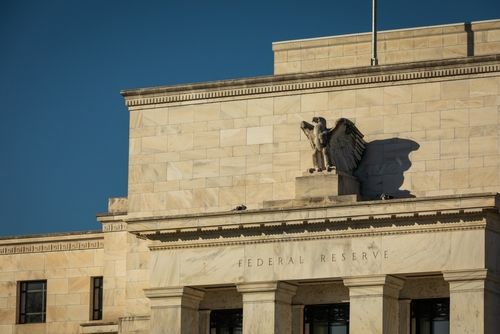
The Federal Reserve has held rates steady, but that does not mean stocks are suddenly getting an easier backdrop. The Fed kept its target range at 3.75% – 4.00%, while inflation remains above target and policymakers are still keeping the door open to further tightening.
For traders, the important question is not another 25-basis-point move. It is which companies can keep growing when borrowing stays expensive and investors demand more from every dollar of earnings.
That puts the focus back on stock selection. Cash-rich technology leaders can keep funding AI investment internally. Banks may earn more from higher rates but face softer lending and credit pressure. Consumer stocks can feel the squeeze if mortgage, card and vehicle-finance costs stay high. The same split is visible in Australia, where CBA, NAB, Wesfarmers and JB Hi-Fi are all exposed to the rate cycle in different ways.
Cash-rich tech can keep spending
Higher rates usually make expensive growth stocks harder to justify because investors put a lower value on profits expected years into the future. But the biggest technology companies have one major defence: they generate enough cash to keep investing without leaning heavily on debt.
Microsoft and Alphabet are good examples. Both continue to spend heavily on data centres, chips and cloud infrastructure, yet their core businesses still generate enough cash to support that investment.
That matters because AI has become a capital-intensive race. Companies need huge upfront spending before the revenue fully arrives, and higher financing costs make that harder for smaller competitors.
The advantage therefore shifts towards businesses that can fund expansion internally. For traders, the question is less “are rates high?” and more “does this company need cheap money to keep growing?”
That can separate large technology leaders from more speculative growth stocks even when both are exposed to the same AI boom.
Meta and Nvidia show both sides of the AI trade
Meta sits on the spending side of AI. Its advertising business remains highly profitable, but capital expenditure is expected to reach roughly $135 billion to $145 billion this year as the company builds more computing capacity. Third-quarter capex reached $34.9 billion, while free cash flow turned negative as investment accelerated.
The market can tolerate that if AI keeps improving engagement, advertising performance and future revenue. The risk is that spending keeps rising faster than the returns.
Nvidia sits on the other side. It benefits when Meta, Microsoft, Alphabet and other hyperscalers keep buying chips, but that demand is not completely independent of financing conditions. If customers become more cautious about enormous infrastructure budgets, the effects eventually flow back to suppliers.
That does not make either stock a simple rate trade. Meta needs to prove that AI investment is translating into stronger earnings, while Nvidia needs its customers to keep seeing enough return on their own capex to justify more orders.
Banks can benefit — until borrowers weaken
Banks look like obvious winners when rates stay high because they can earn more on loans. The reality is more mixed.
JPMorgan has continued to benefit from strong banking and trading revenue, while Australian banks remain highly profitable. CBA reported FY26 cash profit of almost A$11 billion, a 14% cash return on equity and a fully franked annual dividend of A$5.05 per share.
But the longer rates stay restrictive, the more attention moves to borrowers. Loan demand can slow, mortgage stress can increase and credit losses can rise. Deposit competition can also reduce the benefit of charging customers more.
That makes CBA and NAB useful Australian examples. Both can benefit from healthy lending margins, but both are also heavily exposed to households and businesses carrying expensive debt.
For traders, the bank story is therefore not simply “rates up, shares up.” The better question is whether higher margins are still outweighing softer lending and credit risk.
Consumer stocks can reveal where pressure is building
Consumer stocks are where higher borrowing costs can become visible fastest.
In the US, Amazon has enough diversification through cloud computing and advertising to avoid being treated as a pure retailer, but consumer spending still matters across its core commerce business.
In Australia, Wesfarmers and JB Hi-Fi offer a more direct read on household pressure.
Wesfarmers has exposure to Bunnings, Kmart and Officeworks, so it can benefit if shoppers become more value-conscious while still feeling the effect of weaker discretionary spending. JB Hi-Fi is more exposed to electronics and appliances, where purchases can often be delayed when mortgage and credit costs rise.
The important point for traders is not that consumers suddenly stop spending. Behaviour changes at the margin. Households can choose cheaper products, postpone large purchases or become more sensitive to promotions.
Those shifts can show up in sales growth and margins quickly, making retailer earnings a useful test of whether high rates are beginning to bite.
US and Australian stocks face the same problem differently
The Fed is the immediate trigger, but the stock-market effect extends beyond the US. Australian companies are also operating with restrictive borrowing costs, and local inflation is keeping rate expectations in focus. Many of the same questions therefore apply.
Can CBA and NAB keep margins strong without a meaningful deterioration in credit quality?
Can Wesfarmers and JB Hi-Fi maintain sales if household budgets stay tight?
Can growth companies keep expanding without cheaper capital?
The answers will differ by company, which is exactly why higher rates can create opportunities for stock traders rather than one broad market call. A cash-generative technology company can still outperform. A bank can remain resilient if margins stay strong and bad debts remain contained. A retailer can surprise positively if consumers hold up better than expected. Companies that require both strong demand and cheap financing have much less room for disappointment.
What should traders watch next?
AI capex: Microsoft, Meta and Alphabet need to show that infrastructure spending is producing enough growth to justify the cost.
Bank credit quality: Rising arrears or provisions at JPMorgan, CBA or NAB would suggest high rates are starting to hurt borrowers more materially.
Consumer margins: Wesfarmers, JB Hi-Fi and Amazon can show whether shoppers are trading down, delaying purchases or forcing more discounting.
Cash flow: Companies capable of funding growth internally have more flexibility if borrowing remains expensive.
Inflation: Persistent inflation keeps pressure on rates in both the US and Australia, while a sustained slowdown could change the setup quickly.
Trading high-rate stock markets with Mitrade
Higher rates can create sharp differences between companies even when the broader market does not move much.
Eligible Australian clients can use Mitrade CFDs to take long or short positions on available US and Australian shares, allowing traders to respond to those differences without owning the underlying stock.
That flexibility is relevant when one company is benefiting from strong cash flow while another is dealing with weaker demand, rising financing costs or margin pressure. Traders can therefore take separate views on individual companies rather than relying on the entire market moving in the same direction.
Stop-loss and take-profit orders can help define exit levels, while pending orders allow positions to open when selected prices are reached. Earnings announcements and central-bank decisions can produce sharp moves, so leverage and position sizing remain important.
Mitrade is regulated in Australia by ASIC. Share CFDs are leveraged products, so both potential gains and losses can be magnified.
Start trading US and Australian shares in three simple steps
You might be interested in…
1. Which stocks can cope better when rates stay high?
Companies with strong free cash flow, manageable debt and the ability to fund investment internally generally have more flexibility than businesses dependent on refinancing or distant future profits.
2. Can bank shares still fall when rates are high?
Yes. Higher lending income can be offset by weaker loan demand, rising deposit costs and higher bad-debt provisions.
3. Why are Australian retailers relevant to the rate story?
They provide a direct read on household pressure. If consumers start delaying purchases or trading down more aggressively, sales and margins can show the effect quickly.
Disclaimer: The content presented above, whether from a third party or not, is considered as general advice only. CFD trading involves significant risk of loss. Past performance does not guarantee future results. This article serves informational purposes only and does not constitute financial advice. Consider your risk tolerance before trading.


