




Not Intel. Not CoreWeave. This Underappreciated Nvidia-Backed Company Is Growing Artificial Intelligence (AI) Revenue by 123%. Here's Why It's a Buy Today for $8.
Key Points
Nvidia is using its record profits to make strategic investments in artificial intelligence (AI) partners.
Last October, Nvidia invested $1 billion in Nokia to help build AI radio access networks.
Nokia's fastest-growing business now comes from its AI & Cloud customers.
- Motley Fool Issues Rare "Total Conviction" Buy Alert ›
When most investors think of Nokia (NYSE: NOK), they probably remember the brick phones that pioneered mobile devices decades ago. What you may not appreciate is that the Finnish company is quietly undergoing a renaissance, and artificial intelligence (AI) is at the center of its transformation.
Nokia has built telecommunications infrastructure spanning networks that connect mobile devices and transport data. Given the AI infrastructure boom, the company is smartly leveraging these assets to become a supplier of AI networking equipment.
Missed AI’s "Act 1"? Act 2 Could Be 15x Bigger. Most investors think they missed the AI boat because they didn't buy Nvidia in 2005. But according to our analysts, we’re only at the end of "Act 1"—the R&D phase. "Act 2" is the global rollout. Continue »
One of the biggest believers in this strategy is Nvidia (NASDAQ: NVDA). While Nvidia has made a number of strategic investments in chip and foundry specialists like Intel or neocloud providers like CoreWeave, I think its most lucrative partnership might be with Nokia.
The semiconductor giant invested $1 billion in Nokia last year, establishing a framework that stands to reshape the telecommunications industry. Following Nokia's third-quarter earnings report, investors have fresh evidence that its AI-driven transformation is gaining momentum.

Image source: Getty Images.
How Nokia is evolving from phones to AI
Last October, Nvidia invested $1 billion in Nokia, acquiring 2.9% of the company. The two companies are collaborating on artificial intelligence radio access networks (AI-RAN), which combine traditional wireless networking equipment with accelerated computing. Essentially, Nvidia and Nokia are turning telecommunications networks into distributed AI platforms.
This is important because much of the current AI revolution revolves around data centers. However, emerging applications involving autonomous vehicles, robotics, industrial automation, and connected devices will require AI processing closer to where information is actually generated. This process is known as edge AI, and according to data compiled by Omdia, the AI-RAN market is expected to exceed $200 billion by 2030.
Nokia's earnings reveal where the real growth is happening
During the third quarter, Nokia generated 5.2 billion euros in revenue. On the surface, this may look mundane, as it represented only 9% growth year over year on a constant-currency basis. Operating profit increased 35% to 605 million euros, while earnings per share (EPS) climbed 50% to 0.09 euros.
The most impressive performance came from Nokia's AI & Cloud division. Revenue from these customers increased 123% year over year to 631 million euros, while order intake surged 118%. Nokia secured approximately 1.5 billion euros in new orders during the quarter.
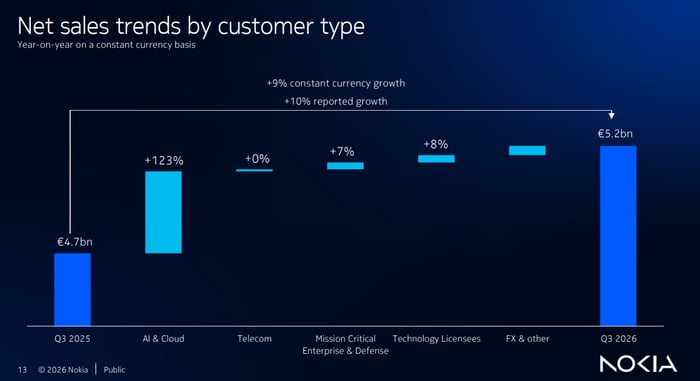
Data source: Nokia investor relations.
One subtle theme to understand here is that Nokia's acquisition of Infinera has helped expand its optical networking capabilities and strengthen the company's ability to supply high-speed connectivity required for AI infrastructure. The company's position in the AI infrastructure ecosystem should not be discounted. Nokia is working with companies including Alphabet, which is pursuing a 13 billion-euro investment in Finland, as well as major telecoms players like Zayo and neocloud providers developing AI inference connectivity.
Is Nokia stock a buy?
I think the biggest reason to be bullish on Nokia is its position within the broader AI infrastructure supply chain. When investors think about the capital expenditures (capex) that Amazon, Microsoft, Alphabet, and Meta Platforms are pouring into AI development, they typically default to GPUs and memory chips.
However, the AI build-out requires more than semiconductors. As hyperscalers build more data centers, they also need high-speed optical networking equipment to move information between computing systems.
In other words, the pick-and-shovel suppliers of AI extend well beyond chips. They also include networking equipment, optical systems, and underlying connectivity infrastructure that keep data centers functioning. Nokia fits squarely into this opportunity.
I think this is an underappreciated part of the broader AI investment thesis. Many investors understand why Nvidia benefits when hyperscalers purchase GPUs, but they may not fully grasp how much spending is also flowing downstream toward the companies supplying the underlying networking infrastructure.
At around a 2.6 price-to-sales (P/S) ratio, I see Nokia as a compelling AI infrastructure investment for long-term investors. Considering Wall Street expects hyperscaler spending to continue accelerating, Nokia's AI story may still be in its early stages. Against this backdrop, I think there is meaningful upside potential in buying and holding Nokia stock throughout the AI infrastructure era.
Should you buy stock in Nokia right now?
Before you buy stock in Nokia, consider this:
The Motley Fool Stock Advisor analyst team just identified what they believe are the 10 best stocks for investors to buy now… and Nokia wasn’t one of them. The 10 stocks that made the cut could produce monster returns in the coming years.
Consider when Netflix made this list on December 17, 2004... if you invested $1,000 at the time of our recommendation, you’d have $361,596!* Or when Nvidia made this list on April 15, 2005... if you invested $1,000 at the time of our recommendation, you’d have $1,303,935!*
Now, it’s worth noting Stock Advisor’s total average return is 910% — a market-crushing outperformance compared to 211% for the S&P 500. Don't miss the latest top 10 list, available with Stock Advisor, and join an investing community built by individual investors for individual investors.
See the 10 stocks »
*Stock Advisor returns as of October 23, 2026.
Adam Spatacco has positions in Alphabet, Amazon, Microsoft, and Nvidia. The Motley Fool has positions in and recommends Alphabet, Amazon, Intel, Meta Platforms, Microsoft, and Nvidia. The Motley Fool has a disclosure policy.
Recommended Articles


