




WTI Crude Oil Price Today: Can Oil Break $100 as US-Iran Tensions Escalate? (22 October 2026)

WTI crude oil prices remained volatile near the psychologically important US$100-per-barrel level on Thursday, 22 October, as escalating US-Iran tensions, threats to Middle Eastern energy infrastructure and declining US oil inventories continued to influence global energy markets.
According to an Associated Press market snapshot on 22 October, US crude oil futures climbed approximately 2% to US$99.05 per barrel, following reports of renewed threats to oil tankers in the Strait of Hormuz. The reported incidents have raised concerns about further disruptions to global energy supplies.
Meanwhile, reports that the United States and Israel have developed plans for potential renewed military strikes against Iran following the US midterm elections have added another layer of uncertainty to the crude oil outlook.
The key question for traders is whether WTI crude oil can break above US$100 and sustain its gains, or whether another rejection at this resistance level could trigger a correction towards US$95.
WTI Crude Oil Price Today: Key Market Highlights
Immediate resistance: US$100, followed by US$105.
Key support: US$95, followed by US$90.
US oil inventories: Commercial crude stocks fell by approximately 3.1 million barrels to 412.5 million barrels in the week ending 16 October.
Geopolitical developments: Reports of potential renewed US-Israeli strikes against Iran have intensified uncertainty surrounding Middle Eastern oil supplies.
Market sentiment: Volatile, with geopolitical supply risks providing support while the US$100 level remains an important technical hurdle.
Why Are WTI Crude Oil Prices Rising Today?
1. US-Iran Tensions Raise the Risk of Further Oil Supply Disruptions
Geopolitical uncertainty remains one of the most important factors influencing crude oil prices.
On 22 October, reports citing The New York Times indicated that the United States and Israel had prepared plans for possible renewed military operations against Iran following the US midterm elections on 3 November.
According to the reports, potential targets could include Iranian nuclear facilities, missile and drone arsenals, and elements of the country's energy infrastructure.
However, the existence of military contingency plans does not mean that further strikes have been authorised or are inevitable.
President Donald Trump could postpone or ultimately decide against additional military action, particularly given concerns about the economic consequences of higher energy prices.
For oil traders, the distinction between military preparations and actual disruptions to supply is crucial.
If further attacks damage production facilities, export terminals or major transportation routes, crude oil prices could experience another sharp increase.
Conversely, a diplomatic breakthrough or reduction in regional hostilities could remove part of the geopolitical risk premium currently supporting prices.
2. Strait of Hormuz Shipping Risks Keep Oil Markets on Edge
The Strait of Hormuz remains central to the global oil price outlook.
On 22 October, the Associated Press reported that Iranian state television had alleged that seven oil tankers caught fire in the strait. The claims had not been independently confirmed at the time of reporting.
Nevertheless, concerns about maritime security have continued to influence oil market sentiment.
Earlier Reuters reporting highlighted attacks on commercial vessels extending beyond the Strait of Hormuz into the Gulf of Oman, creating additional risks for crude oil transportation and regional export operations.
These developments matter because disruptions to shipping can affect global oil prices even when production facilities remain operational.
Higher insurance premiums, longer shipping routes, reduced tanker availability and logistical uncertainty can all increase the effective cost of supplying crude oil to international markets.
For Australian investors, these developments are particularly relevant because Australia remains exposed to international petroleum markets through its reliance on imported crude oil and refined fuels.
Sustained increases in global oil prices could eventually place additional upward pressure on domestic petrol and diesel prices.
3. Falling US Crude Oil Inventories Provide Additional Price Support
Alongside geopolitical developments, US oil inventory data has strengthened the near-term fundamental outlook for crude oil.
According to the US Energy Information Administration's latest weekly figures, commercial crude oil inventories declined from approximately 415.6 million barrels to 412.5 million barrels during the week ending 16 October.
This represents a weekly decrease of approximately 3.1 million barrels.
The decline suggests that US crude oil supplies have tightened, providing another source of support for prices.
US crude production also declined to approximately 13.27 million barrels per day during the reporting week, although temporary production disruptions can affect weekly figures.
Falling inventories are generally considered supportive for crude oil prices, particularly when they occur alongside geopolitical supply concerns.
However, traders should avoid interpreting a single inventory report as confirmation of a sustained upward trend.
WTI Crude Oil Technical Analysis: Will Oil Break Above $100?
WTI crude oil continues to trade around a critical technical and psychological price zone.
The US$100 level has repeatedly attracted market attention, while the broader US$95–US$105 range remains a useful framework for evaluating near-term price scenarios.
With geopolitical uncertainty increasing, traders should prepare for the possibility of larger price swings and false breakouts.
WTI Crude Oil Daily Chart Analysis
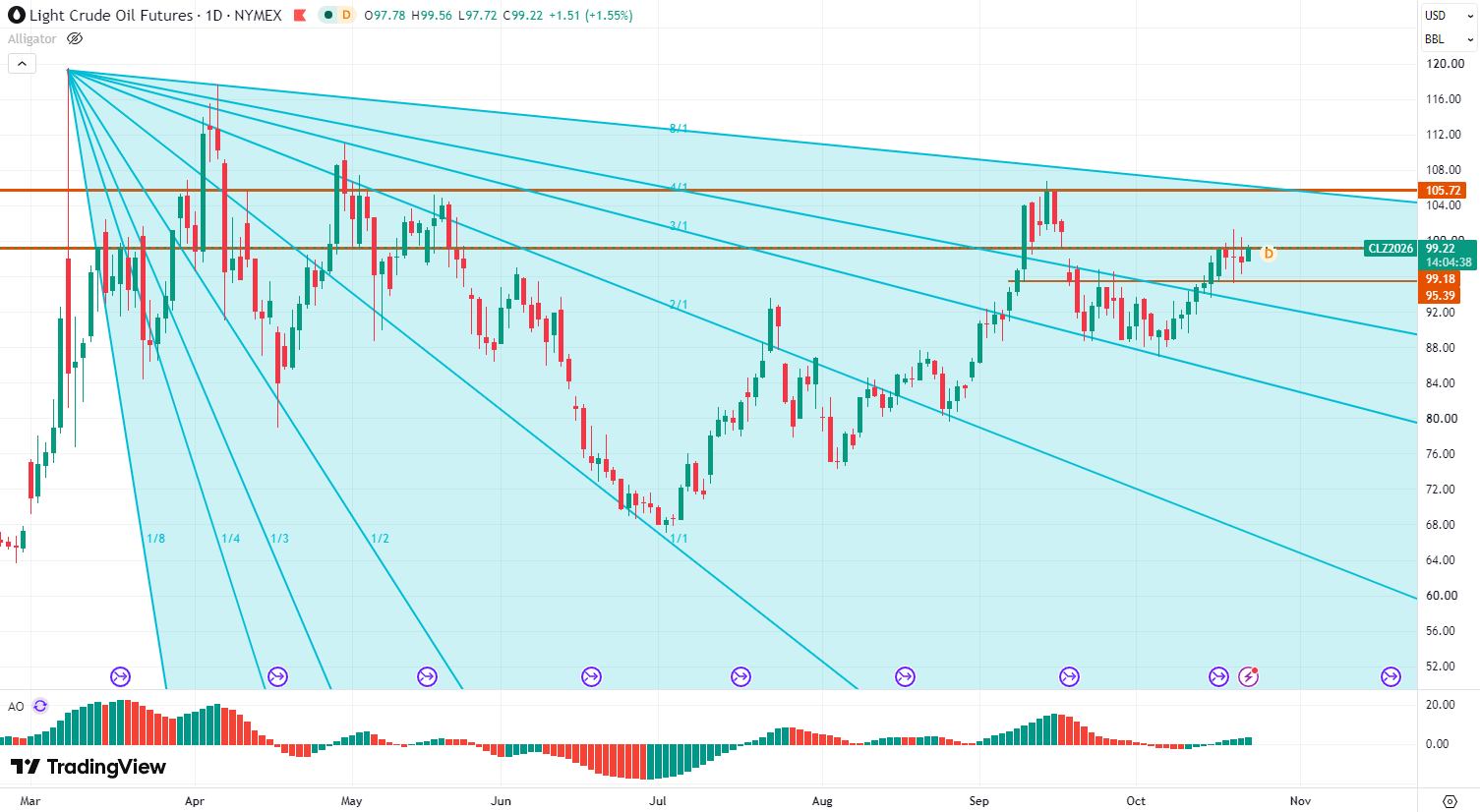
Source: Tradingview
From a technical perspective, US$100 remains the immediate resistance level to watch.
A sustained move above this threshold could indicate improving bullish momentum, particularly if supported by rising trading volume and further evidence of supply disruptions.
However, a temporary move above US$100 followed by a rapid reversal would suggest that sellers remain active around this level.
The next important upside level is approximately US$105.
A confirmed daily close above US$105 could weaken the current range-bound interpretation and open the possibility of an extension towards US$110 and potentially US$120 under a stronger bullish scenario.
On the downside, US$95 remains the first major support level.
A sustained break below US$95 could indicate that bearish momentum is strengthening, with US$90 becoming the next downside reference.
If geopolitical tensions ease significantly and oil supply conditions improve, a deeper correction towards US$80 cannot be ruled out over a longer horizon.
These levels are scenario-based reference points rather than guaranteed price targets. Confirmation should come from current price action and chart indicators.
How to Trade WTI Crude Oil CFDs in Australia
For Australian traders who want exposure to short-term oil price movements, WTI CFDs provide a way to speculate on both rising and falling crude prices without owning physical barrels of oil.
A CFD trader can potentially take a long position if they expect WTI to rise, or a short position if they expect prices to fall.
For example:
WTI breaks above US$105 → bullish traders may look for continuation towards US$110.
WTI holds US$100 → traders may monitor whether the breakout develops into a new uptrend.
WTI falls below US$95 → bearish traders may watch for a move towards US$90.
WTI breaks below US$90 → the medium-term bullish structure would become less convincing.
However, CFDs are leveraged products, meaning both gains and losses can be amplified. Traders should consider position size, stop-loss levels, overnight financing costs and overall risk before opening a position.
Trade WTI Crude Oil CFDs with Mitrade
Australian traders can use Mitrade to access WTI crude oil CFDs and respond to fast-moving oil markets.
With CFDs, you don't need to take physical delivery of crude oil. You can trade based on whether you expect the oil price to rise or fall, giving you flexibility during both bullish and bearish market conditions.


What Do Rising Oil Prices Mean for Australian Traders?
For Australian market participants, rising global oil prices can influence several financial markets beyond crude oil itself.
Australian energy shares: Higher oil prices may support revenue expectations for some energy producers, although individual company performance also depends on production costs, operational factors and broader equity market conditions.
AUD/USD exchange rate: Energy prices can influence inflation expectations, global risk sentiment and currency movements. However, the Australian dollar is also heavily affected by Chinese economic activity, commodity demand and interest rate expectations.
Australian inflation: Sustained increases in global crude oil and refined fuel prices may eventually contribute to higher domestic transport and operating costs.
Oil CFDs: Traders seeking exposure to crude oil price movements may consider contracts for difference, which allow speculation on both rising and falling markets without owning physical oil.
You might be interested in…
Disclaimer: The content presented above, whether from a third party or not, is considered as general advice only. CFD trading involves significant risk of loss. Past performance does not guarantee future results. This article serves informational purposes only and does not constitute financial advice. Consider your risk tolerance before trading.


