




How Australia's Superannuation Boom Is Moving the ASX and What Traders Need to Know

Every Australian with a job contributes to the single largest pool of capital in the country's history. Australia's superannuation system now holds $4.8 trillion in total assets as at the June 2026 quarter, a figure that makes it one of the largest pension systems globally relative to the size of the economy it sits inside.
Most Australians think of super as a retirement savings account they check twice a year and largely ignore. What they do not realise is that $4.8 trillion does not sit still. Super funds buy and sell billions of dollars of ASX stocks every single quarter on a schedule that is predictable, published in advance, and creates price movements that have nothing to do with the underlying performance of any individual company. The traders who understand this dynamic have a structural edge over those who do not.
The next ASX 200 quarterly rebalance is September 22, 2026, five days away. This guide explains how super fund capital flows move the ASX, what the rebalance means for specific stocks, what the September 22 event will do to the index, and how Australian traders can position around the most powerful institutional force in the local market.
How Big Is $4.8 Trillion: The Numbers in Context
$4.8 trillion is larger than Australia's entire annual GDP, making the superannuation system one of the most consequential pools of institutional capital in the world relative to the domestic economy it operates within.
The RBA projects this figure will grow to $8.1 trillion by 2035, less than a decade from now. Employer contributions hit $164.4 billion for the year to June 2026, up 9.6% year on year, driven by the Superannuation Guarantee rate increasing to 12%. Member contributions added a further $71.9 billion for the same period, up 21%.
There are 25 million super accounts in Australia. Every fortnight, compulsory contributions flow from employers into those accounts and from those accounts into investment mandates that are overwhelmingly weighted toward Australian and international equities.
For the ASX 200 specifically, super funds are the single largest category of institutional investor. Their decisions on asset allocation, sector weighting, and index benchmarking move share prices at a scale that no other domestic investor class comes close to matching.
How Super Funds Move the ASX: The Quarterly Rebalance Explained
Most super funds invest a significant portion of their Australian equity allocation through passive or index-aware mandates benchmarked to the ASX 200. This means they hold the ASX 200 in proportion to its current composition and must adjust their holdings every time that composition changes.
S&P Dow Jones Indices conducts formal quarterly reviews in March, June, September, and December each year. At each review, stocks are added and removed from the ASX 200 based on market capitalisation and liquidity criteria. When a stock is added, every passive super fund must buy it. When a stock is removed, every passive super fund must sell it.
This creates mechanical demand and supply that temporarily moves prices independent of any company-specific news. The June 2026 rebalance saw ALS move up into the ASX 50, displacing Pro Medicus. Stocks joining the ASX 200 saw systematic buying from index-tracking funds in the days before and on the effective date. Stocks leaving faced the opposite pressure as funds sold their holdings to realign with the new composition.
What the 2026 Rebalance Dates Show on the Chart
Looking at the ASX 200 daily chart with the three 2026 rebalance dates marked, a clear pattern emerges that is worth understanding before the September 22 event arrives.
At the March 22 rebalance, the index was trading around 8,700 before the sharp April selloff to approximately 8,280. The rebalance date coincided with the beginning of a volatile period driven by broader macro uncertainty and Middle East tensions.
At the June 23 rebalance, the index was around 8,750 to 8,800. The June rebalance marked the beginning of the strong rally that took the index to its all-time high of 9,296.7 in early August. Passive fund rebalancing brought fresh capital into new ASX 200 entrants and the broader index benefited from improved market sentiment in the weeks that followed.
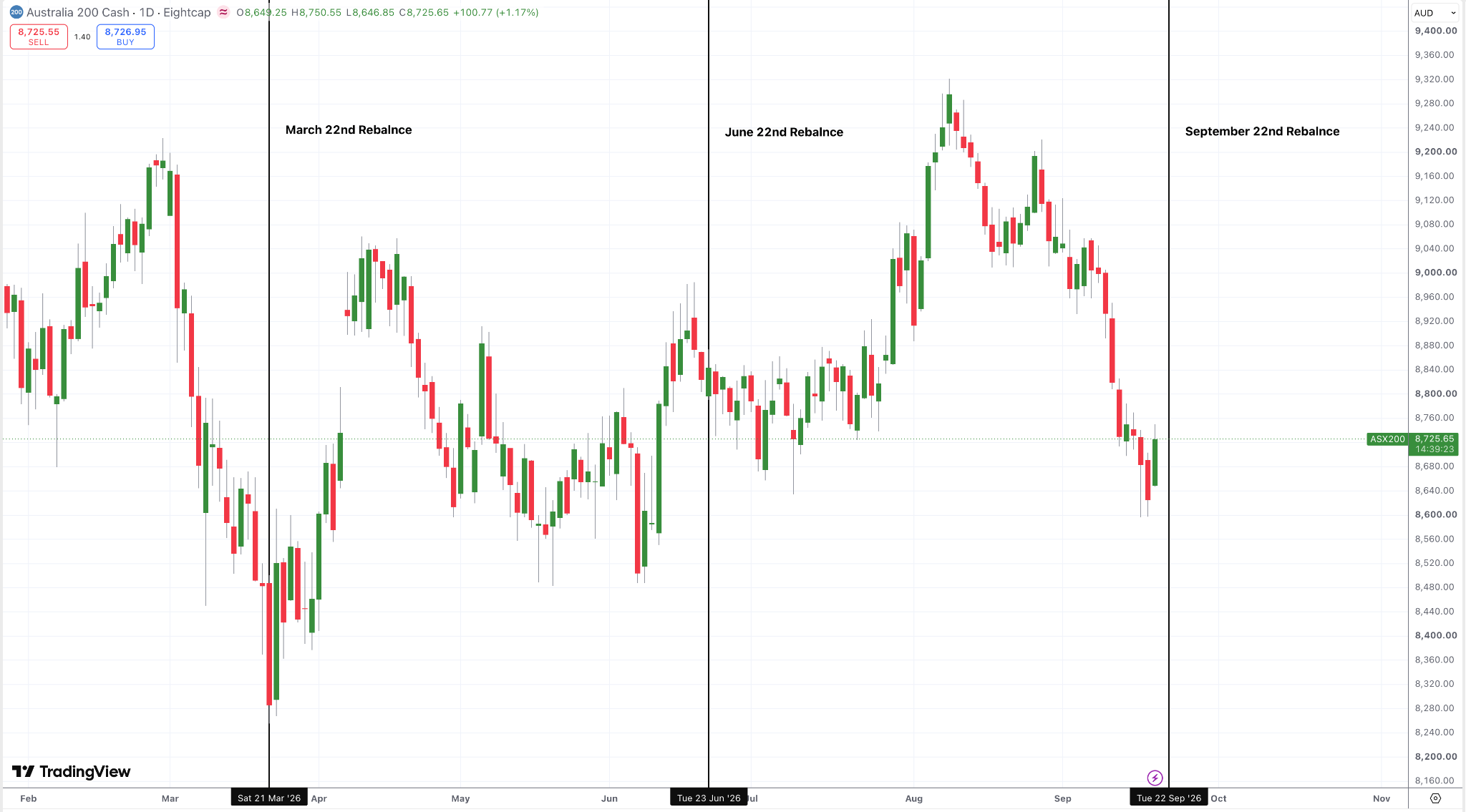
Source - TradingView (ASX 200 Daily Chart, 2026 Rebalance Dates Marked)
The September 22 Rebalance: What Traders Need to Know This Week
The September 22 rebalance arrives in five days with the index at 8,723, deep in a correction from the August all-time high of 9,296.7.
Stocks confirmed as ASX 200 additions in this rebalance cycle face mechanical buying from passive super funds regardless of whether they have risen or fallen in preceding weeks. Stocks face selling pressure entirely disconnected from their business performance or valuation.
Stocks confirmed as ASX 200 additions tend to see buying pressure in the week before the rebalance effective date. That buying pressure often reverses within one to two months as mechanical demand is fully absorbed, which means the trade is time-sensitive and requires a clear exit plan. The inverse applies to deletions, which face systematic selling in the days around September 22 before eventually finding a new equilibrium without the passive fund support they previously enjoyed.
Super Funds Are No Longer Just Passive
The second major way super funds move the ASX has nothing to do with quarterly rebalancing. It is about their growing willingness to use $4.8 trillion in assets as leverage in corporate transactions.
Super funds are using their substantial shareholdings in ASX-listed companies to block, influence, and reshape public M&A transactions at a scale not seen before. UniSuper participated in the $32 billion Sydney Airport buyout and helped determine the outcome every ASX shareholder received. Macquarie Asset Management's $11.7 billion acquisition of Qube announced in early 2026 was directly influenced by super fund positioning. This activist turn is expected to intensify as consolidation within the super sector concentrates capital and increases the number of funds capable of influencing large-scale public transactions.
For ASX traders, any M&A announcement now carries the additional variable of how super funds are positioned in the target stock and whether they are likely to support or oppose the deal.
The New $3 Million Super Tax and What It Does to Capital Flows
From July 1, 2026, Australia introduced an additional tax on super balances exceeding $3 million. Balances above the threshold now attract an extra tax on earnings on top of the standard 15% paid in the accumulation phase, applying to realised gains rather than paper profits.
This structural change has two direct consequences for ASX capital flows. High-balance super members are actively restructuring portfolios to manage the tax liability, shifting capital out of high-return growth assets and into tax-efficient structures outside the standard super environment. Some high-balance members are withdrawing capital from super entirely and deploying it into alternative investment structures.
Both movements represent capital that previously sat in ASX-benchmarked mandates and is now being redirected. At $4.8 trillion in total assets, even a small percentage shift in allocation creates hundreds of billions of dollars in flow changes across the ASX 200.
How to Trade Around Super Fund Activity on Mitrade
Mitrade, regulated by ASIC under licence AFSL 398528, offers the ASX 200 as an index CFD instrument that Australian traders can go long or short from a single zero-commission account. Three specific super-driven trading setups are worth understanding.
The first is positioning around quarterly rebalance dates. Stocks confirmed as ASX 200 additions face mechanical buying from passive super funds in the days before September 22 regardless of market direction.
The second is tracking M&A announcements where super funds hold significant stakes in the target company. When a major super fund is a top-ten shareholder in a takeover target, its likely stance on the deal determines whether the takeover premium holds or compresses in the sessions after announcement.
The third is monitoring super fund quarterly performance updates, which often reveal sector-level asset allocation shifts that preview where institutional capital is moving before it shows up in individual share prices. Stop-loss and take-profit controls appear directly on the Mitrade order screen before any trade is confirmed.
A free demo account with $50,000 in virtual funds lets Australian traders practise positioning around super fund-driven market events before committing real capital.
You might be interested in…
1. How much does Australia's superannuation system manage in 2026?
Total super assets reached $4.8 trillion at the end of the June 2026 quarter, up from $4.4 trillion at December 2025. The RBA projects this figure will grow to $8.1 trillion by 2035. Employer contributions totalled $164.4 billion for the year to June 2026, up 9.6% year on year, driven by the Superannuation Guarantee rate rising to 12%.
2. What is the ASX 200 quarterly rebalance and when does it happen?
The ASX 200 quarterly rebalance is the process by which S&P Dow Jones Indices adds and removes stocks from the index based on market capitalisation and liquidity criteria. It occurs four times per year with effective dates in March, June, September, and December. The next rebalance is September 22, 2026. When stocks are added, passive super funds must buy them. When stocks are removed, passive super funds must sell them, creating mechanical price pressure on both groups around the effective date.
3. How do super fund rebalances affect individual ASX stock prices?
Stocks added to the ASX 200 face mechanical buying from passive super funds in the days before and on the effective date, which temporarily pushes prices higher. Stocks removed face systematic selling pressure as funds must divest their holdings to match the new index composition. Empirical research shows these price effects typically reverse within one to two months as mechanical demand and supply are fully absorbed, meaning trading the rebalance requires precise timing and a clear exit plan.
4. Are Australian super funds still passive investors?
No. Super funds have become increasingly activist investors using substantial shareholdings to influence major corporate transactions. Examples include super fund participation in the $32 billion Sydney Airport buyout and the influence of super fund positioning on Macquarie Asset Management's $11.7 billion acquisition of Qube in early 2026. This trend is expected to intensify as consolidation within the super sector concentrates capital into fewer, larger funds capable of exercising significant corporate influence on ASX-listed companies.
5. What is the new $3 million super tax introduced in 2026?
From July 1, 2026, super balances exceeding $3 million attract an additional tax on earnings on top of the standard 15% paid in the accumulation phase. The change applies to realised gains rather than paper profits. High-balance members are restructuring portfolios and in some cases withdrawing capital from super entirely, redirecting it into alternative structures outside the ASX 200 benchmarked mandates that previously held that capital.
6. Can Australian traders access the ASX 200 index on Mitrade?
Yes. Mitrade offers the ASX 200 as an index CFD under ASIC regulation with licence AFSL 398528. Australian traders can go long or short on the index from a single zero-commission account, allowing them to position around quarterly rebalance dates, M&A announcements influenced by super fund activity, and super fund quarterly asset allocation shifts. A free demo account with $50,000 in virtual funds is available before going live.
Disclaimer: The content presented above, whether from a third party or not, is considered as general advice only. CFD trading involves significant risk of loss. Past performance does not guarantee future results. This article serves informational purposes only and does not constitute financial advice. Consider your risk tolerance before trading.


