




XRP defends $1.30 support as Ripple partners with Arf to bring RLUSD settlement liquidity to XRPL
- XRP eyes short-term recovery after bulls defended the $1.30 support level following Thursday’s sharp decline.
- Ripple and Arf partner to bring RLUSD-powered settlement liquidity to the XRP Ledger.
- XRP’s upside remains capped by the 50-day, 100-day and 200-day EMAs, limiting its recovery potential.
Ripple (XRP) holds near recently confirmed support at $1.30 on Friday, as bulls eye a short-term recovery toward $1.40. The remittance token’s upside remains capped by structural levels, suggesting recovery would depend on whether buyers can sustain momentum. A daily close below $1.30 could affirm the bearish outlook, raising the odds of an extended downtrend toward the $1.12 psychological demand area.
Ripple and Arf partner on RLUSD-powered settlement liquidity
Ripple and Arf announced a strategic partnership on Thursday to bring stablecoin settlement liquidity to licensed cross-border merchants on the XRP Ledger (XRPL). Arf said in the press release that cross-border payment companies face liquidity challenges that can be solved by PayFi, its financial infrastructure built around treasury, foreign exchange, custody, investment products and real-time settlements. PayFi spans settlement liquidity, working capital financing and treasury management, using both fiat and stablecoins.
The collaboration brings together the XRPL blockchain and Arf’s regulated infrastructure to provide short-term working capital to cross-border payment companies, deployed and repaid on-chain.
“Through this partnership with Ripple, we’re bringing stablecoin working capital to the XRP Ledger to help payment companies bridge that gap and support more payment volume,” Ali Erhat Nalbant, Co-founder and CEO at Arf, said in the press release.
Arf’s short-term settlement liquidity is generally repaid within one to five days as cross-border transactions clear, enabling efficient redeployment of capital into ongoing, real-world payment flows.
Technical analysis: XRP holds key support
XRP trades at $1.32, maintaining a bearish near-term bias as price holds below key Exponential Moving Averages. The 100-day EMA at $1.34, together with the 50-day EMA at $1.37 and the 200-day EMA at $1.38, all sit overhead and suggest that recent rebounds remain capped within a broader corrective phase.
The SuperTrend indicator at $1.47 reinforces a dominant resistance band above current levels, while the Relative Strength Index (RSI) near 42 hints at subdued buying interest. The Moving Average Convergence Divergence (MACD) indicator stays marginally negative, with readings below zero that reinforce a still-weak momentum backdrop.
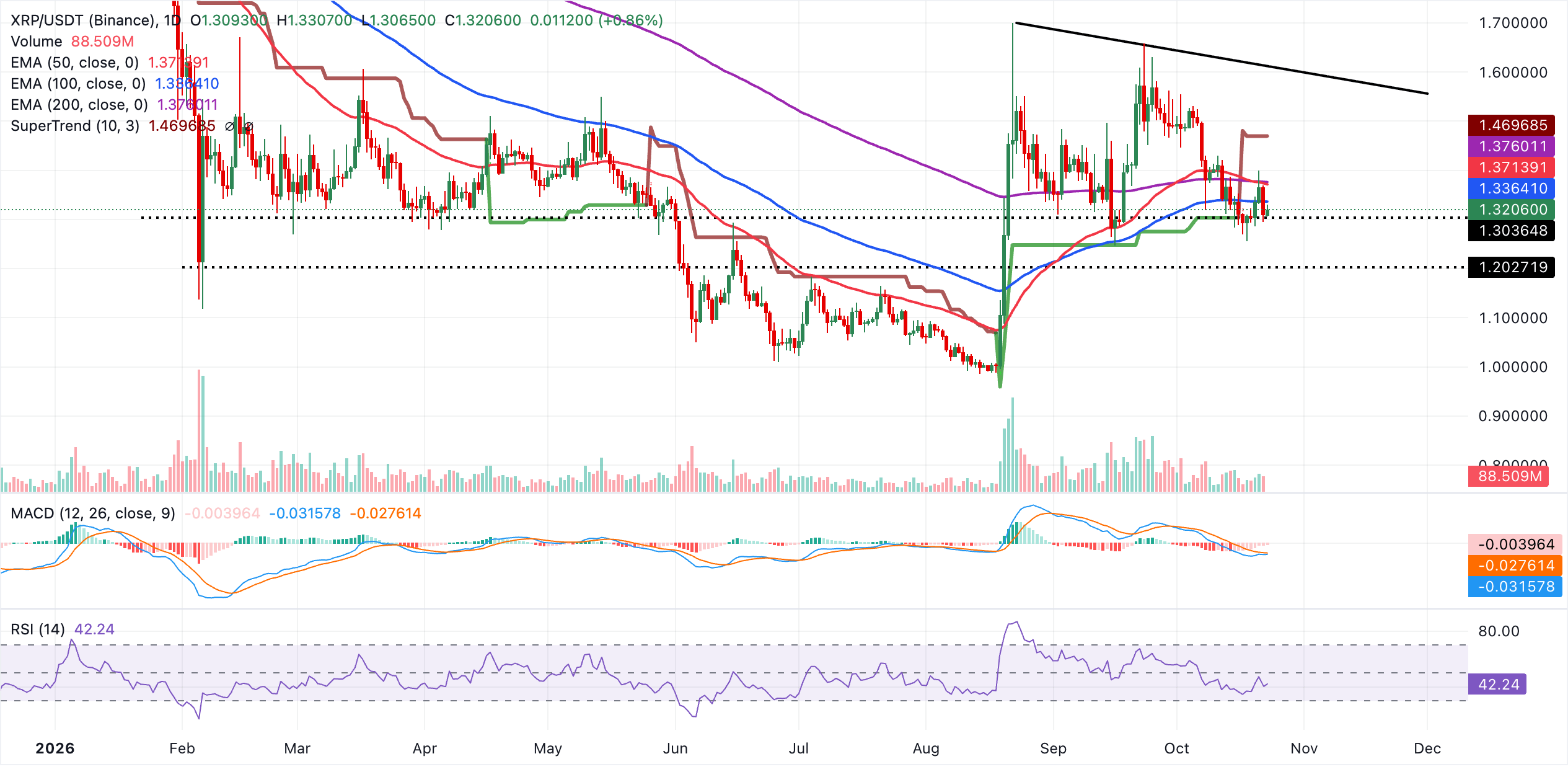
Immediate resistance emerges at the 100-day EMA around $1.34, with further obstacles clustered near the 50-day EMA at $1.37 and the 200-day EMA at $1.38, where bears could attempt to reassert control on any bounce. Above these, the SuperTrend line at $1.47 is followed by a more distant structural barrier defined by the downward resistance trend line, with a notable reference at its break price near $1.61 and the origin zone around $1.70.
On the downside, the lack of clearly defined moving-average or trend-line support on the daily chart leaves the recent low area around $1.30 as a soft floor, suggesting that a clear break under $1.32 would expose XRP to further bearish extension before a stronger demand zone emerges.
(The technical analysis of this story was written with the help of an AI tool. Know more.)
Ripple FAQs
Ripple is a payments company that specializes in cross-border remittance. The company does this by leveraging blockchain technology. RippleNet is a network used for payments transfer created by Ripple Labs Inc. and is open to financial institutions worldwide. The company also leverages the XRP token.
XRP is the native token of the decentralized blockchain XRPLedger. The token is used by Ripple Labs to facilitate transactions on the XRPLedger, helping financial institutions transfer value in a borderless manner. XRP therefore facilitates trustless and instant payments on the XRPLedger chain, helping financial firms save on the cost of transacting worldwide.
XRPLedger is based on a distributed ledger technology and the blockchain using XRP to power transactions. The ledger is different from other blockchains as it has a built-in inflammatory protocol that helps fight spam and distributed denial-of-service (DDOS) attacks. The XRPL is maintained by a peer-to-peer network known as the global XRP Ledger community.
XRP uses the interledger standard. This is a blockchain protocol that aids payments across different networks. For instance, XRP’s blockchain can connect the ledgers of two or more banks. This effectively removes intermediaries and the need for centralization in the system. XRP acts as the native token of the XRPLedger blockchain engineered by Jed McCaleb, Arthur Britto and David Schwartz.
Recommended Articles


