




How to Trade Crypto CFDs in Australia in 2026 Without a Wallet, Without an Exchange, and Without Owning a Single Coin

How to Trade Crypto CFDs in Australia
Bitcoin (BTCUSD) is trading at AU$107,214 today. For most Australian traders, accessing that price movement means opening a crypto exchange account, passing identity verification, depositing AUD, waiting for it to clear, buying Bitcoin, and then setting up a hardware wallet so it is not sitting on an exchange that could be hacked. That is five steps, multiple custody risks, and a process that can take days before a single trade is placed.
There is a cleaner route. Crypto CFDs let Australian traders get direct exposure to Bitcoin, Ethereum, and 20-plus other cryptocurrencies from a single ASIC-regulated account, with no wallet, no exchange, no custody risk, and the ability to profit when prices fall as easily as when they rise.
This guide covers exactly how crypto CFDs work, the ASIC rule every Australian crypto CFD trader must know but almost none do, which cryptocurrencies cover the most market cap, and how to place your first crypto CFD trade on Mitrade without owning a single coin.
What a Crypto CFD Actually Is
A cryptocurrency CFD, or contract for difference, is a financial instrument that lets you speculate on the price movement of a cryptocurrency without ever buying, holding, or storing the underlying coin.
When you open a crypto CFD position, you agree to exchange the difference in the price of the chosen cryptocurrency from when you open the trade to when you close it. If Bitcoin rises from AU$107,000 to AU$115,000 and you are long, you collect that difference. If it falls from AU$107,000 to AU$95,000 and you are short, you collect that difference. In both cases, no Bitcoin ever changes hands. There is no blockchain transaction, no wallet address, no private key to lose, and no exchange custody risk.
The CFD sits inside your Mitrade account alongside any forex, index, or commodity positions you hold. One login, one account, one set of risk management tools across every market.
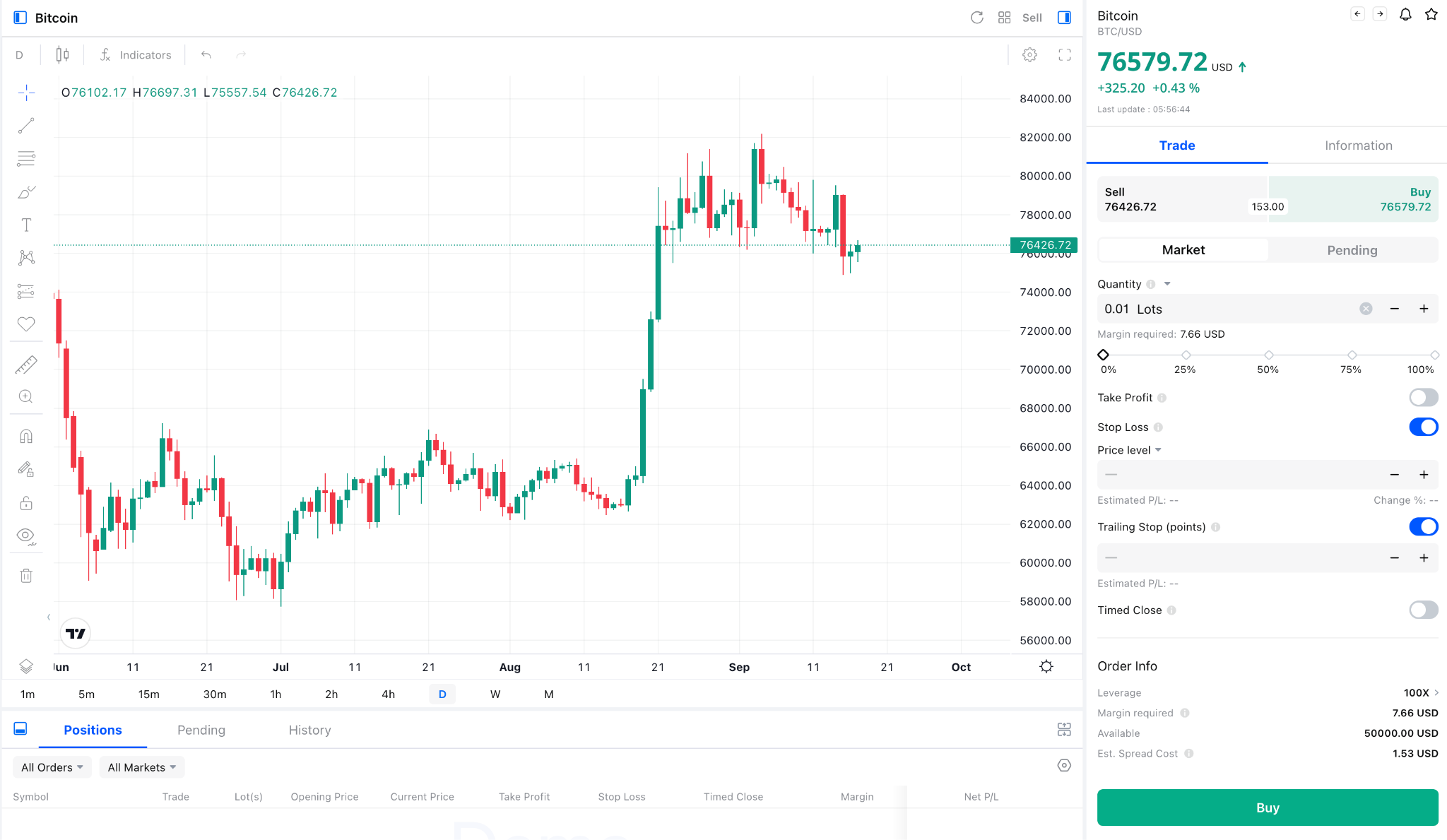
Image - Mitrade (Bitcoin BTCUSD CFD Trading Terminal)
The Three Problems With Owning Crypto Directly
Understanding why CFDs solve problems that direct crypto ownership creates is the fastest way to see their value.
Custody risk is the first problem. When you buy Bitcoin on a crypto exchange and leave it there, your coins are only as safe as that exchange's security infrastructure. Australian crypto exchange collapses and hacks have resulted in millions of dollars of investor losses in recent years. Moving coins to a hardware wallet solves the exchange risk but introduces its own problem: lose the seed phrase and the coins are gone permanently. A Mitrade CFD has none of these risks because you never hold the underlying asset.
Every sale is a tax event. The ATO treats cryptocurrency as a capital gains tax asset. Every time you sell Bitcoin for AUD, that is a taxable event requiring calculation of your cost base and gain. If you trade frequently, the record-keeping alone becomes significant work. A CFD is treated differently for tax purposes and the reporting is far simpler for active traders who open and close positions regularly.
You cannot short on a crypto exchange. When Bitcoin fell to a four-week low following the failure of the US Digital Asset Clarity vote in August 2026, Coinbase and Swyftx users could only watch their portfolios decline or sell to cut losses. CFD traders on Mitrade went short, collected the difference as Bitcoin fell, and closed for a profit. Shorting is built into every crypto CFD and requires no additional account, no borrowing, and no complexity.
“Trade Crypto CFDs with an ASIC-regulated broker. Fast AUD funding via PayID. ”
The ASIC 2:1 Rule Every Australian Crypto CFD Trader Must Know
This is the section most Australian crypto traders do not know exists, and it directly affects every position they open.
ASIC caps leverage on cryptocurrency CFDs at 2:1 for retail traders, the tightest leverage limit of any asset class ASIC regulates. Forex majors can be traded at up to 30:1. Indices at up to 20:1. Commodities at up to 10:1. Crypto sits at 2:1 specifically because of its volatility.
In practical terms, 2:1 leverage means AU$1,000 in your account controls AU$2,000 of Bitcoin exposure. If Bitcoin moves 5% in your favour, your gain is calculated on AU$2,000, not AU$1,000. That doubles the return compared to trading without leverage. The same applies in reverse: a 5% move against your position produces a loss calculated at AU$2,000. This is why stop losses are not optional on crypto CFD positions. A 10% adverse move would wipe the entire AU$1,000 margin without a stop loss in place.
ASIC's 2:1 limit is a protection mechanism, not an obstacle. It prevents retail traders from taking the kind of leveraged crypto positions that have destroyed portfolios in previous cycles. Understanding the rule before placing a trade is the single most important step any Australian crypto CFD trader can take.
Which Cryptocurrencies Are Available on Mitrade and Why They Cover Most of the Market
Mitrade offers over 50 cryptocurrency CFDs covering everything from the largest assets by market cap to DeFi tokens and sports fan tokens.
Bitcoin (BTCUSD) alone accounts for 58.82% of the total cryptocurrency market cap, which currently stands at $2.6 trillion. Ethereum (ETHUSD) accounts for a further 10.9%. Together, Bitcoin and Ethereum represent close to 70% of every dollar currently invested in cryptocurrency globally. Add Solana, BNB, Ripple XRP, Avalanche, and Polkadot and you are covering the vast majority of the liquid crypto market within a single Mitrade account.
Beyond the blue chips, Mitrade also lists DeFi protocols like Aave and Uniswap, layer-two tokens, and sports fan tokens for clubs including Manchester City, PSG, and Santos FC. This breadth means Australian traders can access niche crypto narratives alongside the mainstream market leaders without opening multiple accounts on separate platforms.
How to Go Long When You Think Bitcoin Will Rise
You open the Bitcoin BTCUSD instrument on Mitrade. Bitcoin is trading at AU$107,214. You believe the price will rise over the next week as institutional buying continues. You set your position size at AU$2,000 of exposure, which requires AU$1,000 in margin at 2:1 leverage. You set a stop loss at AU$103,000, which limits your maximum loss on this trade to approximately AU$400 if you are wrong. You set a take profit at AU$115,000, targeting approximately AU$1,600 in profit if the trade goes your way. You confirm the position.
If Bitcoin reaches AU$115,000 before your stop loss is triggered, the position closes automatically at your take profit and your account is credited. If Bitcoin falls to AU$103,000 first, the stop loss closes the position and your loss is capped at the AU$400 you decided to risk when you entered.
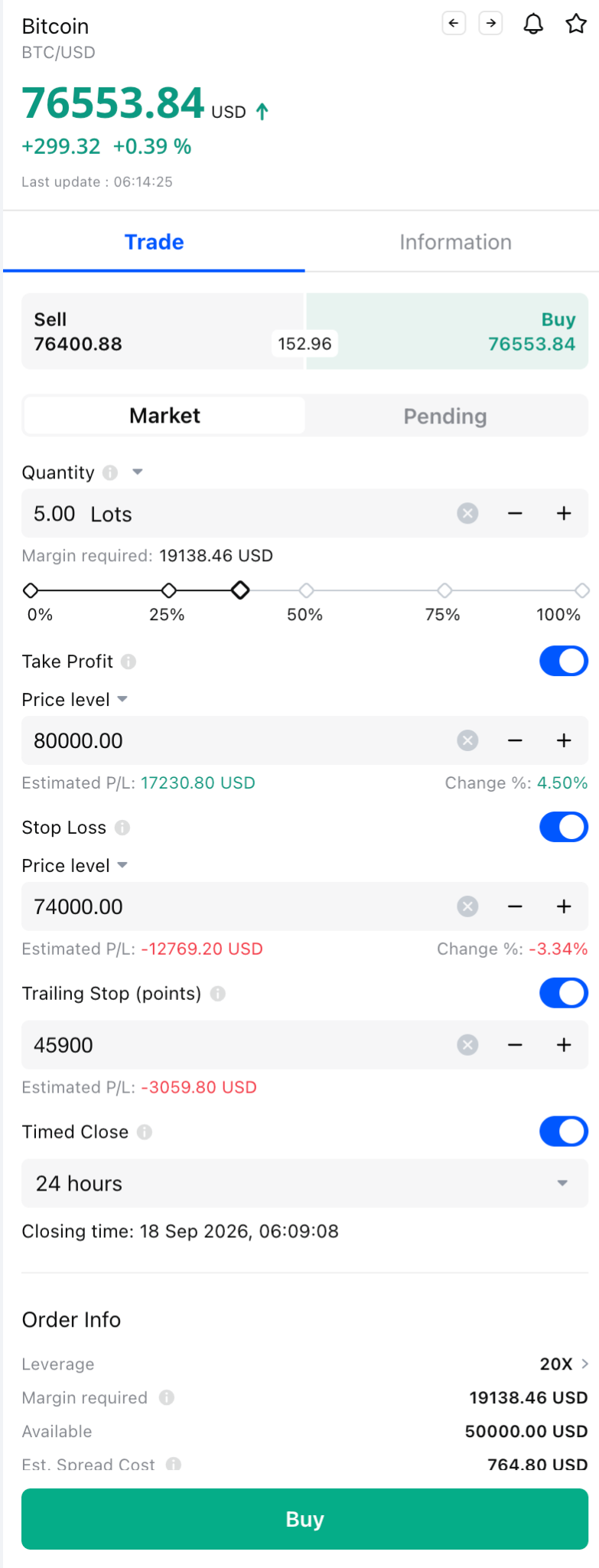
Image - Mitrade (Bitcoin BTCUSD Buy Order Panel)
The Mitrade order screen above shows exactly what a live Bitcoin CFD position looks like before confirmation. The buy price sits at US$76,554 with a spread of $153 built in between the sell and buy price. Take profit is set at $80,000 with an estimated gain of $17,230. Stop loss sits at $74,000, capping the maximum loss at $12,769 if Bitcoin moves against the position. A trailing stop follows the price upward automatically as the trade runs in your favour, locking in gains without any manual action required.
How to Go Short When Bitcoin Falls
A short position on Bitcoin BTCUSD means you profit when the price decreases. This is the trade that is impossible on a crypto exchange and straightforward on Mitrade.
The US Digital Asset Clarity vote failed in August 2026 and Bitcoin dropped sharply to a four-week low. Traders who understood the regulatory risk and had positioned short on Mitrade before the vote result landed collected the move as Bitcoin fell. The short position is opened exactly like a long position but with the sell button rather than the buy button. The stop loss sits above your entry price rather than below it.
The ability to go short is not just about profiting in falling markets. It is also a hedging tool. If you hold Bitcoin through a hardware wallet and are worried about a short-term price correction, a short CFD position on Mitrade offsets some of that downside without requiring you to sell your long-term holding and trigger a capital gains tax event.
Risk Management Rules Specific to Crypto CFDs
Crypto CFDs carry more volatility than any other asset class on Mitrade. Three rules apply specifically to this market.
Always place a stop loss before confirming any crypto CFD position. Bitcoin can move 10% in a single session on a major news event. Without a stop loss at 2:1 leverage, a 50% adverse move would wipe your entire margin. A stop loss placed at a defined risk level before entry converts a potentially catastrophic outcome into a manageable, planned loss.
Never risk more than 1% to 2% of your total account on a single crypto CFD position. The volatility that makes crypto CFDs exciting is the same volatility that destroys accounts when position sizes are too large. An AU$10,000 account should have no more than AU$100 to AU$200 at risk on any single Bitcoin or Ethereum trade.
Monitor the macro calendar. Bitcoin is highly sensitive to Federal Reserve rate decisions, US regulatory developments, and major exchange-level events. The failed US Clarity vote in August 2026 moved Bitcoin significantly in one session. Knowing these events are coming before you hold a position overnight is the difference between a managed position and an unplanned loss.
* Cryptocurrency and CFD trading involve significant risk. Cryptocurrency prices can be highly volatile, and leverage can amplify both profits and losses. You should only trade products you understand and can afford to risk.



You might be interested in…
1. What is a crypto CFD and how is it different from buying Bitcoin?
A crypto CFD is a contract that lets you speculate on the price movement of a cryptocurrency without buying, holding, or storing the underlying coin. When you buy Bitcoin on a crypto exchange, you own the actual asset and must manage custody, security, and tax reporting for every sale. A CFD gives you the same price exposure without any of those requirements. You can go long or short, and your position sits in your trading account alongside any other instruments you hold.
2. What is the ASIC leverage limit for crypto CFDs in Australia?
ASIC caps leverage on crypto-asset CFDs at 2:1 for retail traders, the tightest limit of any asset class regulated by ASIC. In practical terms, AU$1,000 in margin controls AU$2,000 of cryptocurrency exposure. This limit applies to all retail clients at all ASIC-regulated CFD brokers in Australia and exists specifically because of the high volatility of cryptocurrency markets.
3. Can I go short on Bitcoin in Australia?
Yes. Crypto CFDs allow Australian retail traders to go short on Bitcoin and other cryptocurrencies, meaning you profit when the price falls. This is not possible when buying Bitcoin directly on a crypto exchange. On Mitrade, you open a short position by selecting sell on the Bitcoin BTCUSD instrument. A stop loss above your entry price limits your maximum loss if the price rises against your position.
4. How much of the crypto market do Bitcoin and Ethereum represent?
Bitcoin dominance sits at 58.82% of the total cryptocurrency market cap, which currently stands at $2.6 trillion. Ethereum accounts for a further 10.9%. Together they represent close to 70% of every dollar invested in crypto globally. Trading Bitcoin and Ethereum through Mitrade means trading the two assets that set the direction and tone for the entire asset class.
5. Do I need a crypto wallet to trade crypto CFDs on Mitrade?
No. A crypto CFD gives you price exposure to cryptocurrency without any on-chain transaction. There is no wallet address, no private key, no seed phrase, and no blockchain confirmation. Your position exists entirely within your Mitrade account. If you lose access to your Mitrade account, standard account recovery applies. There is no risk of permanently losing access to funds the way there is with a self-custody crypto wallet.
6. Which cryptocurrencies can I trade as CFDs on Mitrade?
Mitrade offers over 24 cryptocurrency CFDs including Bitcoin (BTCUSD), Ethereum (ETHUSD), Ripple, Litecoin, and Bitcoin Cash, all under ASIC regulation with licence AFSL 398528. Traders can go long or short on all instruments with zero commission and stop-loss controls directly on the order screen. A free demo account with AU$50,000 in virtual funds is available before going live.
Disclaimer: The content presented above, whether from a third party or not, is considered as general advice only. CFD trading involves significant risk of loss. Past performance does not guarantee future results. This article serves informational purposes only and does not constitute financial advice. Consider your risk tolerance before trading.


