




USD/CAD edges higher after strong US NFP payrolls
- March payrolls smashed forecasts, reinforcing the US economy’s resilience.
- Falling unemployment boosted speculation the Fed may stay on hold.
- BoC rate hike expectations and thin holiday trade capped gains.
The USD/CAD rises some 0.14% on Friday after an outstanding employment report in the US, which exceeded economists projectio by almost three times, according to the US Bureau of Labor Statistics (BLS). At the time of writing, the pair trades at 1.3936 on thin liquidity trading as most global markets remain shut due to Good Friday.
Strong payrolls revive Fed hold bets as BoC tightening stays eyed
Nonfarm Payrolls in March rose by 178,000, exceeding forecasts of 60,000, up from February’s downward revised figures of -133,000. The Unemployment Rate fell two ticks to 4.3%, below the Federal Reserve’s 4.5% long-run target, which means the central bank's priority has returned to inflation.
The US Dollar Index (DXY), which measures the buck’s value against six currencies, is up a minimal 0.06% and back above the 100.00 handle amid growing speculation that the Fed would not cut rates, as indicated by money markets.
Data by the Chicago Board of Trade (CBOT) revealed that investors trimmed dovish bets and predicted the Fed would hold rates throughout the year,
Across the northern border, the Bank of Canada held rates steady on March 18, and Governor Tiff Macklem commented that policymakers would look through the immediate inflationary impact of the Iran conflict but would act if price pressures proved persistent.
The swaps market had priced in two BoC rate hikes for the second half of the year.
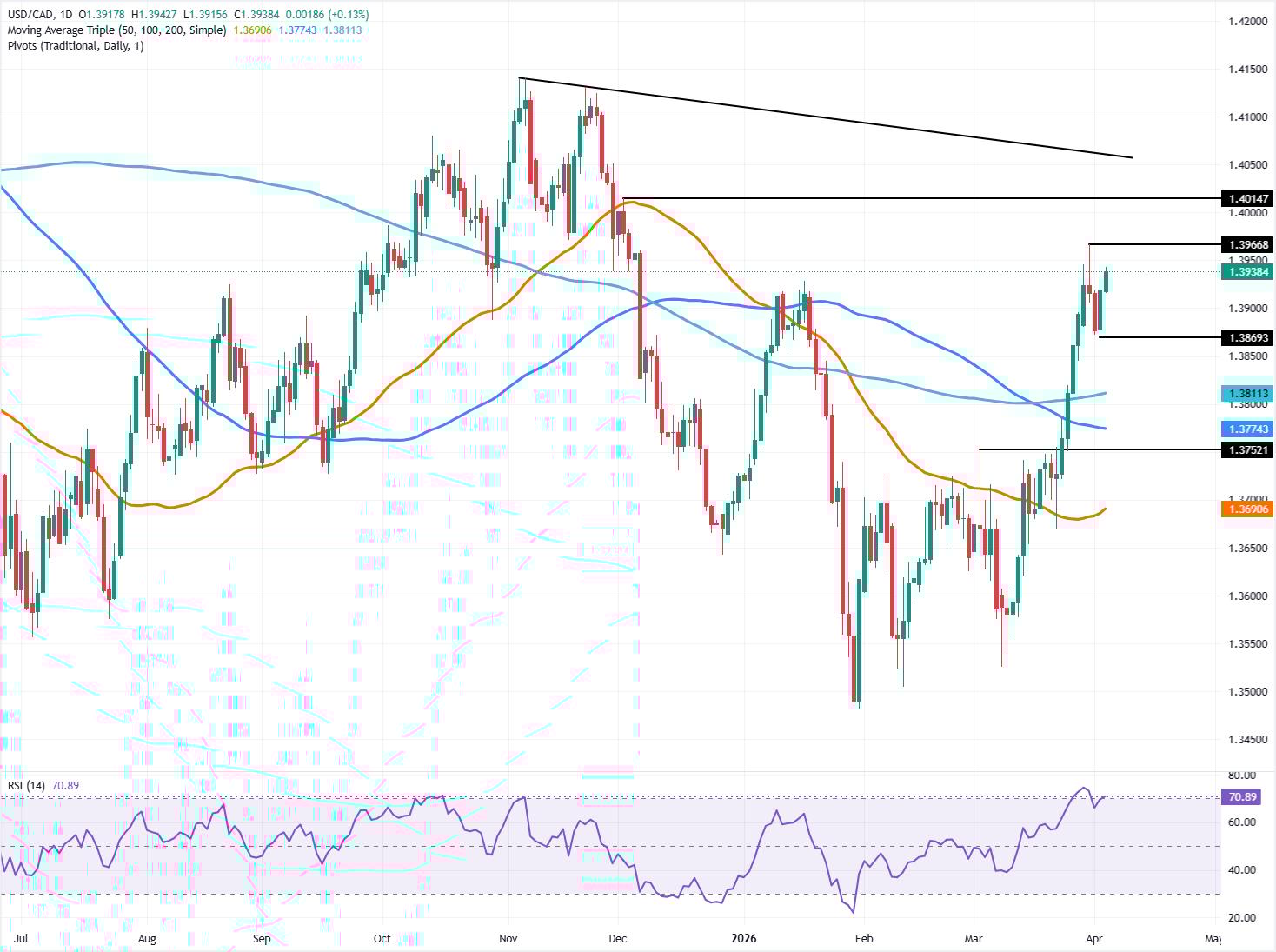
USD/CAD Price Analysis: Technical Outlook
The immediate reaction to NFP saw the USD/CAD rise past the April 2 high of 1.3933, which could open the door to a challenge of 1.3950, with the next area of interest at 1.4000. On the downside, the 1.3900 figure would be the floor, amid low volumes on Friday.
Canadian Dollar FAQs
The key factors driving the Canadian Dollar (CAD) are the level of interest rates set by the Bank of Canada (BoC), the price of Oil, Canada’s largest export, the health of its economy, inflation and the Trade Balance, which is the difference between the value of Canada’s exports versus its imports. Other factors include market sentiment – whether investors are taking on more risky assets (risk-on) or seeking safe-havens (risk-off) – with risk-on being CAD-positive. As its largest trading partner, the health of the US economy is also a key factor influencing the Canadian Dollar.
The Bank of Canada (BoC) has a significant influence on the Canadian Dollar by setting the level of interest rates that banks can lend to one another. This influences the level of interest rates for everyone. The main goal of the BoC is to maintain inflation at 1-3% by adjusting interest rates up or down. Relatively higher interest rates tend to be positive for the CAD. The Bank of Canada can also use quantitative easing and tightening to influence credit conditions, with the former CAD-negative and the latter CAD-positive.
The price of Oil is a key factor impacting the value of the Canadian Dollar. Petroleum is Canada’s biggest export, so Oil price tends to have an immediate impact on the CAD value. Generally, if Oil price rises CAD also goes up, as aggregate demand for the currency increases. The opposite is the case if the price of Oil falls. Higher Oil prices also tend to result in a greater likelihood of a positive Trade Balance, which is also supportive of the CAD.
While inflation had always traditionally been thought of as a negative factor for a currency since it lowers the value of money, the opposite has actually been the case in modern times with the relaxation of cross-border capital controls. Higher inflation tends to lead central banks to put up interest rates which attracts more capital inflows from global investors seeking a lucrative place to keep their money. This increases demand for the local currency, which in Canada’s case is the Canadian Dollar.
Macroeconomic data releases gauge the health of the economy and can have an impact on the Canadian Dollar. Indicators such as GDP, Manufacturing and Services PMIs, employment, and consumer sentiment surveys can all influence the direction of the CAD. A strong economy is good for the Canadian Dollar. Not only does it attract more foreign investment but it may encourage the Bank of Canada to put up interest rates, leading to a stronger currency. If economic data is weak, however, the CAD is likely to fall.
Recommended Articles


